


Page 77 - Clinical Immunology_ Principles and Practice ( PDFDrive )
P. 77
62           Part one  Principles of Immune Response


                                                                  Lymphoid-specific expression of RAG-1 and RAG-2 limits
                        V      D          J
                                                               V(D)J recombination to B and T lymphocytes. To ensure that
                                                               TCR genes are rearranged to completion only in T cells and Ig
                                                               genes are rearranged to completion only in B cells,  V(D)J
                                            RAG1, 2            recombination is further regulated by limiting the accessibility
                                                               of the appropriate gene segments to the specific lineage as well
                                                               as to the specific stage of development. For example, H chain
                                                               genes are typically assembled before L chain genes are.
                        V      D          J
                                                                  The RAG-1 and RAG-2 recombinases cooperatively associate
                                                               with 12-bp and 23-bp RSSs and their flanking coding gene
                                                               segments to form a synaptic complex. Typically, the initial event
                                                               will be recognition of the nonamer sequence of a 12-bp spacer
                                                               RSS by RAG-1, which appears to function as the catalytic
                        V      D
                                                               component of the recombinase. RAG-1 binding to the heptamer
                                                               provides specificity. RAG-2 does not bind DNA independently
                                     J
                                                               but does make contact with the heptamer when in a synaptic
                                                               complex with RAG-1. Binding of a second RAG-1 and RAG-2
                       Nonhomologous end joining               complex to the 23-bp, two-turn RSS permits the interaction of
                                                               the two synaptic complexes to form what is known as a paired
                                                               complex. Creation of this paired complex is facilitated by the
                                                               actions of the DNA-bending proteins HMGB1 and HMGB2 and
                       Signal joint                            by the presence of a divalent metal ion.
                                                                  After paired complex assembly, the RAG proteins single-strand
                                                               cut the DNA at the heptamer sequence. The 3’ OH of the coding
                                  +
                                                               sequence ligates to 5’ phosphate and creates a hairpin loop. The
                        V      D   J                           clean-cut ends of the signal sequences enable formation of precise
                                                               signal joints. However, the hairpin junction created at the coding
                                                               ends must be resolved by renicking the DNA, usually within 4–5
                       Coding joint
                                                               nucleotides from the end of the hairpin. This forms a 3’ overhang
                                                               that is amenable to further diversification. It can be filled in via
                            V   D  J                           DNA polymerases, nibbled back, or serve as a substrate for
                                                               TdT-catalyzed N addition. DNA polymerase  µ, which shares
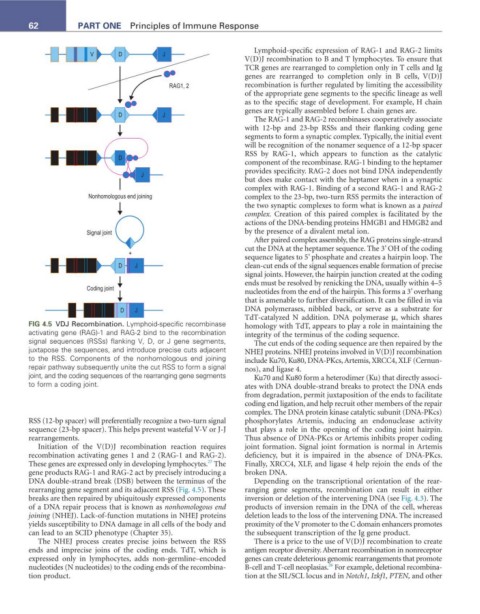
        FIG 4.5  VDJ Recombination. Lymphoid-specific recombinase   homology with TdT, appears to play a role in maintaining the
        activating gene (RAG)-1 and RAG-2 bind to the recombination   integrity of the terminus of the coding sequence.
        signal  sequences  (RSSs)  flanking  V,  D,  or  J  gene  segments,   The cut ends of the coding sequence are then repaired by the
        juxtapose the sequences, and introduce precise cuts adjacent   NHEJ proteins. NHEJ proteins involved in V(D)J recombination
        to the RSS. Components of the nonhomologous end joining   include Ku70, Ku80, DNA-PKcs, Artemis, XRCC4, XLF (Cernun-
        repair pathway subsequently unite the cut RSS to form a signal   nos), and ligase 4.
        joint, and the coding sequences of the rearranging gene segments   Ku70 and Ku80 form a heterodimer (Ku) that directly associ-
        to form a coding joint.                                ates with DNA double-strand breaks to protect the DNA ends
                                                               from degradation, permit juxtaposition of the ends to facilitate
                                                               coding end ligation, and help recruit other members of the repair
                                                               complex. The DNA protein kinase catalytic subunit (DNA-PKcs)
        RSS (12-bp spacer) will preferentially recognize a two-turn signal   phosphorylates  Artemis, inducing an endonuclease activity
        sequence (23-bp spacer). This helps prevent wasteful V-V or J-J   that plays a role in the opening of the coding joint hairpin.
        rearrangements.                                        Thus absence of DNA-PKcs or Artemis inhibits proper coding
           Initiation of the  V(D)J recombination reaction requires   joint formation. Signal joint formation is normal in Artemis
        recombination activating genes 1 and 2 (RAG-1 and RAG-2).   deficiency,  but  it is  impaired in  the absence  of DNA-PKcs.
                                                      27
        These genes are expressed only in developing lymphocytes.  The   Finally, XRCC4, XLF, and ligase 4 help rejoin the ends of the
        gene products RAG-1 and RAG-2 act by precisely introducing a   broken DNA.
        DNA double-strand break (DSB) between the terminus of the   Depending on the transcriptional orientation of the rear-
        rearranging gene segment and its adjacent RSS (Fig. 4.5). These   ranging gene segments, recombination can result in either
        breaks are then repaired by ubiquitously expressed components   inversion or deletion of the intervening DNA (see Fig. 4.3). The
        of a DNA repair process that is known as nonhomologous end   products of inversion remain in the DNA of the cell, whereas
        joining (NHEJ). Lack-of-function mutations in NHEJ proteins   deletion leads to the loss of the intervening DNA. The increased
        yields susceptibility to DNA damage in all cells of the body and   proximity of the V promoter to the C domain enhancers promotes
        can lead to an SCID phenotype (Chapter 35).            the subsequent transcription of the Ig gene product.
           The  NHEJ  process  creates  precise  joins  between  the RSS    There is a price to the use of V(D)J recombination to create
        ends  and  imprecise  joins  of  the  coding  ends. TdT,  which  is   antigen receptor diversity. Aberrant recombination in nonreceptor
        expressed only in lymphocytes, adds non-germline–encoded   genes can create deleterious genomic rearrangements that promote
                                                                                     26
        nucleotides (N nucleotides) to the coding ends of the recombina-  B-cell and T-cell neoplasias.  For example, deletional recombina-
        tion product.                                          tion at the SIL/SCL locus and in Notch1, Izkf1, PTEN, and other

