


Page 78 - Clinical Immunology_ Principles and Practice ( PDFDrive )
P. 78
CHaPter 4  Antigen Receptor Genes, Gene Products, and Coreceptors                    63


                                                              H
                                                                              H
                                                       H
                             Ig H chain locus  V  (39)  D  (27)  J  (6)      C  (9)
                                              H
                              Chr. 14q32.2
                                            V3-74   V6-1  D1-1  D7-27  CD252  123456  Cµ  Cδ  Cγ3  Cγ1  Cα1  Cγ2  Cγ4  Cε  Cα2
                                        5’                         S    S  S  S  S  S  S  S      3’
                             Ig κ chain locus  V  (40)  J  (5)  C  (1)
                                                      κ
                                              κ
                                                            κ
                               Chr. 2p 1.2
                                            3D-7    4.1  12345  Cκ    κde
                                        5’                                3’
                                                          iEκ  3’E κ
                             Ig λ chain locus  V  (40)   J - C  cluster (4)
                                              λ
                                                          λ    λ
                              Chr. 22q 11.2
                                            4.69    3.1  Jλ1  Cλ1  Jλ2  Cλ2  Jλ3  Cλ3  Jλ7  Cλ7
                                        5’                                   3’
                                                                        3’E κ
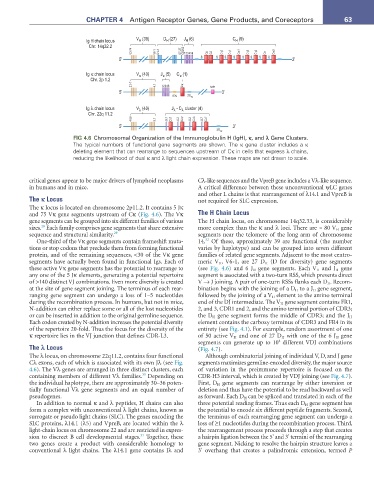
                         FIG 4.6  Chromosomal Organization of the Immunoglobulin H (IgH), κ, and λ Gene Clusters.
                         The typical numbers of functional gene segments are shown. The κ gene cluster includes a κ
                         deleting element that can rearrange to sequences upstream of Cκ in cells that express λ chains,
                         reducing the likelihood of dual κ and λ light chain expression. These maps are not drawn to scale.
           critical genes appear to be major drivers of lymphoid neoplasms   Cλ-like sequences and the VpreB gene includes a Vλ-like sequence.
           in humans and in mice.                                 A critical difference between these unconventional ψLC genes
                                                                  and other L chains is that rearrangement of λ14.1 and VpreB is
           The κ Locus                                            not required for SLC expression.
           The κ locus is located on chromosome 2p11.2. It contains 5 Jκ
           and 75 Vκ gene segments upstream of Cκ (Fig. 4.6). The Vκ   The H Chain Locus
           gene segments can be grouped into six different families of various   The H chain locus, on chromosome 14q32.33, is considerably
               28
           sizes.  Each family comprises gene segments that share extensive   more complex than the κ and λ loci. There are ≈ 80 V H  gene
           sequence and structural similarity. 29                 segments near the telomere of the long arm of chromosome
                                                                    32
             One-third of the Vκ gene segments contain frameshift muta-  14.   Of these, approximately 39  are  functional  (the  number
           tions or stop codons that preclude them from forming functional   varies by haplotype) and can be grouped into seven different
           protein, and of the remaining sequences, <30 of the Vκ gene   families of related gene segments. Adjacent to the most centro-
           segments have actually been found in functional Igs. Each of   meric V H ,  V6-1, are 27 D H  (D for diversity) gene segments
           these active Vκ gene segments has the potential to rearrange to   (see  Fig. 4.6)  and 6  J H  gene  segments. Each V H  and  J H  gene
           any one of the 5 Jκ elements, generating a potential repertoire   segment is associated with a two-turn RSS, which prevents direct
           of >140 distinct VJ combinations. Even more diversity is created   V → J joining. A pair of one-turn RSSs flanks each D H . Recom-
           at the site of gene segment joining. The terminus of each rear-  bination begins with the joining of a D H  to a J H  gene segment,
           ranging gene segment can undergo a loss of 1–5 nucleotides   followed by the joining of a V H  element to the amino terminal
           during the recombination process. In humans, but not in mice,   end of the DJ intermediate. The V H  gene segment contains FR1,
           N-addition can either replace some or all of the lost nucleotides   2, and 3, CDR1 and 2, and the amino terminal portion of CDR3;
           or can be inserted in addition to the original germline sequence.   the D H  gene segment forms the middle of CDR3; and the J H
           Each codon created by N-addition increases the potential diversity   element contains the carboxy terminus of CDR3 and FR4 in its
           of the repertoire 20-fold. Thus the focus for the diversity of the   entirety (see Fig. 4.1). For example, random assortment of one
           κ repertoire lies in the VJ junction that defines CDR-L3.  of 50 active V H  and one of 27 D H  with one of the 6 J H  gene
                                                                                            4
                                                                  segments can generate up to 10  different VDJ combinations
           The λ Locus                                            (Fig. 4.7).
           The λ locus, on chromosome 22q11.2, contains four functional   Although combinatorial joining of individual V, D, and J gene
           Cλ exons, each of which is associated with its own Jλ (see Fig.   segments maximizes germline-encoded diversity, the major source
           4.6). The Vλ genes are arranged in three distinct clusters, each   of variation in  the preimmune repertoire is focused on  the
                                                30
           containing members of different Vλ families.  Depending on   CDR-H3 interval, which is created by VDJ joining (see Fig. 4.7).
           the individual haplotype, there are approximately 30–36 poten-  First, D H  gene segments can rearrange by either inversion or
           tially  functional Vλ  gene  segments  and  an  equal  number  of   deletion and thus have the potential to be read backward as well
           pseudogenes.                                           as forward. Each D H  can be spliced and translated in each of the
             In addition to normal κ and λ peptides, H chains can also   three potential reading frames. Thus each D H  gene segment has
           form a complex with unconventional λ light chains, known as   the potential to encode six different peptide fragments. Second,
           surrogate or pseudo light chains (SLC). The genes encoding the   the terminus of each rearranging gene segment can undergo a
           SLC proteins, λ14.1 (λ5) and VpreB, are located within the λ   loss of ≥1 nucleotides during the recombination process. Third,
           light-chain locus on chromosome 22 and are restricted in expres-  the rearrangement process proceeds through a step that creates
                                               31
           sion to discreet B cell developmental stages.  Together, these   a hairpin ligation between the 5’ and 3’ termini of the rearranging
           two genes create a product with considerable homology to   gene segment. Nicking to resolve the hairpin structure leaves a
           conventional  λ light  chains. The  λ14.1 gene  contains Jλ and   3’ overhang that creates a palindromic extension, termed  P

