


Page 79 - Clinical Immunology_ Principles and Practice ( PDFDrive )
P. 79
64           Part one  Principles of Immune Response


                                   Combination diversity
                                                   4
                                      H
                                             H
                               39V H  x 27D  x 6rf x 6J  =3.8 x10    Light chain   Heavy chain
                                V                                          CDR-H3
                              FR  H    D             C                FR4             CDR-H1
                              1  2  3   H      J H    H
                                                                 CDR-L2
                               12
                              CDR                             FR3                            FR3
                                                                                            (family)
                                V H   N  N  J H   C H
                                           W
                                                              FR1                            FR1
                                 FR3        FR4  C  1                                       (Clan)
                                                  H
                                      CDR-H3
                                     N - D  - N                     CDR-L1
                                        H
                                                                               FR4
                                  N region junction diversity              CDR-L3 CDR-H2
                                               7
                                        3
                                     3
                           A       20  x 20  = 6.4 x 10        B
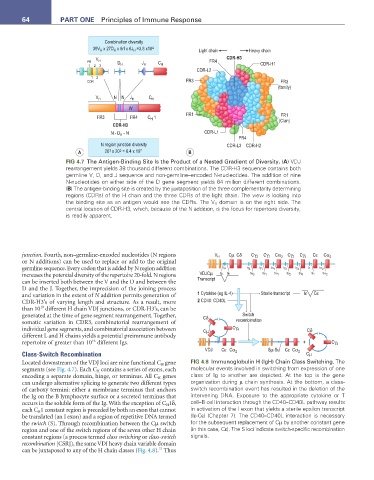
                       FIG 4.7  The Antigen-Binding Site Is the Product of a Nested Gradient of Diversity. (a) VDJ
                       rearrangement yields 38 thousand different combinations. The CDR-H3 sequence contains both
                       germline V, D, and J sequence and non-germline–encoded N-nucleotides. The addition of nine
                       N-nucleotides on either side of the D gene segment yields 64 million different combinations.
                       (B) The antigen-binding site is created by the juxtaposition of the three complementarity determining
                       regions (CDRs) of the H chain and the three CDRs of the light chain. The view is looking into
                       the binding site as an antigen would see the CDRs. The V H  domain is on the right side. The
                       central location of CDR-H3, which, because of the N addition, is the focus for repertoire diversity,
                       is readily apparent.


        junction. Fourth, non–germline-encoded nucleotides (N regions     V H  Cµ  Cδ  Cγ 3  Cγ 1  Cα 3  Cγ 2  Cγ 4  Cε  Cα 2
        or N additions) can be used to replace or add to the original
        germline sequence. Every codon that is added by N region addition   Iµ    Iγ 3  Iγ 1  Iα 1  Iγ 2  Iγ 4  Iε  Iα 2
        increases the potential diversity of the repertoire 20-fold. N regions   VDJCµ  Eµ  Sµ  Sγ 3  Sγ 1  Sα 1  Sγ 2  Sγ 4  Sε  Sα 2
        can be inserted both between the V and the D and between the   Transcript
        D and the J. Together, the imprecision of the joining process
        and variation in the extent of N addition permits generation of   1 Cytokine (eg IL-4)  Sterile transcript  Iε  Cε
        CDR-H3’s of varying length and structure. As a result, more   2 CD40: CD40L
              10
        than 10  different H chain VDJ junctions, or CDR-H3’s, can be
        generated at the time of gene segment rearrangement. Together,   Cδ     Switch
        somatic  variation in  CDR3,  combinatorial  rearrangement of         recombination
        individual gene segments, and combinatorial association between   Cµ  Cγ 4                   Cδ
        different L and H chains yields a potential preimmune antibody
                               16
        repertoire of greater than 10  different Igs.                                               +        Cγ 4
                                                                    VDJ  Cε Cα 2         Sµ-Sε  Cε Cα 2
        Class-Switch Recombination                                                                   Cµ
        Located downstream of the VDJ loci are nine functional C H  gene   FIG 4.8  Immunoglobulin H (IgH) Chain Class Switching. The
        segments (see Fig. 4.7). Each C H  contains a series of exons, each   molecular events involved in switching from expression of one
        encoding a separate domain, hinge, or terminus. All C H  genes   class of Ig to another are depicted. At the top is the gene
        can undergo alternative splicing to generate two different types   organization during µ chain synthesis. At the bottom, a class-
        of carboxy termini: either a membrane terminus that anchors   switch recombination event has resulted in the deletion of the
        the Ig on the B lymphocyte surface or a secreted terminus that   intervening DNA. Exposure to the appropriate cytokine or T
        occurs in the soluble form of the Ig. With the exception of C H 1δ,   cell–B cell interaction through the CD40–CD40L pathway results
        each C H 1 constant region is preceded by both an exon that cannot   in activation of the I exon that yields a sterile epsilon transcript
        be translated (an I exon) and a region of repetitive DNA termed   (Iε-Cε) (Chapter 7). The CD40–CD40L interaction is necessary
        the switch (S). Through recombination between the Cµ switch   for the subsequent replacement of Cµ by another constant gene
        region and one of the switch regions of the seven other H chain   (in this case, Cε). The S loci indicate switch-specific recombination
        constant regions (a process termed class switching or class-switch   signals.
        recombination [CSR]), the same VDJ heavy chain variable domain
                                                     33
        can be juxtaposed to any of the H chain classes (Fig. 4.8).  Thus

