


Page 81 - Clinical Immunology_ Principles and Practice ( PDFDrive )
P. 81
66           Part one  Principles of Immune Response


                                                         TCR αδ locus
                                           Vδ

                             V α  (n = 42)            Dδ   Jδ                 Jα
                                      Vδ4  Vδ6  Vα  Vδ1  Vα  Vδ5/Vα17.1  δ rec  Vδ2  Dδ1  Dδ2  Dδ3  Jδ1  Jδ2  Jδ3  Cδ  Vδ3  TEA  ΨJα  Cα
                          5’                                                                   3’
                          Chr. 14q11-12                      δ enhancer                  α enhancer

                                                         TCR β locus
                                             Vβ (n = 47)  Jβ1         Jβ2       Vβ
                                                        Dδ1   Cβ1   Dδ2  Cβ2
                          Chr. 7q35       5’                                         3’
                                                                          β enhancer

                                                         TCR γ locus
                                                                               *  Exon 2 encodes cysteine
                                               Vγ1  Vγ2   Jγ1        Jγ2
                                                               Cγ1*      Cγ2
                          Chr. 7q14-15    5’                                    3’
                                                                          γ enhancer
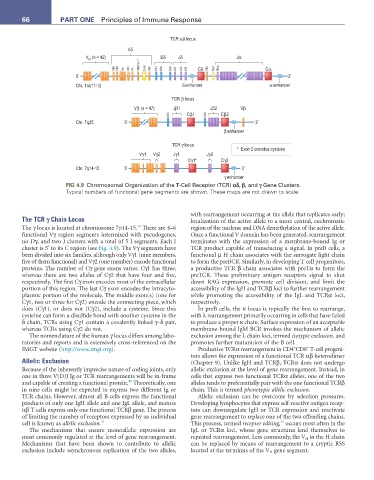
                       FIG 4.9  Chromosomal Organization of the T-Cell Receptor (TCR) αδ, β, and γ Gene Clusters.
                       Typical numbers of functional gene segments are shown. These maps are not drawn to scale.


                                                               with rearrangement occurring at the allele that replicates early;
        The TCR γ Chain Locus                                  localization of the active allele to a more central, euchromatic
                                              39
        The γ locus is located at chromosome 7p14-15.  There are 4–6   region of the nucleus; and DNA demethylation of the active allele.
        functional Vγ region segments intermixed with  pseudogenes,   Once a functional V domain has been generated, rearrangement
        no Dγ, and two J clusters with a total of 5 J segments. Each J   terminates with the expression of a membrane-bound Ig or
        cluster is 5’ to its C region (see Fig. 4.9). The Vγ segments have   TCR product capable of transducing a signal. In preB cells, a
        been divided into six families, although only Vγ1 (nine members,   functional µ H chain associates with the surrogate light chain
        five of them functional) and Vγ2 (one member) encode functional   to form the preBCR. Similarly, in developing T cell progenitors,
        proteins. The number of Cγ gene exons varies: Cγ1 has three,   a productive TCR β chain associates with preTα to form the
        whereas there are two alleles of Cγ2 that have four and five,   preTCR. These preliminary antigen receptors signal to shut
        respectively. The first Cγ exon encodes most of the extracellular   down RAG expression, promote cell division, and limit the
        portion of this region. The last Cγ exon encodes the intracyto-  accessibility of the IgH and TCRβ loci to further rearrangement
        plasmic portion of the molecule. The middle exon(s) (one for   while promoting the accessibility of the IgL and TCRα loci,
        Cγ1, two or three for Cγ2) encode the connecting piece, which   respectively.
        does (Cγ1), or does not (Cγ2), include a cysteine. Since this   In preB cells, the κ locus is typically the first to rearrange,
        cysteine can form a disulfide bond with another cysteine in the   with λ rearrangement primarily occurring in cells that have failed
        δ chain, TCRs using Cγ1 contain a covalently linked γ–δ pair,   to produce a proper κ chain. Surface expression of an acceptable
        whereas TCRs using Cγ2 do not.                         membrane-bound IgM BCR invokes the mechanism of allelic
           The nomenclature of the human γ locus differs among labo-  exclusion among the L chain loci, termed isotypic exclusion, and
        ratories and reports and is extensively cross-referenced on the   promotes further maturation of the B cell.
                                                                                                     +
                                                                                                 +
        IMGT website (http://www.imgt.org).                       Productive TCRα rearrangement in CD4 CD8  T-cell progeni-
                                                               tors allows the expression of a functional TCR αβ heterodimer
        Allelic Exclusion                                      (Chapter 9). Unlike IgH and TCRβ, TCRα does not undergo
        Because of the inherently imprecise nature of coding joints, only   allelic exclusion at the level of gene rearrangement. Instead, in
        one in three V(D)J Ig or TCR rearrangements will be in-frame   cells that express two functional TCRα alleles, one of the two
                                           40
        and capable of creating a functional protein.  Theoretically, one   alleles tends to preferentially pair with the one functional TCRβ
        in nine cells might be expected to express two different Ig or   chain. This is termed phenotypic allelic exclusion.
        TCR chains. However, almost all B cells express the functional   Allelic exclusion can be overcome by selection pressures.
        products of only one IgH allele and one IgL allele, and mature   Developing lymphocytes that express self-reactive antigen recep-
        αβ T cells express only one functional TCRβ gene. The process   tors can downregulate IgH or TCR expression and reactivate
        of limiting the number of receptors expressed by an individual   gene rearrangement to replace one of the two offending chains.
                                                                                             42
        cell is known as allelic exclusion. 41                 This process, termed receptor editing,  occurs most often in the
           The mechanisms that ensure monoallelic expression are   IgL or TCRα loci, whose gene structures lend themselves to
        most commonly regulated at the level of gene rearrangement.   repeated rearrangement. Less commonly, the V H  in the H chain
        Mechanisms that have been shown to contribute to allelic   can be replaced by means of rearrangement to a cryptic RSS
        exclusion include asynchronous replication of the two alleles,   located at the terminus of the V H  gene segment.

