


Page 83 - Clinical Immunology_ Principles and Practice ( PDFDrive )
P. 83
68           Part one  Principles of Immune Response


        in development, Igα and Igβ are coexpressed together with Igs
                                                         43
        of all isotypes on the surface of B cells as a mature BCR complex.
        The CD79 proteins are specific to the B lineage and are expressed              AG
        throughout B lymphopoiesis. This has led to their use as markers   IgH  BCR
        for the identification of B-cell neoplasms. 46,47
           The signaling capacity of both Igα and Igβ resides within an
        immunoreceptor tyrosine-based activation motif (ITAM) that                   IgL
        has the consensus sequence of D/IxxYxxL(x)7YxxL, where x is
        any amino acid. Similar  ITAMs are also  found within the
        cytoplasmic domain of the molecules that associate with, and             Ig-α
        signal for, the T-cell antigen receptor (CD3) and certain Fc                  Ig-β
        receptors (Chapter 15). The phosphorylation of both tyrosines
        in both Igα/β ITAMs is considered an obligate initial step in the
        propagation of antigen receptor engagement to the cell nucleus. 44,48
           Tyrosine-phosphorylated ITAMs serve as efficient binding
        sites for Src homology 2 (SH2) domains, which are present within
        a large number of cytosolic signaling molecules. Whether Igα         Syk
        and Igβ make qualitatively different contributions toward BCR                    Lyn
        signaling  or are functionally redundant  remains unclear, as                    Fyn
        evidence exists to support both views. Moreover, the high degree                 Blk
        of evolutionary conservation within the non-ITAM portion of
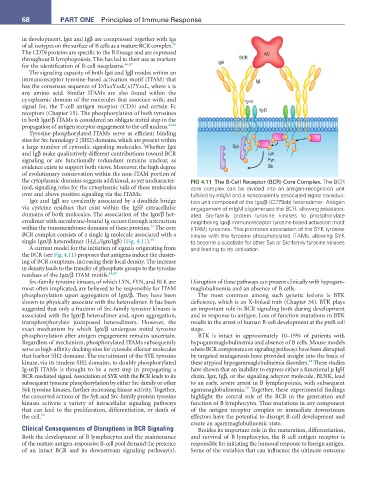
        the cytoplasmic domains suggests additional, as yet uncharacter-  FIG 4.11  The B-Cell Receptor (BCR) Core Complex. The BCR
        ized, signaling roles for the cytoplasmic tails of these molecules   core complex can be divided into an antigen-recognition unit
        over and above positive signaling via the ITAMs.       fulfilled by mIgM and a noncovalently associated signal transduc-
           Igα and Igβ are covalently associated by a disulfide bridge   tion unit composed of the Igα/β (CD79ab) heterodimer. Antigen
        via cysteine residues that exist within the IgSF extracellular   engagement of mIgM oligomerizes the BCR, allowing preassoci-
        domains of both molecules. The association of the Igα/β het-  ated Src-family protein tyrosine kinases to phosphorylate
        erodimer with membrane-bound Ig occurs through interaction   neighboring Igαβ immunoreceptor tyrosine-based activation motif
                                                  43
        within the transmembrane domains of these proteins.  The core   (ITAM) tyrosines. This promotes association of the SYK tyrosine
        BCR complex consists of a single Ig molecule associated with a   kinase with the tyrosine phosphorylated ITAMs, allowing SYK
        single Igα/β heterodimer (H 2 L 2 /Igα/Igβ) (Fig. 4.11). 49  to become a substrate for other Syk or Src-family tyrosine kinases
           A current model for the initiation of signals originating from   and leading to its activation.
        the BCR (see Fig. 4.11) proposes that antigens induce the cluster-
        ing of BCR complexes, increasing their local density. The increase
        in density leads to the transfer of phosphate groups to the tyrosine
        residues of the Igα/β ITAM motifs. 44,48
           Src-family tyrosine kinases, of which LYN, FYN, and BLK are   Disruption of these pathways can present clinically with hypogam-
        most often implicated, are believed to be responsible for ITAM   maglobulinemia and an absence of B cells.
        phosphorylation upon aggregation of Igα/β. They have been   The most common among such genetic lesions is BTK
        shown to physically associate with the heterodimer. It has been   deficiency, which is an X-linked trait (Chapter 34). BTK plays
        suggested that only a fraction of Src-family tyrosine kinases is   an important role in BCR signaling both during development
        associated with the Igα/β heterodimer and, upon aggregation,   and in response to antigen. Loss of function mutations in BTK
        transphosphorylate juxtaposed heterodimers. However, the   results in the arrest of human B-cell development at the preB cell
        exact mechanism by which Igα/β undergoes initial tyrosine   stage.
        phosphorylation after antigen engagement remains uncertain.   BTK is intact in approximately 10–15% of patients with
        Regardless of mechanism, phosphorylated ITAMs subsequently   hypogammaglobulinemia and absence of B cells. Mouse models
        serve as high-affinity docking sites for cytosolic effector molecules   where BCR components or signaling pathways have been disrupted
        that harbor SH2 domains. The recruitment of the SYK tyrosine   by targeted mutagenesis have provided insight into the basis of
                                                                                                      44
        kinase, via its tandem SH2 domains, to doubly phosphorylated   these atypical hypogammaglobulinemia disorders.  These studies
        Ig-α/β ITAMs is thought to be a next step in propagating a   have shown that an inability to express either a functional µ IgH
        BCR-mediated signal. Association of SYK with the BCR leads to its   chain, Igα, Igβ, or the signaling adaptor molecule, BLNK, lead
        subsequent tyrosine phosphorylation by either Src-family or other   to an early, severe arrest in B lymphopoiesis, with subsequent
                                                                                 50
        Syk tyrosine kinases, further increasing kinase activity. Together,   agammaglobulinemia.  Together, these experimental findings
        the concerted actions of the Syk and Src-family protein tyrosine   highlight the central role of the BCR in the generation and
        kinases activate a variety of intracellular signaling pathways   function of B lymphocytes. Thus mutations in any component
        that can lead to the proliferation, differentiation, or death of    of the antigen receptor complex or immediate downstream
        the cell. 50                                           effectors have the potential to disrupt B-cell development and
                                                               create an agammaglobulinemic state.
        Clinical Consequences of Disruptions in BCR Signaling     Besides its important role in the maturation, differentiation,
        Both the development of B lymphocytes and the maintenance   and survival of B lymphocytes, the B cell antigen receptor is
        of the mature antigen-responsive B-cell pool demand the presence   responsible for initiating the humoral response to foreign antigen.
        of an intact BCR and its downstream signaling pathway(s).   Some of the variables that can influence the ultimate outcome

