


Page 82 - Clinical Immunology_ Principles and Practice ( PDFDrive )
P. 82
CHaPter 4  Antigen Receptor Genes, Gene Products, and Coreceptors                    67


               KeY ConCePtS                                       Membrane-Bound Immunoglobulin
            B Cell Receptor (BCR) and Coreceptors                 Igs mediate their effector functions as secreted products of plasma

            •  The BCR–antigen complex consists of a membrane-bound immuno-  cells. However, as membrane-bound structures on mature B cells,
              globulin (mIg) that is responsible for antigen recognition and an Igα/β   Igs serve as the antigen-recognition component of the BCR
              heterodimer that is responsible for transducing the recognition signal   complex. Although all Ig classes can be expressed at the cell
              into the cell.                                      surface, the vast majority of circulating mature B cells coexpress
            •  BCR engagement leads to the phosphorylation of tyrosines in the   membrane-bound IgM and IgD. Appropriate activation of a naïve
              Igα/β immunoreceptor tyrosine-based activation motif (ITAM) motifs.   IgM- and IgD-expressing B cell leads to plasma cell differentiation
              This signal is then transmitted to one or more other intracellular signaling
              pathways.                                           and antibody secretion. The membrane-bound forms of IgM
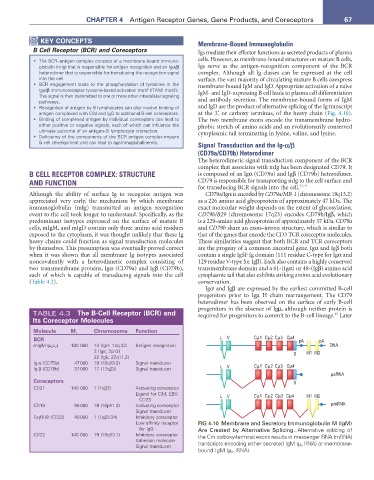
            •  Recognition of antigen by B lymphocytes can also involve binding of   and IgD are the product of alternative splicing of the Ig transcript
              antigen complexed with C3d and IgG to additional B-cell coreceptors.  at the 3’, or carboxy terminus, of the heavy chain (Fig. 4.10).
            •  Binding of complexed antigen by individual coreceptors can lead to   The two membrane exons encode the transmembrane hydro-
              either positive or negative signals, each of which can influence the   phobic stretch of amino acids and an evolutionarily conserved
              ultimate outcome of an antigen–B lymphocyte interaction.  cytoplasmic tail terminating in lysine, valine, and lysine.
            •  Deficiency of the components of the BCR antigen complex impairs
              B cell development and can lead to agammaglobulinemia.
                                                                  Signal Transduction and the Ig-α/β
                                                                  (CD79a/CD79b) Heterodimer
                                                                  The heterodimeric signal transduction component of the BCR
                                                                  complex that associates with mIg has been designated CD79. It
           B CELL RECEPTOR COMPLEX: STRUCTURE                     is composed of an Igα (CD79a) and Igβ (CD79b) heterodimer.
           AND FUNCTION                                           CD79 is responsible for transporting mIg to the cell surface and
                                                                  for transducing BCR signals into the cell. 43,44
           Although the ability of surface Ig to recognize antigen was   CD79a/Igα is encoded by CD79a/MB-1 (chromosome 19q13.2)
           appreciated very early, the mechanism by which membrane   as a 226 amino acid glycoprotein of approximately 47 kDa. The
           immunoglobulin (mIg) transmitted an antigen recognition   exact molecular weight depends on the extent of glycosylation.
           event to the cell took longer to understand. Specifically, as the   CD79b/B29 (chromosome 17q23) encodes CD79b/Igβ, which
           predominant isotypes expressed on the surface of mature B   is a 229-amino acid glycoprotein of approximately 37 kDa. CD79a
           cells, mIgM, and mIgD contain only three amino acid residues   and CD79b share an exon–intron structure, which is similar to
           exposed to the cytoplasm, it was thought unlikely that these Ig   that of the genes that encode the CD3 TCR coreceptor molecules.
           heavy chains could function as signal transduction molecules   These similarities suggest that both BCR and TCR coreceptors
           by themselves. This presumption was eventually proved correct   are the progeny of a common ancestral gene. Igα and Igβ both
           when it was shown that all membrane Ig isotypes associated   contain a single IgSF Ig domain (111 residue C-type for Igα and
           noncovalently with a heterodimeric complex consisting of   129 residue V-type for Igβ). Each also contains a highly conserved
           two transmembrane proteins, Igα (CD79a) and Igβ (CD79b),   transmembrane domain and a 61-(Igα) or 48-(Igβ) amino acid
           each of which is capable of transducing signals into the cell    cytoplasmic tail that also exhibits striking amino acid evolutionary
           (Table 4.3).                                           conservation.
                                                                    Igα and Igβ are expressed by the earliest committed B-cell
                                                                  progenitors prior to Igµ H chain rearrangement. The CD79
                                                                  heterodimer has been observed on the surface of early B-cell
                                                                  progenitors in the absence of Igµ, although neither protein is
            TABLE 4.3  the B-Cell receptor (BCr) and              required for progenitors to commit to the B-cell lineage.  Later
                                                                                                              45
            Its Coreceptor Molecules
            Molecule    M r     Chromosome   Function
            BCr                                                          LV         Cµ1Cµ2Cµ3Cµ4   pA    pA
            mIgM (µ 2 L 2 )  180 000  14 (IgH; 14q.32)  Antigen recognition                                  DNA
                                2 (Igκ; 2p12)                                                    S   M1  M2
                                22 (Igλ; 22q11.2)
            Ig-α (CD79a)  47 000  19 (19q13.2)  Signal transducer                   Cµ1Cµ2Cµ3Cµ4
            Ig-β (CD79b)  37 000  17 (17q23)  Signal transducer          LV
                                                                                                              µsRNA
            Coreceptors                                                                          S
            CD21        140 000  1 (1q32)    Activating coreceptor
                                             Ligand for C3d, EBV,        LV         Cµ1Cµ2Cµ3Cµ4     M1  M2
                                               CD23
            CD19         95 000  16 (16p11.2)  Activating coreceptor                                          µmRNA
                                             Signal transducer
            FcγRIIB (CD32)  40 000  1 (1q23-24)  Inhibitory coreceptor
                                             Low affinity receptor   FIG 4.10  Membrane and Secretory Immunoglobulin M (IgM)
                                               for IgG            Are Created by Alternative Splicing. Alternative splicing  of
            CD22        140 000  19 (19q13.1)  Inhibitory coreceptor  the Cm carboxy-terminal exons results in messenger RNA (mRNA)
                                             Adhesion molecule    transcripts encoding either secreted IgM (µ s  RNA) or membrane-
                                             Signal transducer
                                                                  bound IgM (µ m  RNA).

