


Page 87 - Clinical Immunology_ Principles and Practice ( PDFDrive )
P. 87
72           Part one  Principles of Immune Response


                          A                                                           Lck binding site
                                                                                      ITAM
                           D1       CD4                     TCR                          CD8
                              D2                          α    β
                                                   CD3              CD3
                                 D3                                                    α    β
                                                  ε   δ            γ   ε
                                  D4                                         ς  ς

                                                  -    -  + +  +  -     -   -   -


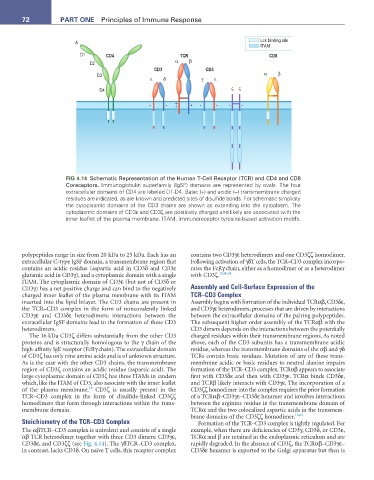
                       FIG 4.14  Schematic Representation of the Human T-Cell Receptor (TCR) and CD4 and CD8
                       Coreceptors. Immunoglobulin superfamily (IgSF) domains are represented by ovals. The four
                       extracellular domains of CD4 are labeled D1-D4. Basic (+) and acidic (−) transmembrane charged
                       residues are indicated, as are known and predicted sites of disulfide bonds. For schematic simplicity
                       the cytoplasmic domains of the CD3 chains are shown as extending into the cytoplasm. The
                       cytoplasmic domains of CD3ε and CD3ζ are positively charged and likely are associated with the
                       inner leaflet of the plasma membrane. ITAM, immunoreceptor tyrosine-based activation motifs.


        polypeptides range in size from 20 kDa to 25 kDa. Each has an   contains two CD3γε heterodimers and one CD3ζζ homodimer.
        extracellular C-type IgSF domain, a transmembrane region that   Following activation of γδT cells, the TCR–CD3 complex incorpo-
        contains an acidic residue (aspartic acid in CD3δ and CD3ε   rates the FcRγ chain, either as a homodimer or as a heterodimer
        glutamic acid in CD3γ), and a cytoplasmic domain with a single   with CD3ζ. 18,60,61
        ITAM. The cytoplasmic domain of CD3ε (but not of CD3δ or
        CD3γ) has a net positive charge and can bind to the negatively   Assembly and Cell-Surface Expression of the
        charged inner leaflet of the plasma membrane with its ITAM   TCR–CD3 Complex
        inserted into the lipid bilayer. The CD3 chains are present in   Assembly begins with formation of the individual TCRαβ, CD3δε,
        the  TCR–CD3  complex  in  the form of  noncovalently  linked   and CD3γε heterodimers, processes that are driven by interactions
        CD3γε  and CD3δε  heterodimers;  interactions  between  the   between the extracellular domains of the pairing polypeptides.
        extracellular IgSF domains lead to the formation of these CD3   The subsequent higher order assembly of the TCRαβ with the
        heterodimers.                                          CD3 dimers depends on the interactions between the potentially
           The 16 kDa CD3ζ differs substantially from the other CD3   charged residues within their transmembrane regions. As noted
        proteins and is structurally homologous to the γ chain of the   above, each of the CD3 subunits has a transmembrane acidic
        high-affinity IgE receptor (FcRγ chain). The extracellular domain   residue, whereas the transmembrane domains of the αβ and γδ
        of CD3ζ has only nine amino acids and is of unknown structure.   TCRs contain basic residues. Mutation of any of these trans-
        As is the case with the other CD3 chains, the transmembrane   membrane acidic or basic residues to neutral alanine impairs
        region of CD3ζ contains an acidic residue (aspartic acid). The   formation of the TCR–CD3 complex. TCRαβ appears to associate
        large cytoplasmic domain of CD3ζ has three ITAMs in tandem   first with CD3δε and then with CD3γε. TCRα binds CD3δε,
        which, like the ITAM of CD3, also associate with the inner leaflet   and TCRβ likely interacts with CD3γε. The incorporation of a
                              18
        of the plasma membrane.  CD3ζ is usually present in the   CD3ζζ homodimer into the complex requires the prior formation
        TCR–CD3 complex in the form of disulfide-linked CD3ζζ   of a TCRαβ–CD3γε–CD3δε hexamer and involves interactions
        homodimers that form through interactions within the trans-  between the arginine residue in the transmembrane domain of
        membrane domain.                                       TCRα and the two colocalized aspartic acids in the transmem-
                                                               brane domains of the CD3ζζ homodimer. 18,62
        Stoichiometry of the TCR–CD3 Complex                      Formation of the TCR–CD3 complex is tightly regulated. For
        The αβTCR–CD3 complex is univalent and consists of a single   example, when there are deficiencies of CD3γ, CD3δ, or CD3ε,
        αβ TCR heterodimer together with three CD3 dimers: CD3γε,   TCRα and β are retained in the endoplasmic reticulum and are
        CD3δε, and CD3ζζ (see Fig. 4.14). The γδTCR–CD3 complex,   rapidly degraded. In the absence of CD3ζ, the TCRαβ–CD3γε–
        in contrast, lacks CD3δ. On naïve T cells, this receptor complex   CD3δε hexamer is exported to the Golgi apparatus but then is

