


Page 845 - Clinical Immunology_ Principles and Practice ( PDFDrive )
P. 845
CHaPtEr 59  Large-Vessel Vasculitides             817


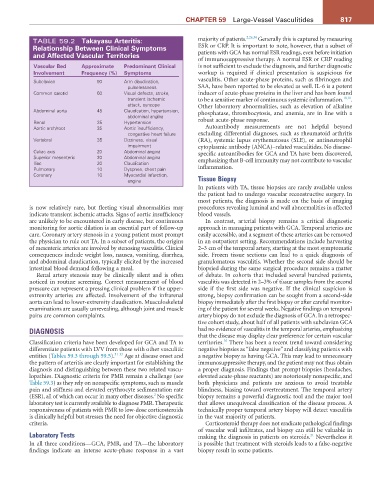
            TABLE 59.2  takayasu arteritis:                       majority of patients. 2,26,34  Generally this is captured by measuring
            relationship Between Clinical Symptoms                ESR or CRP. It is important to note, however, that a subset of
            and affected Vascular territories                     patients with GCA has normal ESR readings, even before initiation
                                                                  of immunosuppressive therapy. A normal ESR or CRP reading
            Vascular Bed    approximate   Predominant Clinical    is not sufficient to exclude the diagnosis, and further diagnostic
            Involvement     Frequency (%)  Symptoms               workup is required if clinical presentation is suspicious for
            Subclavian           90       Arm claudication,       vasculitis. Other acute-phase proteins, such as fibrinogen and
                                           pulselessness          SAA, have been reported to be elevated as well. IL-6 is a potent
            Common carotid       60       Visual defects, stroke,   inducer of acute-phase proteins in the liver and has been found
                                           transient ischemic     to be a sensitive marker of continuous systemic inflammation. 10,11 .
                                           attack, syncope        Other laboratory abnormalities, such as elevation of alkaline
            Abdominal aorta      45       Claudication, hypertension,   phosphatase, thrombocytosis, and anemia, are in line with a
                                           abdominal angina
            Renal                35       Hypertension            robust acute-phase response.
            Aortic arch/root     35       Aortic insufficiency,     Autoantibody measurements are not helpful beyond
                                           congestive heart failure  excluding differential diagnoses, such as rheumatoid arthritis
            Vertebral            35       Dizziness, visual       (RA), systemic lupus erythematosus (SLE), or antineutrophil
                                           impairment             cytoplasmic antibody (ANCA)–related vasculitides. No disease-
            Celiac axis          20       Abdominal angina        specific autoantibodies for GCA and TA have been discovered,
            Superior mesenteric  20       Abdominal angina        emphasizing that B-cell immunity may not contribute to vascular
            Iliac                20       Claudication
            Pulmonary            10       Dyspnea, chest pain     inflammation.
            Coronary             10       Myocardial infarction,
                                           angina                 Tissue Biopsy
                                                                  In patients with TA, tissue biopsies are rarely available unless
                                                                  the patient had to undergo vascular reconstructive surgery. In
                                                                  most patients, the diagnosis is made on the basis of imaging
           is now relatively rare, but fleeting visual abnormalities may   procedures revealing luminal and wall abnormalities in affected
           indicate transient ischemic attacks. Signs of aortic insufficiency   blood vessels.
           are unlikely to be encountered in early disease, but continuous   In contrast, arterial biopsy remains a critical diagnostic
           monitoring for aortic dilation is an essential part of follow-up   approach in managing patients with GCA. Temporal arteries are
           care. Coronary artery stenosis in a young patient must prompt   easily accessible, and a segment of these arteries can be removed
           the physician to rule out TA. In a subset of patients, the origins   in an outpatient setting. Recommendations include harvesting
           of mesenteric arteries are involved by stenosing vasculitis. Clinical   2–3 cm of the temporal artery, starting at the most symptomatic
           consequences include weight loss, nausea, vomiting, diarrhea,   side. Frozen tissue sections can lead to a quick diagnosis of
           and abdominal claudication, typically elicited by the increased   granulomatous vasculitis. Whether the second side should be
           intestinal blood demand following a meal.              biopsied during the same surgical procedure remains a matter
             Renal artery stenosis may be clinically silent and is often   of  debate. In  cohorts  that  included several hundred  patients,
           noticed  in  routine  screening.  Correct  measurement  of  blood   vasculitis was detected in 2–3% of tissue samples from the second
           pressure can represent a pressing clinical problem if the upper-  side if the first side was negative. If the clinical suspicion is
           extremity arteries are affected. Involvement of the infrarenal   strong, biopsy confirmation can be sought from a second-side
           aorta can lead to lower-extremity claudication. Musculoskeletal   biopsy immediately after the first biopsy or after careful monitor-
           examinations are usually unrevealing, although joint and muscle   ing of the patient for several weeks. Negative findings on temporal
           pains are common complaints.                           artery biopsy do not exclude the diagnosis of GCA. In a retrospec-
                                                                  tive cohort study, about half of all patients with subclavian GCA
           DIAGNOSIS                                              had no evidence of vasculitis in the temporal arteries, emphasizing
                                                                  that the disease may display clear preference for certain vascular
                                                                          35
           Classification criteria have been developed for GCA and TA to   territories.  There has been a recent trend toward considering
           differentiate patients with LVV from those with other vasculitic   negative biopsies as “false negative” and classifying patients with
           entities (Tables 59.3 through 59.5). 31-33  Age at disease onset and   a negative biopsy as having GCA. This may lead to unnecessary
           the pattern of arteritis are clearly important for establishing the   immunosuppressive therapy, and the patient may not thus obtain
           diagnosis and distinguishing between these two related vascu-  a proper diagnosis. Findings that prompt biopsies (headaches,
           lopathies. Diagnostic criteria for PMR remain a challenge (see   elevated acute-phase reactants) are notoriously nonspecific, and
           Table 59.3) as they rely on nonspecific symptoms, such as muscle   both physicians and patients are anxious to avoid treatable
           pain and stiffness and elevated erythrocyte sedimentation rate   blindness, biasing toward overtreatment. The temporal artery
                                                   2
           (ESR), all of which can occur in many other diseases.  No specific   biopsy remains a powerful diagnostic tool and the major tool
           laboratory test is currently available to diagnose PMR. Therapeutic   that allows unequivocal classification of the disease process. A
           responsiveness of patients with PMR to low-dose corticosteroids   technically proper temporal artery biopsy will detect vasculitis
           is clinically helpful but stresses the need for objective diagnostic   in the vast majority of patients.
           criteria.                                                Corticosteroid therapy does not eradicate pathological findings
                                                                  of vascular wall infiltrates, and biopsy can still be valuable in
           Laboratory Tests                                       making the diagnosis in patients on steroids.  Nevertheless it
                                                                                                       21
           In all three conditions—GCA, PMR, and TA—the laboratory   is possible that treatment with steroids leads to a false-negative
           findings indicate an intense acute-phase response in a vast   biopsy result in some patients.

