


Page 848 - Clinical Immunology_ Principles and Practice ( PDFDrive )
P. 848
820          Part SIX  Systemic Immune Diseases


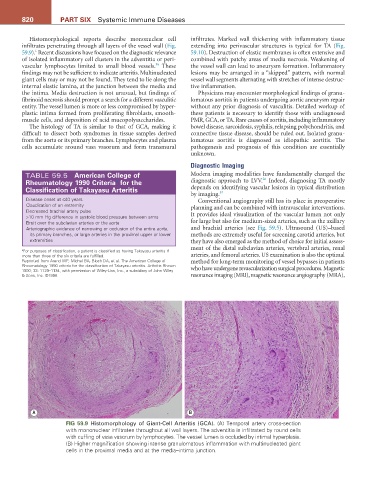
           Histomorphological reports describe mononuclear cell   infiltrates. Marked wall thickening with inflammatory tissue
        infiltrates penetrating through all layers of the vessel wall (Fig.   extending into perivascular structures is typical for TA (Fig.
             1
        59.9).  Recent discussions have focused on the diagnostic relevance   59.10). Destruction of elastic membranes is often extensive and
        of isolated inflammatory cell clusters in the adventitia or peri-  combined with patchy areas of media necrosis. Weakening of
                                                    36
        vascular  lymphocytes limited to small blood vessels.  These   the vessel wall can lead to aneurysm formation. Inflammatory
        findings may not be sufficient to indicate arteritis. Multinucleated   lesions may be arranged in a “skipped” pattern, with normal
        giant cells may or may not be found. They tend to lie along the   vessel wall segments alternating with stretches of intense destruc-
        internal elastic lamina, at the junction between the media and   tive inflammation.
        the intima. Media destruction is not unusual, but findings of   Physicians may encounter morphological findings of granu-
        fibrinoid necrosis should prompt a search for a different vasculitic   lomatous aortitis in patients undergoing aortic aneurysm repair
        entity. The vessel lumen is more or less compromised by hyper-  without any prior diagnosis of vasculitis. Detailed workup of
        plastic intima formed from proliferating fibroblasts, smooth-  these patients is necessary to identify those with undiagnosed
        muscle cells, and deposition of acid mucopolysaccharides.  PMR, GCA, or TA. Rare causes of aortitis, including inflammatory
           The  histology  of  TA  is  similar  to  that  of  GCA,  making  it   bowel disease, sarcoidosis, syphilis, relapsing polychondritis, and
        difficult to dissect both syndromes in tissue samples derived   connective tissue disease, should be ruled out. Isolated granu-
        from the aorta or its primary branches. Lymphocytes and plasma   lomatous aortitis is diagnosed as idiopathic aortitis. The
        cells  accumulate  around  vasa  vasorum  and  form  transmural   pathogenesis and prognosis of this condition are essentially
                                                               unknown.
                                                               Diagnostic Imaging
         TABLE 59.5  american College of                       Modern imaging modalities have fundamentally changed the
                                                                                       26
                                       a
         rheumatology 1990 Criteria  for the                   diagnostic approach to LVV.  Indeed, diagnosing  TA mostly
         Classification of takayasu arteritis                  depends on identifying vascular lesions in typical distribution
                                                               by imaging. 37
          Disease onset at ≤40 years                              Conventional angiography still has its place in preoperative
          Claudication of an extremity                         planning and can be combined with intravascular interventions.
          Decreased brachial artery pulse
          >10 mm Hg difference in systolic blood pressure between arms  It provides ideal visualization of the vascular lumen not only
          Bruit over the subclavian arteries or the aorta      for large but also for medium-sized arteries, such as the axillary
          Arteriographic evidence of narrowing or occlusion of the entire aorta,   and brachial arteries (see  Fig. 59.5). Ultrasound (US)–based
           its primary branches, or large arteries in the proximal upper or lower   methods are extremely useful for screening carotid arteries, but
           extremities                                         they have also emerged as the method of choice for initial assess-
                                                               ment of the distal subclavian arteries, vertebral arteries, renal
        a For purposes of classification, a patient is classified as having Takayasu arteritis if
        more than three of the six criteria are fulfilled.     arteries, and femoral arteries. US examination is also the optimal
        Reprinted from Arend WP, Michel BA, Bloch DA, et al. The American College of   method for long-term monitoring of vessel bypasses in patients
        Rheumatology 1990 criteria for the classification of Takayasu arteritis. Arthritis Rheum   who have undergone revascularization surgical procedures. Magnetic
        1990; 33: 1129–1134, with permission of Wiley-Liss, Inc., a subsidiary of John Wiley
        & Sons, Inc. ©1990.                                    resonance imaging (MRI), magnetic resonance angiography (MRA),


            $                                                  %

                       FIG 59.9  Histomorphology of Giant-Cell Arteritis (GCA). (A) Temporal artery cross-section
                       with mononuclear infiltrates throughout all wall layers. The adventitia is infiltrated by round cells
                       with cuffing of vasa vasorum by lymphocytes. The vessel lumen is occluded by intimal hyperplasia.
                       (B) Higher magnification showing intense granulomatous inflammation with multinucleated giant
                       cells in the proximal media and at the media–intima junction.

