


Page 854 - Clinical Immunology_ Principles and Practice ( PDFDrive )
P. 854
60


                                          Systemic Autoinflammatory Syndromes


                                                       Catharina M. Mulders-Manders, Jeroen C.H. van der Hilst,
                                                                             Jos W.M. van der Meer, Anna Simon


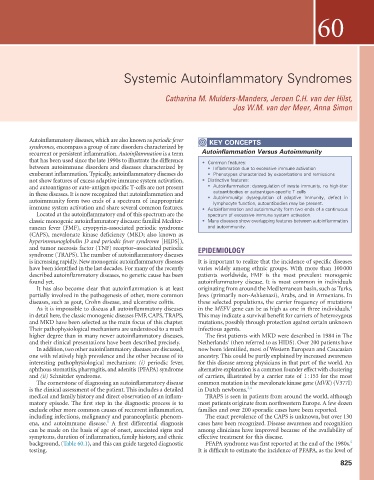
           Autoinflammatory diseases, which are also known as periodic fever    KEY CONCEPTS
           syndromes, encompass a group of rare disorders characterized by
           recurrent or persistent inflammation. Autoinflammation is a term   Autoinflammation Versus Autoimmunity
           that has been used since the late 1990s to illustrate the difference   •  Common features:
           between autoimmune disorders and diseases characterized by   •  Inflammation due to excessive immune activation
           exuberant inflammation. Typically, autoinflammatory diseases do   •  Phenotypes characterized by exacerbations and remissions
           not show features of excess adaptive immune system activation,   •  Distinctive features:
           and autoantigens or auto-antigen specific T-cells are not present   •  Autoinflammation: dysregulation of innate immunity, no high-titer
           in these diseases. It is now recognized that autoinflammation and   autoantibodies or autoantigen-specific T cells
           autoimmunity form two ends of a spectrum of inappropriate   •  Autoimmunity: dysregulation of adaptive immunity, defect  in
                                                                       lymphocyte function, autoantibodies may be present.
           immune system activation and share several common features.  •  Autoinflammation and autoimmunity form two ends of a continuous
             Located at the autoinflammatory end of this spectrum are the   spectrum of excessive immune system activation.
           classic monogenic autoinflammatory diseases: familial Mediter-  •  Many diseases show overlapping features between autoinflammation
           ranean fever (FMF), cryopyrin-associated periodic syndrome   and autoimmunity.
           (CAPS), mevalonate kinase deficiency  (MKD; also known as
           hyperimmunoglobulin D and periodic fever syndrome [HIDS]),
           and tumor necrosis factor (TNF) receptor–associated periodic   EPIDEMIOLOGY
           syndrome (TRAPS). The number of autoinflammatory diseases
           is increasing rapidly. New monogenic autoinflammatory diseases   It is important to realize that the incidence of specific diseases
           have been identified in the last decades. For many of the recently   varies widely among ethnic groups. With more than 100 000
           described autoinflammatory diseases, no genetic cause has been   patients worldwide, FMF is the most prevalent monogenic
           found yet.                                             autoinflammatory disease. It is most common in individuals
             It has also become clear that autoinflammation is at least   originating from around the Mediterranean basin, such as Turks,
           partially involved in the pathogenesis of other, more common   Jews (primarily non-Ashkenazi), Arabs, and in Armenians. In
           diseases, such as gout, Crohn disease, and ulcerative colitis.  these selected populations, the carrier frequency of mutations
                                                                                                                    1
             As it is impossible to discuss all autoinflammatory diseases   in the MEFV gene can be as high as one in three individuals.
           in detail here, the classic monogenic diseases FMF, CAPS, TRAPS,   This may indicate a survival benefit for carriers of heterozygous
           and MKD have been selected as the main focus of this chapter.   mutations, possibly through protection against certain unknown
           Their pathophysiological mechanisms are understood to a much   infectious agents.
           higher degree than in many newer autoinflammatory diseases,   The first patients with MKD were described in 1984 in The
                                                                           2
           and their clinical presentations have been described precisely.  Netherlands  (then referred to as HIDS). Over 200 patients have
             In addition, two other autoinflammatory diseases are discussed,   now been identified, most of Western European and Caucasian
           one with relatively high prevalence and the other because of its   ancestry. This could be partly explained by increased awareness
           interesting pathophysiological mechanism:  (i) periodic fever,   for this disease among physicians in that part of the world. An
           aphthous stomatitis, pharyngitis, and adenitis (PFAPA) syndrome   alternative explanation is a common founder effect with clustering
           and (ii) Schnitzler syndrome.                          of carriers, illustrated by a carrier rate of 1 : 153 for the most
             The cornerstone of diagnosing an autoinflammatory disease   common mutation in the mevalonate kinase gene (MVK) (V377I)
           is the clinical assessment of the patient. This includes a detailed   in Dutch newborns. 3,4
           medical and family history and direct observation of an inflam-  TRAPS is seen in patients from around the world, although
           matory episode. The first step in the diagnostic process is to   most patients originate from northwestern Europe. A few dozen
           exclude other more common causes of recurrent inflammation,   families and over 200 sporadic cases have been reported.
           including infections, malignancy and paraneoplastic phenom-  The exact prevalence of the CAPS is unknown, but over 130
                                    1
           ena, and autoimmune disease.   A first differential diagnosis   cases have been recognized. Disease awareness and recognition
           can be made on the basis of age of onset, associated signs and   among clinicians have improved because of the availability of
           symptoms, duration of inflammation, family history, and ethnic   effective treatment for this disease.
                                                                                                                    5
           background, (Table 60.1), and this can guide targeted diagnostic    PFAPA syndrome was first reported at the end of the 1980s.
           testing.                                               It is difficult to estimate the incidence of PFAPA, as the level of
                                                                                                                825

