


Page 90 - Clinical Immunology_ Principles and Practice ( PDFDrive )
P. 90
CHaPter 4  Antigen Receptor Genes, Gene Products, and Coreceptors                    75


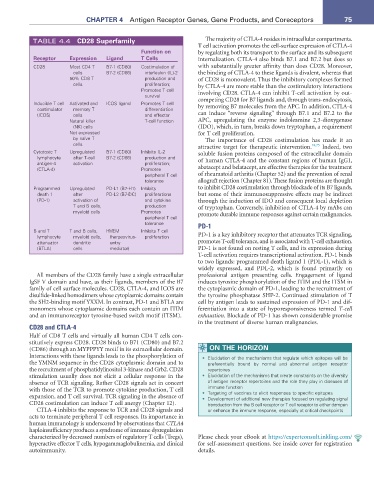
            TABLE 4.4  CD28 Superfamily                             The majority of CTLA-4 resides in intracellular compartments.
                                                                  T cell activation promotes the cell-surface expression of CTLA-4
                                               Function on        by regulating both its transport to the surface and its subsequent
            receptor    expression  Ligand     t Cells            internalization. CTLA-4 also binds B7.1 and B7.2 but does so
            CD28        Most CD4 T   B7-1 (CD80)  Costimulation of   with substantially greater affinity than does CD28. Moreover,
                         cells      B7-2 (CD86)  interleukin (IL)-2   the binding of CTLA-4 to these ligands is divalent, whereas that
                        50% CD8 T               production and    of CD28 is monovalent. Thus the inhibitory complexes formed
                         cells                  proliferation;    by CTLA-4 are more stable than the costimulatory interactions
                                               Promotes T cell    involving CD28. CTLA-4 can inhibit T-cell activation by out-
                                                survival
            Inducible T cell  Activated and   ICOS ligand  Promotes T cell   competing CD28 for B7 ligands and, through trans-endocytosis,
                                                                  by removing B7 molecules from the APC. In addition, CTLA-4
             costimulator   memory T            differentiation
             (ICOS)      cells                  and effector      can  induce “reverse signaling” through  B7.1 and  B7.2 to the
                        Natural killer          T-cell function   APC,  upregulating  the  enzyme  indoleamine  2,3-dioxygenase
                         (NK) cells                               (IDO), which, in turn, breaks down tryptophan, a requirement
                        Not expressed                             for T cell proliferation.
                         by naïve T                                 The importance of CD28 costimulation has made it an
                         cells                                    attractive target for therapeutic intervention. 74,75  Indeed, two
            Cytotoxic T   Upregulated   B7-1 (CD80)  Inhibits IL-2   soluble fusion proteins composed of the extracellular domain
             lymphocyte   after T-cell   B7-2 (CD86)  production and   of human CTLA-4 and the constant regions of human IgG1,
             antigen-4   activation             proliferation;
             (CTLA-4)                          Promotes           abatacept and belatacept, are effective therapies for the treatment
                                                peripheral T cell   of rheumatoid arthritis (Chapter 52) and the prevention of renal
                                                tolerance         allograft rejection (Chapter 81). These fusion proteins are thought
            Programmed   Upregulated   PD-L1 (B7-H1)  Inhibits    to inhibit CD28 costimulation through blockade of its B7 ligands,
             death 1     after      PD-L2 (B7-DC)  proliferations   but some of their immunosuppressive effects may be indirect
             (PD-1)      activation of          and cytokine      through the induction of IDO and consequent local depletion
                         T and B cells,         production        of tryptophan. Conversely, inhibition of CTLA-4 by mAbs can
                         myeloid cells         Promotes           promote durable immune responses against certain malignancies.
                                                peripheral T cell
                                                tolerance         PD-1
            B and T     T and B cells,   HVEM   Inhibits T cell
             lymphocyte   myeloid cells,   (herpesvirus-  proliferation  PD-1 is a key inhibitory receptor that attenuates TCR signaling,
             attenuator   dendritic   entry                       promotes T-cell tolerance, and is associated with T-cell exhaustion.
             (BTLA)      cells       mediator)                    PD-1 is not found on resting T cells, and its expression during
                                                                  T-cell activation requires transcriptional activation. PD-1 binds
                                                                  to two ligands: programmed death ligand 1 (PDL-1), which is
                                                                  widely  expressed,  and  PDL-2,  which  is  found  primarily  on
             All members of the CD28 family have a single extracellular   professional  antigen  presenting  cells. Engagement  of ligand
           IgSF V domain and have, as their ligands, members of the B7   induces tyrosine phosphorylation of the ITIM and the ITSM in
           family of cell surface molecules. CD28, CTLA-4, and ICOS are   the cytoplasmic domain of PD-1, leading to the recruitment of
           disulfide-linked homodimers whose cytoplasmic domains contain   the tyrosine phosphatase SHP-2. Continued stimulation of T
           the SH2-binding motif YXXM. In contrast, PD-1 and BTLA are   cell by antigen leads to sustained expression of PD-1 and dif-
           monomers whose cytoplasmic domains each contain an ITIM   ferentiation into a state of hyporesponsiveness termed  T-cell
           and an immunoreceptor tyrosine-based switch motif (ITSM).  exhaustion. Blockade of PD-1 has shown considerable promise
                                                                  in the treatment of diverse human malignancies.
           CD28 and CTLA-4
           Half of CD8 T cells and virtually all human CD4 T cells con-
           stitutively express CD28. CD28 binds to B71 (CD80) and B7.2
           (CD86) through an MYPPPYY motif in its extracellular domain.    on tHe HorIZon
           Interactions with these ligands leads to the phosphorylation of   •  Elucidation of the mechanisms that regulate which epitopes will be
           the YMNM sequence in the CD28 cytoplasmic domain and to   preferentially bound by normal and abnormal antigen receptor
           the recruitment of phosphatidylinositol 3-kinase and Grb2. CD28   repertoires
           stimulation usually does not elicit a cellular response in the   •  Elucidation of the mechanisms that create constraints on the diversity
           absence of TCR signaling. Rather CD28 signals act in concert   of antigen receptor repertoires and the role they play in diseases of
           with those of the TCR to promote cytokine production, T cell   immune function
           expansion, and T cell survival. TCR signaling in the absence of   •  Targeting of vaccines to elicit responses to specific epitopes
                                                                   •  Development of additional new therapies focused on regulating signal
           CD28 costimulation can induce T cell anergy (Chapter 12).  transduction from the B cell receptor or T cell receptor to either dampen
             CTLA-4 inhibits the response to TCR and CD28 signals and   or enhance the immune response, especially at critical checkpoints
           acts to terminate peripheral T cell responses. Its importance in
           human immunology is underscored by observations that CTLA4
           haploinsufficiency produces a syndrome of immune dysregulation
           characterized by decreased numbers of regulatory T cells (Tregs),   Please check your eBook at https://expertconsult.inkling.com/
           hyperactive effector T cells, hypogammaglobulinemia, and clinical   for self-assessment questions. See inside cover for registration
           autoimmunity.                                          details.

