


Page 955 - Clinical Immunology_ Principles and Practice ( PDFDrive )
P. 955
922          Part Seven  Organ-Specific Inflammatory Disease


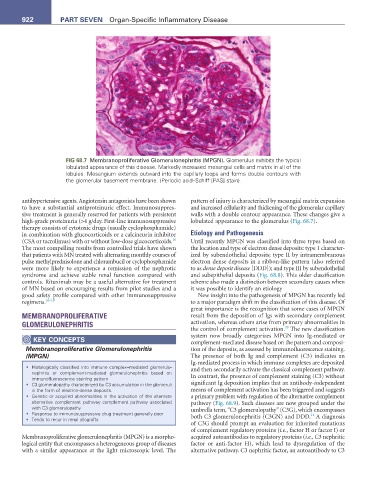
                       FIG 68.7  Membranoproliferative Glomerulonephritis (MPGN). Glomerulus exhibits the typical
                       lobulated appearance of this disease. Markedly increased mesangial cells and matrix in all of the
                       lobules. Mesangium extends outward into the capillary loops and forms double contours with
                       the glomerular basement membrane. (Periodic acid–Schiff [PAS] stain).


        antihypertensive agents. Angiotensin antagonists have been shown   pattern of injury is characterized by mesangial matrix expansion
        to have a substantial antiproteinuric effect. Immunosuppres-  and increased cellularity and thickening of the glomerular capillary
        sive treatment is generally reserved for patients with persistent   walls with a double contour appearance. These changes give a
        high-grade proteinuria (>4 g/day. First-line immunosuppressive   lobulated appearance to the glomerulus (Fig. 68.7).
        therapy consists of cytotoxic drugs (usually cyclophosphamide)
        in combination with glucocorticoids or a calcineurin inhibitor   Etiology and Pathogenesis
                                                         16
        (CSA or tacrolimus) with or without low-dose glucocorticoids.    Until recently MPGN was classified into three types based on
        The most compelling results from controlled trials have shown   the location and type of electron dense deposits: type 1 character-
        that patients with MN treated with alternating monthly courses of   ized by subendothelial deposits; type II by intramembranous
        pulse methylprednisolone and chlorambucil or cyclophosphamide   electron dense deposits in a ribbon-like pattern (also referred
        were  more  likely  to  experience  a  remission  of  the  nephrotic   to as dense deposit disease [DDD]); and type III by subendothelial
        syndrome  and  achieve  stable  renal  function  compared  with   and subepithelial deposits (Fig. 68.8). This older classification
        controls. Rituximab may be a useful alternative for treatment   scheme also made a distinction between secondary causes when
        of MN based on encouraging results from pilot studies and a   it was possible to identify an etiology
        good safety profile compared with other immunosuppressive   New insight into the pathogenesis of MPGN has recently led
        regimens. 16–19                                        to a major paradigm shift in the classification of this disease. Of
                                                               great importance is the recognition that some cases of MPGN
        MEMBRANOPROLIFERATIVE                                  result from the deposition of Igs with secondary complement
        GLOMERULONEPHRITIS                                     activation, whereas others arise from primary abnormalities in
                                                                                              20
                                                               the control of complement activation.  The new classification
            KeY COnCePtS                                       system  now  broadly  categorizes  MPGN  into  Ig-mediated  or
                                                               complement-mediated disease based on the pattern and composi-
         Membranoproliferative Glomerulonephritis              tion of the deposits, as assessed by immunofluorescence staining.
         (MPGN)                                                The  presence  of  both  Ig  and  complement  (C3)  indicates  an
                                                               Ig-mediated process in which immune complexes are deposited
          •  Histologically classified into immune complex–mediated glomerulo-  and then secondarily activate the classical complement pathway.
           nephritis or complement-mediated glomerulonephritis based on
           immunofluorescence staining pattern                 In contrast, the presence of complement staining (C3) without
          •  C3 glomerulopathy characterized by C3 accumulation in the glomeruli   significant Ig deposition implies that an antibody-independent
           in the form of electron-dense deposits.             means of complement activation has been triggered and suggests
          •  Genetic or acquired abnormalities in the activation of the alternate   a primary problem with regulation of the alternative complement
           alternative  complement  pathway  complement  pathway  associated   pathway (Fig. 68.9). Such diseases are now grouped under the
           with C3 glomerulopathy                              umbrella term, “C3 glomerulopathy” (C3G), which encompasses
          •  Response to immunosuppressive drug treatment generally poor  both C3 glomerulonephritis (C3GN) and DDD.  A diagnosis
                                                                                                       21
          •  Tends to recur in renal allografts
                                                               of C3G should prompt an evaluation for inherited mutations
                                                               of complement regulatory proteins (i.e., factor H or factor I) or
        Membranoproliferative glomerulonephritis (MPGN) is a morpho-  acquired autoantibodies to regulatory proteins (i.e., C3 nephritic
        logical entity that encompasses a heterogeneous group of diseases   factor or anti-factor H), which lead to dysregulation of the
        with a similar appearance at the light microscopic level. The   alternative pathway. C3 nephritic factor, an autoantibody to C3

