


Page 956 - Clinical Immunology_ Principles and Practice ( PDFDrive )
P. 956
CHaPter 68  Immunological Renal Diseases                923


               $                                                 %

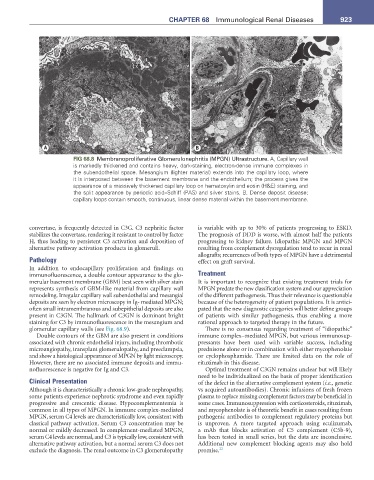
                         FIG 68.8  Membranoproliferative Glomerulonephritis (MPGN) Ultrastructure. A, Capillary wall
                         is markedly thickened and contains heavy, dark-staining, electron-dense immune complexes in
                         the subendothelial space. Mesangium (lighter material) extends into the capillary loop, where
                         it is interposed between the basement membrane and the endothelium; the process gives the
                         appearance of a massively thickened capillary loop on hematoxylin and eosin (H&E) staining, and
                         the split appearance by periodic acid–Schiff (PAS) and silver stains. B, Dense deposit disease;
                         capillary loops contain smooth, continuous, linear dense material within the basement membrane.


           convertase, is frequently detected in C3G. C3 nephritic factor   is variable with up to 30% of patients progressing to ESKD.
           stabilizes the convertase, rendering it resistant to control by factor   The prognosis of DDD is worse, with almost half the patients
           H, thus leading to persistent C3 activation and deposition of   progressing to kidney failure. Idiopathic MPGN and MPGN
           alternative pathway activation products in glomeruli.  resulting from complement dysregulation tend to recur in renal
                                                                  allografts; recurrences of both types of MPGN have a detrimental
           Pathology                                              effect on graft survival.
           In addition to endocapillary proliferation and findings on
           immunofluorescence, a double contour appearance to the glo-  Treatment
           merular basement membrane (GBM) best seen with silver stain   It is important to recognize that existing treatment trials for
           represents synthesis of GBM-like material from capillary wall   MPGN predate the new classification system and our appreciation
           remodeling. Irregular capillary wall subendothelial and mesangial   of the different pathogenesis. Thus their relevance is questionable
           deposits are seen by electron microscopy in Ig- mediated MPGN;   because of the heterogeneity of patient populations. It is antici-
           often small intramembranous and subepithelial deposits are also   pated that the new diagnostic categories will better define groups
           present in C3GN. The hallmark of C3GN is dominant bright   of  patients  with  similar  pathogenesis,  thus enabling a  more
           staining for C3 by immunofluorescence in the mesangium and   rational approach to targeted therapy in the future.
           glomerular capillary walls (see Fig. 68.9).              There is no consensus regarding treatment of “idiopathic”
             Double contours of the GBM are also present in conditions   immune complex–mediated MPGN, but various immunosup-
           associated with chronic endothelial injury, including thrombotic   pressants have been used with variable success, including
           microangiopathy, transplant glomerulopathy, and preeclampsia,   prednisone alone or in combination with either mycophenolate
           and show a histological appearance of MPGN by light microscopy.   or cyclophosphamide. There are limited data on the role of
           However, there are no associated immune deposits and immu-  rituximab in this disease.
           nofluorescence is negative for Ig and C3.                Optimal treatment of C3GN remains unclear but will likely
                                                                  need to be individualized on the basis of proper identification
           Clinical Presentation                                  of the defect in the alternative complement system (i.e., genetic
           Although it is characteristically a chronic low-grade nephropathy,   vs acquired autoantibodies). Chronic infusions of fresh frozen
           some patients experience nephrotic syndrome and even rapidly   plasma to replace missing complement factors may be beneficial in
           progressive and crescentic disease. Hypocomplementemia is   some cases. Immunosuppression with corticosteroids, rituximab,
           common in all types of MPGN. In immune complex-mediated   and mycophenolate is of theoretic benefit in cases resulting from
           MPGN, serum C4 levels are characteristically low, consistent with   pathogenic antibodies to complement regulatory proteins but
           classical pathway activation. Serum C3 concentration may be   is  unproven.  A  more  targeted  approach  using  eculizumab,
           normal or mildly decreased. In complement-mediated MPGN,   a mAb that blocks activation of C5 complement (C5b-9),
           serum C4 levels are normal, and C3 is typically low, consistent with   has been tested in small series, but the data are inconclusive.
           alternative pathway activation, but a normal serum C3 does not   Additional new complement blocking agents may also hold
           exclude the diagnosis. The renal outcome in C3 glomerulopathy   promise. 22

