


Page 960 - Clinical Immunology_ Principles and Practice ( PDFDrive )
P. 960
CHaPter 68  Immunological Renal Diseases                927


           A genetic predisposition to IgAN has been linked with poly-  TABLE 68.2  Prevalence of antineutrophil
           morphisms involving innate and adaptive immunities and the   Cytoplasmic antibodies (anCas) in
           alternative complement pathway. A “second hit” may be needed   renal vasculitis
           in predisposed individuals. Infections may play a role because
           episodes of macroscopic bleeding often coincide with mucosal                      anCaS teSt POSItIvItY (%)
           infections, including upper respiratory tract (synpharyngitic)                  P-anCas or    C-anCas or
           or GI infections.
                                                                   type of renal vasculitis  anti-Mpo    anti-Pr3
           Natural History                                         Polyarteritis nodosa       10–20         10–20
           Patients with IgAN who have low-grade proteinuria (<1 g/day)   Microscopic polyangiitis  50–80   10–20
                                                                                                            80–90
                                                                                              10–20
                                                                   Granulomatosis with
           have a good renal prognosis and usually have a low risk of progres-  polyangiitis (Wegener
           sion. However, it is recognized that at least one-third of patients   granulomatosis)
                                            34
           with IgAN eventually progress to ESKD.  Twenty years after   Necrotizing and crescentic GN  50–80  10–20
           apparent disease onset, the probability of renal failure is 25%,
           and the probability of some renal dysfunction is 50%. Hyperten-  MPO, myeloperoxidase; PR3, proteinase 3.
           sion occurs frequently as the disease progresses and forebodes
           a poor prognosis. Other clinical features that have been associated   granulomatosis), eosinophilic granulomatosis with polyangiitis
           with a poor prognosis include older age at disease onset, persistent   (EGPA, formerly Churg-Strauss syndrome), and renal limited
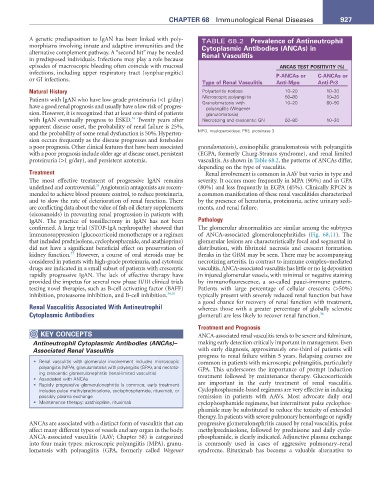
           proteinuria (>1 g/day), and persistent azotemia.       vasculitis. As shown in Table 68.2, the patterns of ANCAs differ,
                                                                  depending on the type of vasculitis.
           Treatment                                                Renal involvement is common in AAV but varies in type and
           The most effective treatment of progressive IgAN remains   severity. It occurs more frequently in MPA (90%) and in GPA
                                34
           undefined and controversial.  Angiotensin antagonists are recom-  (80%) and less frequently in EGPA (45%). Clinically RPGN is
           mended to achieve blood pressure control, to reduce proteinuria,   a common manifestation of these renal vasculitides characterized
           and to slow the rate of deterioration of renal function. There   by the presence of hematuria, proteinuria, active urinary sedi-
           are conflicting data about the value of fish oil dietary supplements   ments, and renal failure.
           (eicosanoids) in preventing renal progression in patients with
           IgAN. The practice of tonsillectomy in IgAN has not been   Pathology
           confirmed. A large trial (STOP-IgA nephropathy) showed that   The glomerular abnormalities are similar among the subtypes
           immunosuppression (glucocorticoid monotherapy or a regimen   of  ANCA-associated glomerulonephritides (Fig. 68.11). The
           that included prednisolone, cyclophosphamide, and azathioprine)   glomerular lesions are characteristically focal and segmental in
           did not have a significant beneficial effect on preservation of   distribution, with fibrinoid necrosis and crescent formation.
                        33
           kidney function.  However, a course of oral steroids may be   Breaks in the GBM may be seen. There may be accompanying
           considered in patients with high-grade proteinuria, and cytotoxic   necrotizing arteritis. In contrast to immune complex–mediated
           drugs are indicated in a small subset of patients with crescentic   vasculitis, ANCA-associated vasculitis has little or no Ig deposition
           rapidly progressive IgAN. The lack of effective therapy have   in injured glomerular vessels, with minimal or negative staining
           provided the impetus for several new phase II/III clinical trials   by immunofluorescence, a so-called pauci-immune pattern.
           testing novel therapies, such as B-cell activating factor (BAFF)   Patients  with  large  percentage  of  cellular  crescents  (>50%)
           inhibition, proteasome inhibition, and B-cell inhibition. 34,35  typically present with severely reduced renal function but have
                                                                  a good chance for recovery of renal function with treatment,
           Renal Vasculitis Associated With Antineutrophil        whereas  those  with  a  greater  percentage of  globally  sclerotic
           Cytoplasmic Antibodies                                 glomeruli are less likely to recover renal function. 36

                                                                  Treatment and Prognosis
               KeY COnCePtS                                       ANCA-associated renal vasculitis tends to be severe and fulminant,
            Antineutrophil Cytoplasmic Antibodies (ANCAs)–        making early detection critically important in management. Even
            Associated Renal Vasculitis                           with early diagnosis, approximately one-third of patients will
                                                                  progress to renal failure within 5 years. Relapsing courses are
            •  Renal vasculitis with glomerular involvement includes microscopic   common in patients with microscopic polyangiitis, particularly
              polyangiitis (MPA), granulomatosis with polyangiitis (GPA), and necrotiz-  GPA. This underscores the importance of prompt induction
              ing crescentic glomerulonephritis (renal-limited vasculitis)
            •  Associated with ANCAs                              treatment followed by maintenance therapy. Glucocorticoids
            •  Rapidly progressive glomerulonephritis is common; early treatment   are important in the early treatment of renal vasculitis.
              includes pulse methylprednisolone, cyclophosphamide, rituximab, or   Cyclophosphamide-based regimens are very effective in inducing
              possibly plasma exchange                            remission in patients with  AAVs. Most advocate daily oral
            •  Maintenance therapy: azathioprine, rituximab       cyclophosphamide regimens, but intermittent pulse cyclophos-
                                                                  phamide may be substituted to reduce the toxicity of extended
                                                                  therapy. In patients with severe pulmonary hemorrhage or rapidly
           ANCAs are associated with a distinct form of vasculitis that can   progressive glomerulonephritis caused by renal vasculitis, pulse
           affect many different types of vessels and any organ in the body.   methylprednisolone, followed by prednisone and daily cyclo-
           ANCA-associated vasculitis (AAV; Chapter 58) is categorized   phosphamide, is clearly indicated. Adjunctive plasma exchange
           into four main types: microscopic polyangiitis (MPA), granu-  is commonly used in cases of aggressive pulmonary–renal
           lomatosis with polyangiitis (GPA, formerly called  Wegener   syndrome. Rituximab  has become a valuable  alternative to

