


Page 1176 - Hall et al (2015) Principles of Critical Care-McGraw-Hill
P. 1176
814        PART 6: Neurologic Disorders


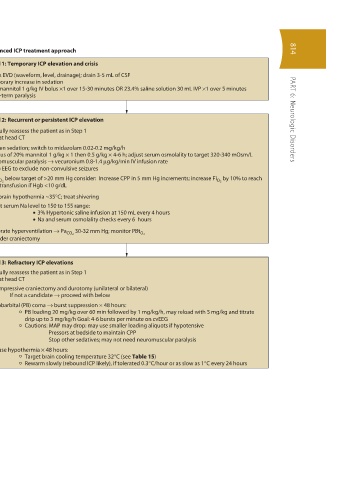
                   B) Advanced ICP treatment approach Level 1: Temporary ICP elevation and crisis Check EVD (waveform, level, drainage); drain 3-5 mL of CSF Temporary increase in sedation 20% mannitol 1 g/kg IV bolus ×1 over 15-30 minutes OR 23.4% saline solution 30 mL IVP ×1 over 5 minutes  Short-term paralysis  Level 2: Recurrent or persistent ICP elevation Carefully reassess the patient as in Step 1  Repeat head CT Deepen sedation; switch to midazolam 0.02-0.2 mg/kg/h IV bolus of 20% mannitol 1 g/kg × 1 then 0.5 g/kg × 4-6 h; adjust serum osmolality to target 320-340 mOsm/L  Neuromuscular paralysis   vecuronium 0.8-1.4  g/kg/min IV infusion


                               Imaging evidence (see Table 4): diffuse brain edema; mass lesion with brain shift, hydrocephalus, etc
                            Suggestive on examination (see Tables 4 and 5): herniation signs, unreactive pupil, posturing, etc


                       Step 1: Recognizing intracranial hypertension


                                       ICP likely elevated Suspected clinically and/or on imaging  Step 2: Stabilization phase Head elevated at 30°C-45°C and straight; neck without tight wrapping Mannitol 1 g/kg IV bolus (or 23.4% saline 30 mL IV bolus) Preparation for immediate head CT (often also CTA and neck CT) Initiate volume resuscitation (normal saline/colloids/blood products) Stabilize blood pressure to MAP >80 mm Hg (fluids/pressors) Stabilize airway, oxygenate, and maintain O 2 sat >90% Intubate if needed; avoid  hypoxemia, hypoventilation, and flat-on-bed time periods Propofol: 25-50 mg IV bolus for induction every 10 seconds  then d
                          High-risk conditions (see Table 86-7): coma, TBI, infection


                   A) ICP Identification and stabilization phase


                                                    Decompression:  Focused serial neurological examinations  Circulation:   Airway/breathing:  Cervical spine precaution if needed Rapid screening neurological examination  Induction medication (example):  If needed, vecuronium 0.1 mg/kg IV      decompression craniectomy)  2. Brain monitoring:     4) cerebral blood flow; 5) microdialysis


    section06.indd   814                                                                                                                             1/23/2015   12:56:10 PM

