


Page 1299 - Hall et al (2015) Principles of Critical Care-McGraw-Hill
P. 1299
906     PART 7: Hematologic and Oncologic Disorders

                                                                           ■
                   TABLE 96-4    Cardiac Catheterization Data for Adults With Sickle Cell Disease a  VASO-OCCLUSIVE PAIN CRISIS (VOC)
                  Parameter             Without Pulmonary HTN  With Pulmonary HTN  VOC is perhaps the most characteristic manifestation of sickle cell disease.
                                                                       These severe painful attacks, most frequently affecting the extremities
                  Pulmonary artery systolic (mm Hg)  30.3 ± 5.77  54.3 ± 12.26  and back, result from acutely impaired microvascular blood flow. Most
                  Pulmonary artery diastolic (mm Hg)  11.7 ± 4.86  25.2 ± 7.72  commonly affected are bones, due primarily to ischemia and infarction
                  Pulmonary artery mean (mm Hg)  17.8 ± 4.86  36.0 ± 7.78  of the bone marrow and inflammation of the periosteum, with intense
                                                                       bone pain due to the resulting edema and tissue swelling in the inelas-
                  Cardiac output (L/min)  8.62 ± 3.03   8.60 ± 1.76    tic compartment of the bone marrow medulla. Most often, pain affects
                  Pulmonary capillary wedge   10.6 ± 3.82  16.0 ± 5.87  the lumbosacral vertebrae, iliac and the long bones, although any bone
                    pressure (mm Hg)                                   may be affected. Joint effusions of the elbows and knees are common. At
                  Pulmonary vascular resistance    57   162            times, especially in children, there is difficulty in distinguishing painful
                  (dynes·s/cm ) 5                                      crisis from osteomyelitis, another complication of sickle cell disease. The
                                                                       mainstays of treatment for pain crisis are analgesics, in particular nonste-
                 a Ranges are mean ± standard deviation.
                                                                       roidal anti-inflammatory drugs and opioids. Correction of dehydration
                            15
                 Data from Castro et al  and Anthi et al. 58           or hypoxemia is important, as is careful monitoring for development of
                                                                       acute chest syndrome (ACS; see below). Clinicians frequently undertreat
                                                                       the severe pain of sickle cell crisis. Opioid tolerance due to recurrent or
                                                                       chronic opioid treatment may dramatically increase the dosage required
                                                                       in individual patients. There is little, if any, risk for developing opioid
                                                                       dependency with short courses of large-dose opioids for VOC.
                                                                           ■  STROKE

                                                                       Ischemic stroke is a frequent complication of sickle cell disease, occur-
                                                                       ring at any age, but mainly in children. This topic is discussed in detail
                                                                       below in the section on special problems in the ICU.
                                                                           ■  EYE DISEASE


                                                                       A proliferative retinopathy develops in 10% of patients with SS disease
                                                                       and at least twice as often in patients with SC disease. This chronic
                                                                       complication may be treated with laser photocoagulation. Two acute
                                                                       complications present ophthalmologic emergencies. The first is vision
                                                                       loss due to acute occlusion of the central retinal artery. This may resolve
                                                                       with emergency exchange transfusion before retinal infarction occurs.
                                                                       The second emergency is traumatic hyphema in a patient with sickle
                                                                       cell disease or sickle trait. The environment of the anterior chamber of
                                                                       the eye promotes sickling, and this can readily cause acute glaucoma.
                                                                       Evacuation of  the blood should be  undertaken  for  hyphema without
                                                                       delay to avoid vision loss. 14
                                                                           ■  LUNG DISEASE

                                                                       Sickle  cell  disease  is  associated with  a high incidence of  acute  and
                                                                       chronic lung complications. The ACS is an acute lung injury syndrome
                                                                       and, in cases of extensive lung involvement, is similar to ARDS. It
                                                                       is defined by a new pulmonary infiltrate secondary to alveolar con-
                                                                       solidation, not atelectasis, in a patient with sickle cell disease often
                                                                       accompanied by chest pain, fever, tachypnea, wheezing, or cough. It is
                                                                       caused frequently by pulmonary fat embolism syndrome from infarcted,
                                                                       necrotic bone marrow or by an exuberant pulmonary inflammatory
                                                                       response to common respiratory pathogens. Its pathogenesis and treat-
                                                                       ment are discussed in detail in the section on special ICU problems.
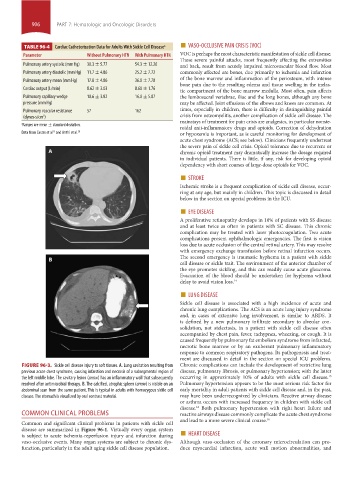
                 FIGURE 96-3.  Sickle cell disease injury to soft tissues. A. Lung cavitation resulting from   Chronic complications can include the development of restrictive lung
                 previous acute chest syndrome, causing infarction and necrosis of a subsegmental region of   disease, pulmonary fibrosis, or pulmonary hypertension; with the latter
                                                                                                                          15
                 the left middle lobe. The cavitary lesion (arrow) has an inflammatory wall that subsequently   occurring in approximately 10% of adults with sickle cell disease.
                 resolved after antimicrobial  therapy. B. The calcified, atrophic spleen (arrow) is visible on an   Pulmonary hypertension appears to be the most serious risk factor for
                 abdominal scan from the same patient. This is typical in adults with homozygous sickle cell   early mortality in adult patients with sickle cell disease and, in the past,
                 disease. The stomach is visualized by oral contrast material.  may have been underrecognized by clinicians. Reactive airway disease
                                                                       or asthma occurs with increased frequency in children with sickle cell
                                                                       disease.  Both pulmonary hypertension with right heart failure and
                                                                             16
                 COMMON CLINICAL PROBLEMS                              reactive airways disease commonly complicate the acute chest syndrome
                                                                       and lead to a more severe clinical course. 16
                 Common and significant clinical problems in patients with sickle cell
                 disease are summarized in Figure 96-1. Virtually every organ system     ■
                 is subject to acute ischemia-reperfusion injury and infarction during   HEART DISEASE
                   vaso-occlusive events. Many organ systems are subject to chronic dys-  Although vaso-occlusion of the coronary microcirculation can pro-
                 function, particularly in the adult aging sickle cell disease population.  duce myocardial infarction, acute wall motion abnormalities, and


            section07.indd   906                                                                                       1/21/2015   7:43:21 AM

