


Page 1300 - Hall et al (2015) Principles of Critical Care-McGraw-Hill
P. 1300
CHAPTER 96: Sickle Cell Disease  907


                    cardiac enzyme release, coronary atherosclerosis is essentially non-  frequently encountered, which very rarely cause bone sepsis in patients
                    existent in patients with sickle cell disease for reasons that are poorly   without sickle cell disease. Joint effusions and occasionally hemarthro-
                    understood, possibly owing to low levels of low-density lipoprotein   sis may be seen adjacent to infarcted bones. Septic arthritis is seen less
                    cholesterol, early mortality of males, and increased heme oxygenase-1   commonly.
                    activity. Cardiomegaly and biventricular chamber dilation are nearly
                    universal due to a long-term high cardiac output state as compensa-    ■  SKIN
                    tion for severe chronic anemia. High-output cardiac failure, diastolic   Leg ulcers, a clinical feature of this and other hemolytic disorders, are
                    dysfunction, and pulmonary hypertension are common cardiac com-  usually limited to adolescence and adulthood. They usually heal very
                    plications of sickle cell disease (see Tables 96-3 and 96-4).  slowly and can cause very severe pain. They rarely develop acute cellu-
                        ■  HEPATOBILIARY                                  litis or osteomyelitis. They are best treated with scrupulous wound care
                                                                          rather than antibiotics.
                    Up to 42% of patients with sickle cell disease have calcium bilirubinate
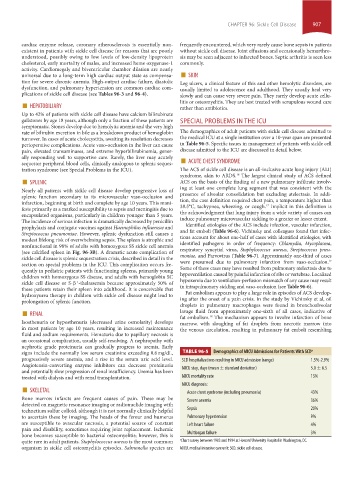
                    gallstones by age 18 years, although only a fraction of these patients are   SPECIAL PROBLEMS IN THE ICU
                    symptomatic. Stones develop due to hemolytic anemia and the very high
                    rate of bilirubin excretion in bile as a breakdown product of hemoglobin   The demographics of adult patients with sickle cell disease admitted to
                    turnover. In cases of acute cholecystitis, awaiting its resolution decreases   the medical ICU at a single institution over a 10-year span are presented
                    perioperative complications. Acute vaso-occlusion in the liver can cause   in Table 96-5. Specific issues in management of patients with sickle cell
                    pain, elevated transaminases, and extreme hyperbilirubinemia, gener-  disease admitted to the ICU are discussed in detail below.
                    sequester peripheral blood cells, clinically analogous to splenic seques-  ■  ACUTE CHEST SYNDROME
                    ally responding well to supportive care. Rarely, the liver may acutely
                    tration syndrome (see Special Problems in the ICU).   The ACS of sickle cell disease is an all-inclusive acute lung injury (ALI)
                        ■  SPLENIC                                        syndrome, akin to ARDS.  The largest clinical study of ACS defined
                                                                                             16
                                                                          ACS on the basis of the finding of a new pulmonary infiltrate involv-
                    Nearly all patients with sickle cell disease develop progressive loss of   ing at least one complete lung segment that was consistent with the
                    splenic function secondary to its microvascular vaso-occlusion and   presence of alveolar consolidation but excluding atelectasis. In addi-
                    infarction, beginning at birth and complete by age 10 years. This mani-  tion, the case definition required chest pain, a temperature higher than
                                                                                                       17
                    fests primarily as a marked susceptibility to sepsis and meningitis due to   38.5°C, tachypnea, wheezing, or cough.  Implicit in this definition is
                    encapsulated organisms, particularly in children younger than 5 years.   the acknowledgment that lung injury from a wide variety of causes can
                    The incidence of serious infection is dramatically decreased by penicillin   induce pulmonary microvascular sickling to a greater or lesser extent.
                    prophylaxis and conjugate vaccines against Haemophilus influenzae and   Identified etiologies of the ACS include infection, vascular infarction,
                    Streptococcus pneumoniae. However, splenic dysfunction still causes a   and fat emboli (Table 96-6). Vichinsky and colleagues found that infec-
                    modest lifelong risk of overwhelming sepsis. The spleen is atrophic and   tions account for about one-half of cases with identified etiologies, with
                    nonfunctional in 98% of adults with homozygous SS sickle cell anemia   identified  pathogens in  order  of frequency:  Chlamydia,  Mycoplasma,
                    (see calcified spleen in Fig. 96-3B). A dramatic acute complication of   respiratory syncytial virus,  Staphylococcus aureus,  Streptococcus pneu-
                    sickle cell disease is splenic sequestration crisis, described in detail in the   moniae, and Parvovirus (Table 96-7). Approximately one-third of cases
                                                                                                                            17
                    section on special problems in the ICU. This complication occurs fre-  were presumed due to pulmonary infarction from vaso-occlusion.
                    quently in pediatric patients with functioning spleens, primarily young   Some of these cases may have resulted from pulmonary atelectasis due to
                    children with homozygous SS disease, and adults with hemoglobin SC   hypoventilation caused by painful infarction of ribs or vertebrae. Localized
                    sickle cell disease or S-β -thalassemia because approximately 50% of   hypoxemia due to ventilation-perfusion mismatch of any cause may result
                                      +
                    these patients retain their spleen into adulthood. It is conceivable that   in intrapulmonary sickling and vaso-occlusion (see Table 96-6).
                    hydroxyurea therapy in children with sickle cell disease might lead to   Fat embolism appears to play a large role in episodes of ACS develop-
                    prolongation of splenic function.                     ing after the onset of a pain crisis. In the study by Vichinsky et al, oil
                                                                          droplets in pulmonary macrophages were found in bronchoalveolar
                        ■  RENAL                                          lavage  fluid  from  approximately  one-sixth  of  all  cases,  indicative  of
                                                                                    18
                    Isosthenuria or hyposthenuria (decreased urine osmolarity) develops   fat embolism.  The mechanism appears to involve infarction of bone
                                                                          marrow, with sloughing of fat droplets from necrotic marrow into
                    in most patients by age 10 years, resulting in increased maintenance   the venous circulation, resulting in pulmonary fat emboli resembling
                    fluid and sodium requirements. Hematuria due to papillary necrosis is
                    an occasional complication, usually self-resolving. A nephropathy with
                    nephrotic grade proteinuria can gradually progress to uremia. Early
                    signs include the normally low serum creatinine exceeding 0.6 mg/dL,     TABLE 96-5    Demographics of MICU Admissions for Patients With SCD a
                    progressively severe anemia, and a rise in the serum uric acid level.   SCD hospitalizations resulting in MICU admission (range)  1.5%-2.9%
                    Angiotensin-converting enzyme inhibitors can decrease proteinuria
                    and potentially slow progression of renal insufficiency. Uremia has been   MICU stay, days (mean ± standard deviation)  5.0 ± 6.5
                    treated with dialysis and with renal transplantation.  MICU mortality rate                        13%
                        ■  SKELETAL                                       MICU diagnosis:                             43%
                                                                            Acute chest syndrome (including pneumonia)
                    Bone marrow infarcts are frequent causes of pain. These may be     Severe anemia                  36%
                    detected on magnetic resonance imaging or radionuclide imaging with
                    technetium sulfur colloid, although it is not normally clinically helpful     Sepsis              20%
                    to ascertain these by imaging. The heads of the femur and humerus     Pulmonary hypertension      9%
                    are susceptible to avascular necrosis, a potential source of constant     Left heart failure      4%
                    pain and disability, sometimes requiring joint replacement. Ischemic
                    bone becomes susceptible to bacterial osteomyelitis; however, this is     Multiorgan failure      3%
                    quite rare in adult patients. Staphylococcus aureus is the most common     a Chart survey between 1983 and 1994 at Howard University Hospital in Washington, DC.
                    organism in sickle cell osteomyelitis episodes. Salmonella species are   MICU, medical intensive care unit; SCD, sickle cell disease.


            section07.indd   907                                                                                       1/21/2015   7:43:21 AM

