


Page 1377 - Hall et al (2015) Principles of Critical Care-McGraw-Hill
P. 1377
950     PART 8: Renal and Metabolic Disorders

                                                                           ■
                 restriction to increase the serum sodium. (Note: In patients with a   METABOLISM
                 positive C EFW , adding  a loop  diuretic  can have the  opposite  effect  by     Intestinal Absorption:  Normal daily intake is roughly 40 to 80 mmol.
                 increasing a low urine Na, indicative of good C EFW , to around 70.)  Potassium is rapidly and completely absorbed by the small intestine.
                   In patients with chronic  SIADH, use of  the antibiotic demeclocycline                                 49
                 acts as an ADH antagonist and so allows more liberal fluid intake. Likewise,   Net GI absorption (intake minus GI losses) is approximately 90%.
                                                                       Lower GI secretions have high concentrations of potassium, 80 to
                 increasing the solute load by using a high-protein diet or increased sodium   90 mmol/L, but due to the limited amount of stool (80-120 g/d), daily
                 and potassium intake will also allow increased daily fluid intake.
                                                                       GI excretion of potassium is only 10 mEq. 50-52  The colonic epithelium
                 The Role of Vasopressin Antagonists  There are three AVP receptor subtypes   is capable of actively excreting potassium, but this is not clinically sig-
                 (V1a, V1b, and V2). Vaptans are nonpeptide competitive inhibitors of   nificant. Patients with chronic renal failure have elevated stool potas-
                 V2 primarily, the receptor subtype which mediates the effects of ADH.    sium but total potassium excretion is still limited to about 12 mEq/d. 53
                                                                    37
                 They reduce urine osmolality, increase C EFW  (aquaresis), and conse-  Cell Uptake:  Following absorption, potassium distributes among the
                 quently increase serum sodium concentration.          intracellular and extracellular compartments. The intracellular com-
                   Currently there are no data to support the use of vaptans in acute   partment acts as the primary buffer to changes in serum potassium
                 symptomatic hyponatremia.  However, their use has been examined in   concentration.
                                     38
                 chronic hyponatremia from various causes. In the SALT-1 and SALT-2   The Na-K-ATPase pump, driven by a ubiquitous cell surface enzyme,
                 trials, Tolvaptan was efficacious at raising serum sodium at day 4 and   moves potassium into cells while pumping sodium out of cells. The
                 day 30 in patients with euvolemic and hypervolemic hypernatremia.    pump is stimulated by β -adrenergic activity, while α-adrenergic activity
                                                                    39
                 Initial studies supported the efficacy of long-term vaptan use in chronic   results in potassium efflux.  Insulin also stimulates the activity of this
                                                                                        2
                                                                                           53
                 hyponatremia. 40,41  However, due to concerns of liver injury the FDA   pump and is independent of its hypoglycemic activity. 54
                 recently advised that use of Tolvaptan should not exceed 30 days,   Extracellular pH can affect the cellular distribution of potassium.
                 and that its use be avoided in those with underlying liver disease.    Various explanations have been proposed, including a direct effect of
                                                                    42
                 Additional limitations include expense compared to more standard   pH on the Na-K-ATPase, or an H -K  exchange to maintain electroneu-
                                                                                               +
                                                                                                  +
                 therapies, and the potential for over rapid correction, which is more   trality. The effect of pH on potassium distribution varies depending on
                 likely to occur with use of these agents.  Furthermore, increased thirst   the nature of the acid-base disturbance. Respiratory acidosis, alkalosis,
                                              38
                 may limit the rise in serum sodium. 39
                                                                       and organic acidosis all have minimal effect on potassium distribu-
                 Osmotic Demyelination Syndrome  ODS is the primary complication of therapy   tion. Inorganic acidosis can increase serum potassium, while metabolic
                 for hyponatremia. With rapid or complete restoration of extracellular   alkalosis can lower potassium.
                 osmolality, a well-adjusted intracellular environment becomes relatively   Renal Excretion of Potassium:  Renal excretion of potassium can range
                 hypotonic. Water then flows from the intracellular to the extracellular   from 5 to 500 mEq/d. 55,56  Though 500 mmol of potassium is filtered by
                 compartment, causing cell volume collapse. In the CNS, this can cause   the glomerulus each day, >90% is resorbed in the proximal tubule and
                 a demyelinating lesion. Symptoms usually present within a week of the   loop of Henle. Thus the secretory contribution from the distal tubule is
                 correction of the hyponatremia. Although slowly evolving neurologic   the main determinant of urinary potassium excretion.  Because of this
                                                                                                              57
                 symptoms similar to a pseudobulbar palsy and the “locked-in” quadri-  phenomenon, the study of renal potassium handling can focus exclu-
                 paresis are classic, findings may be more subtle. Disturbances of move-  sively on the distal nephron.
                 ment  or  behavior  or  seizures  may  be  the presenting  finding.   Some   The secretion of potassium in the distal tubule is governed by
                                                               43
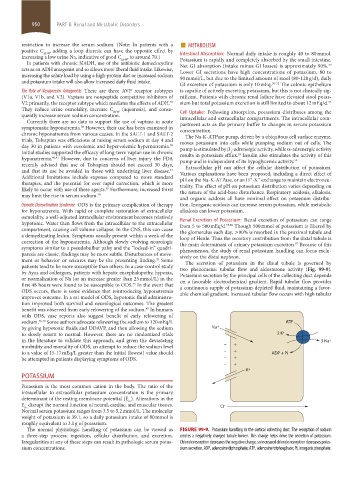
                 patients tend to be more susceptible than others. In a case-control study   two phenomena: tubular flow and aldosterone activity (Fig. 99-9).
                 by Ayus and colleagues, patients with hepatic encephalopathy, hypoxia,   Potassium secretion by the principal cells of the collecting duct depends
                 or normalization of Na (or an increase greater than 25 mmol/L) in the   on a favorable electrochemical gradient. Rapid tubular flow provides
                 first 48 hours were found to be susceptible to ODS.  In the event that   a continuous supply of potassium-depleted fluid, maintaining a favor-
                                                       44
                 ODS occurs, there is some evidence that reintroducing hyponatremia   able chemical gradient. Increased tubular flow occurs with high tubular
                 improves outcome. In a rat model of ODS, hypotonic fluid administra-
                 tion improved both survival and neurological outcomes. The greatest
                 benefit was observed from early relowering of the sodium.  In humans
                                                            45
                 with ODS, case reports also suggest benefit of early relowering of
                 sodium. 46-48  Some authors advocate relowering the sodium to 120 mEq/L                   ATP
                 by giving hypotonic fluids and DDAVP, and then allowing the sodium   Na +
                 to slowly return to normal. However, there are no randomized  trials                   2 K +
                 in the literature to validate this approach, and given the devastating                                3 Na +
                 morbidity and mortality of ODS, an attempt to reduce the sodium level   –  +
                 to a value of 15-17 mEq/L greater than the initial (lowest) value should   –  +      ADP + Pi
                 be attempted in patients displaying symptoms of ODS.                 –   +
                                                                                      –   +
                                                                                              K +
                 POTASSIUM
                 Potassium is the most common cation in the body. The ratio of the
                 intracellular to extracellular potassium concentration is the primary
                 determinant of the resting membrane potential (E ). Alterations in the
                                                      m
                 E  disrupt the normal function of neural, cardiac, and muscular tissues.   CI –
                  m
                 Normal serum potassium ranges from 3.5 to 5.2 mmol/L. The molecular
                 weight of potassium is 39.1, so a daily potassium intake of 80 mmol is
                 roughly equivalent to 3.1 g of potassium.
                   The  normal  physiologic  handling  of  potassium  can  be  viewed  as   FIGURE 99-9.  Potassium handling in the cortical collecting duct. The resorption of sodium
                 a three-step process: ingestion, cellular distribution, and excretion.   creates a negatively charged tubule lumen. This charge helps drive the secretion of potassium.
                 Irregularities at any of these steps can result in pathologic serum potas-  Chloride resorption decreases the negative charge, so increased chloride resorption decreases potas-
                 sium concentrations.                                  sium secretion. ADP, adenosine diphosphate; ATP, adenosine triphosphate; Pi, inorganic phosphate.


            section08.indd   950                                                                                       1/14/2015   8:28:13 AM

