Page 1399 - Hall et al (2015) Principles of Critical Care-McGraw-Hill
P. 1399
972     PART 8: Renal and Metabolic Disorders


                 from hypermetabolism.  In all cases, the SID is decreased and is expected     TABLE 100-2    Causes of an Increased AG (Na  − Cl − HCO )
                                  36
                                                                                                         −
                                                                                                     +
                                                                                                                −
                 to remain so unless some therapy is provided. Hemodialysis will permit                         3
                 the removal of sulfate and other ions and allow normal Na  and Cl  bal-  Renal failure
                                                                 −
                                                           +
                 ance to be restored, thus returning the SID to normal (or near normal).   Ketoacidosis
                 However, patients not yet requiring dialysis and those who are between     Diabetic
                 treatments are often given other therapies to increase the SID. NaHCO
                                                                    3
                 is used as long as the plasma [Na ] is not already elevated. Other options     Alcoholic
                                         +
                 include Ca , which usually requires replacement anyway. Ca  replace-    Starvation
                                                             2+
                         2+
                 ment cannot increase the SID much given the rather narrow range of       Change in AG (usually small AG)
                 ionized Ca  (0.975 − 1.125 mmol/L). Even though Ca  is a divalent cation,
                         2+
                                                      2+
                 it is unreasonable to expect much effect on the SID by administering Ca .  Lactic acidosis
                                                                   2+
                     ■  POISONS                                         Toxins
                                                                          Methanol
                 Metabolic acidosis with an increased AG and SIG is a major feature of     Ethylene glycol
                 various types of drug and substance intoxications (Table 100-2; see also
                 Chap. 124). Again, it is generally more important to recognize these     Salicylates
                 disorders so that specific therapy can be provided than to treat the acid-    Toluene
                 base disorder itself.                                  Critical illness a
                     ■  MISCELLANEOUS AND UNKNOWN                       Sodium with weak anions
                 Table 100-2 lists several commonly and not so commonly recognized   Decreased cation
                 causes of positive AG metabolic acidosis. It is important to recognize     Hypomagnesemia
                 that unexplained anions have been found commonly in the plasma of     Hypokalemia
                 critically ill and injured patients. The etiology or even identity of these     Hypocalcemia
                 anions has not been established, nor has the clinical significance.
                                                                        Alkalosis
                 NON-ANION-GAP (HYPERCHLOREMIC) ACIDOSES               a Unexplained anions have been found in critically ill and injured patients, especially those with sepsis
                                                                       and liver disease. The causative anions have not been identified.
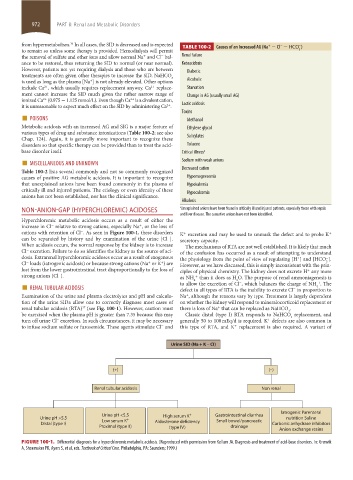
                 Hyperchloremic metabolic acidosis occurs as a result of either the
                 increase in Cl  relative to strong cations, especially Na , or the loss of
                                                         +
                           −
                 cations with retention of Cl . As seen in Figure 100-1, these disorders   K  excretion and may be used to unmask the defect and to probe K
                                     −
                                                                        +
                                                                                                                          +
                 can be separated by history and by examination of the urine [Cl ].   secretory capacity.
                                                                   −
                 When acidosis occurs, the normal response by the kidney is to increase   The mechanisms of RTA are not well established. It is likely that much
                 Cl  excretion. Failure to do so identifies the kidney as the source of aci-  of the confusion has occurred as a result of attempting to understand
                   −
                 dosis. Extrarenal hyperchloremic acidoses occur as a result of exogenous   the physiology from the point of view of regulating [H ] and [HCO ].
                                                                                                               +
                                                                                                                         −
                                                                                                                         3
                 Cl  loads (iatrogenic acidosis) or because strong cations (Na  or K ) are   However, as we have discussed, this is simply inconsistent with the prin-
                                                            +
                   −
                                                                 +
                 lost from the lower gastrointestinal tract disproportionally to the loss of   ciples of physical chemistry. The kidney does not excrete H  any more
                                                                                                                   +
                 strong anions (Cl ).                                  as NH  than it does as H O. The purpose of renal ammoniagenesis is
                              −
                                                                            +
                     ■  RENAL TUBULAR ACIDOSIS                         to allow the excretion of Cl , which balances the charge of NH . The
                                                                            4
                                                                                          2
                                                                                           −
                                                                                                                      +
                                                                                                                      4
                                                                       defect in all types of RTA is the inability to excrete Cl  in proportion to
                                                                                                              −
                 Examination of the urine and plasma electrolytes and pH and calcula-  Na , although the reasons vary by type. Treatment is largely dependent
                                                                         +
                 tion  of  the  urine SIDa allow  one  to  correctly  diagnose  most  cases  of   on whether the kidney will respond to mineralocorticoid replacement or
                 renal tubular acidosis (RTA)  (see Fig. 100-1). However, caution must   there is loss of Na  that can be replaced as NaHCO . 3
                                                                                    +
                                      37
                 be exercised when the plasma pH is greater than 7.35 because this may   Classic distal (type I) RTA responds to NaHCO  replacement, and
                                                                                                             3
                 turn off urine Cl  excretion. In such circumstances, it may be necessary   generally 50 to 100   mEq/d is required. K  defects are also common in
                                                                                                     +
                             −
                 to infuse sodium sulfate or furosemide. These agents stimulate Cl  and   this type of RTA, and K  replacement is also required. A variant of
                                                                 −
                                                                                          +
                                                                    Urine SID (Na + K – CI)
                                                (+)                                                  (–)
                                          Renal tubular acidosis                                   Non renal
                                                                                                          latrogenic Parenteral
                                             Urine pH <5.5       High serum K +    Gastrointestinal diarrhea
                        Urine pH >5.5        Low serum K +                          Small bowel/pancreatic  nutrition Saline
                        Distal (type I)                        Aldosterone deficiency                   Carbonic anhydrase inhibitors
                                            Proximal (type II)      (type IV)           drainage         Anion exchange resins
                 FIGURE 100-1.  Differential diagnosis for a hyperchloremic metabolic acidosis. (Reproduced with permission from Kellum JA. Diagnosis and treatment of acid-base disorders. In: Grenvik
                 A, Shoemaker PK, Ayers S, et al, eds. Textbook of Critical Care. Philadelphia, PA: Saunders; 1999.)
            section08.indd   972                                                                                       1/14/2015   8:28:27 AM
   1394   1395   1396   1397   1398   1399   1400   1401   1402   1403   1404