


Page 1403 - Hall et al (2015) Principles of Critical Care-McGraw-Hill
P. 1403
976     PART 8: Renal and Metabolic Disorders


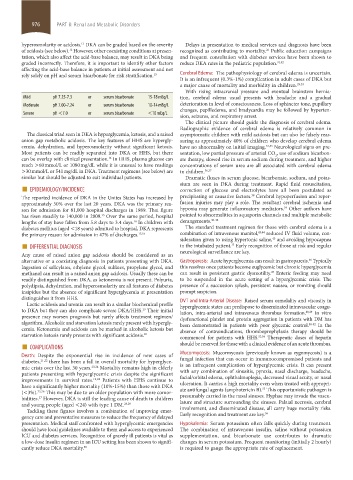
                 hyperosmolarity or acidosis.  DKA can be graded based on the severity   Delays in presentation to medical services and diagnosis have been
                                      11
                 of acidosis (see below).  However, other coexisting conditions at presen-  recognized as contributing to mortality.  Public education campaigns
                                                                                                     26
                                  12
                 tation, which also affect the acid-base balance, may result in DKA being   and frequent consultation with diabetes services have been shown to
                 graded incorrectly. Therefore, it is important to identify other factors   reduce DKA rates in the pediatric population. 31,32
                 affecting the acid-base balance in patients at initial assessment and not
                 rely solely on pH and serum bicarbonate for risk stratification.    Cerebral Edema:  The pathophysiology of cerebral edema is uncertain.
                                                              13
                                                                       It is an infrequent (0.3%-1%) complication in adult cases of DKA but
                                                                       a major cause of mortality and morbidity in children. 29,33
                                                                         With  rising intracranial  pressure and eventual  brainstem hernia-
                  Mild      pH 7.25-7.3  or  serum bicarbonate   15-18 mEq/L  tion, cerebral edema usual presents with headache and a gradual
                  Moderate  pH 7.00-7.24  or  serum bicarbonate   10-14 mEq/L    deterioration in level of consciousness. Loss of sphincter tone, pupillary
                                                                       changes, papilledema, and bradycardia may be followed by hyperten-
                  Severe    pH <7.0     or   serum bicarbonate  <10 mEq/L
                                                                       sion, seizures, and respiratory arrest.
                                                                         The clinical picture should guide the diagnosis of cerebral edema.
                                                                       Radiographic evidence of cerebral edema is relatively common in
                   The classical triad seen in DKA is hyperglycemia, ketosis, and a raised   asymptomatic children with mild acidosis but can also be falsely reas-
                 anion gap metabolic acidosis. The key features of HHS are hypergly-  suring as approximately 40% of children who develop cerebral edema
                 cemia, dehydration, and hyperosmolarity without significant ketosis.   have no abnormality on initial imaging. 34,35  Neurological signs on pre-
                 Most patients can be readily separated into DKA or HHS, but there   sentation, low partial pressure of arterial CO , use of sodium bicarbon-
                                                                                                        2
                 can be overlap with clinical presentation.  In HHS, plasma glucose can   ate therapy, slowed rise in serum sodium during treatment, and higher
                                               14
                 reach >60 mmol/L or 1080 mg/dL while it is unusual to have readings   concentrations of serum urea are all associated with cerebral edema
                 >30 mmol/L or 541 mg/dL in DKA. Treatment regimens (see below) are   in children. 36,37
                 similar but should be adjusted to suit individual patients.  Dramatic fluxes in serum glucose, bicarbonate, sodium, and potas-
                     ■  EPIDEMIOLOGY/INCIDENCE                         sium are seen in DKA during treatment. Rapid fluid resuscitation,
                                                                       correction of glucose and electrolytes have all been postulated as
                                                                                                38
                 The reported incidence of DKA in the Unites States has increased by   precipitating or causative factors.  Cerebral hypoperfusion and reper-
                 approximately 50% over the last 20 years. DKA was the primary rea-  fusion injuries may play a role. The resultant cerebral ischemia and
                                                                                                           39
                 son for admission for 81,000 hospital discharges in 1989. That figure   hypoxia may generate inflammatory mediators.  Other authors have
                 has risen steadily to 140,000 in 2009.  Over the same period, hospital   pointed to abnormalities in aquaporin channels and multiple metabolic
                                            15
                 lengths of stay have fallen from 5.8 days to 3.4 days.  In children with   derangements. 40-42
                                                       16
                 diabetes mellitus (aged <18 years) admitted to hospital, DKA represents   The standard treatment regimen for those with cerebral edema is a
                 the primary reason for admission in 47% of discharges. 17,18  combination of intravenous manitol, 43,44  reduced IV fluid volume, con-
                     ■  DIFFERENTIAL DIAGNOSIS                         in the intubated patient.  Early recognition of those at risk and regular
                                                                       sideration given to using hypertonic saline,  and avoiding hypocapnea
                                                                                                       45
                                                                                         33
                 Any cause of raised anion gap acidosis should be considered as an   neurological surveillance are key.
                 alternative or a coexisting diagnosis in patients presenting with DKA.   Gastroparesis:  Acute hyperglycemia can result in gastroparesis.  Typically
                                                                                                                   46
                 Ingestion of salicylates, ethylene glycol, sulfates, propylene glycol, and   this resolves once patients become euglycemic but chronic hyperglycemia
                                                                                                      47
                 methanol can result in a raised anion gap acidosis. Usually these can be   can result in persistent gastric dysmotility.  Enteric feeding may need
                 readily distinguished from DKA, as ketonemia is not present. Polyuria,   to be suspended in the acute setting of a hyperglycemic crisis. The
                 polydipsia, dehydration, and hyperosmolarity are all features of diabetes   presence  of a  succussion splash,  persistent  nausea,  or  vomiting  should
                 insipidus but the absence of significant hyperglycemia at presentation   prompt suspicion.
                 distinguishes it from HHS.                            DvT and Intra-Arterial Disease:  Raised serum osmolality and viscosity in
                   Lactic acidosis and uremia can result in a similar biochemical profile   hyperglycemic states can predispose to disseminated intravascular coagu-
                 to DKA but they can also complicate severe DKA/HHS.  Their initial   lation, intra-arterial and intravenous thrombus formation. 48,49  In vitro
                                                          19
                 presence may worsen prognosis but rarely affects treatment regimen/  dysfunctional platelet and protein aggregation in patients with DM has
                 algorithm. Alcoholic and starvation ketosis rarely present with hypergly-  been demonstrated in patients with poor glycemic control. 50-52  In the
                 cemia. Ketonemia and acidosis can be marked in alcoholic ketosis but   absence of contraindications, thromboprophylaxis therapy should be
                 starvation ketosis rarely presents with significant acidosis. 20  commenced for patients with HHS. 53,54  Therapeutic doses of heparin
                     ■  COMPLICATIONS                                  should be reserved for those with a clinical evidence of an acute thrombus.
                 Death:  Despite the exponential rise in incidence of new cases of    Mucormycosis:  Mucormycosis (previously known as zygomycosis) is a
                 diabetes, 21,22  there has been a fall in overall mortality for hyperglyce-  fungal infection that can occur in immunocompromised patients and
                 mic crisis over the last 30 years. 23,24  Mortality remains high in elderly   is an infrequent complication of hyperglycemic crisis. It can present
                 patients presenting with hyperglycemic crisis despite the significant   with any combination of sinusitis, pyrexia, nasal discharge, headache,
                 improvements in survival rates. 14,24  Patients with HHS continue to   facial/orbital edema, ophthalmoplegia, decreased visual acuity, or nasal
                 have a significantly higher mortality (10%-15%) than those with DKA   ulceration. It carries a high mortality even when treated with appropri-
                                                                                                   55
                 (<3%). 25,26  This may be due to an older population with more comor-  ate antifungal agents (amphotericin B).  This opportunistic pathogen is
                 bidities.  However, DKA is still the leading cause of death in children   presumably carried in the nasal sinuses. Hyphae may invade the vascu-
                       27
                 and young people (aged <24) with type 1 DM. 28,29     lature and structure surrounding the sinuses. Palatal necrosis, cerebral
                   Tackling these figures involves a combination of improving emer-  involvement, and disseminated disease, all carry huge mortality risks.
                 gency care and preventative measures to reduce the frequency of delayed   Early recognition and treatment are key. 56
                 presentation. Medical staff confronted with hyperglycemic emergencies   Hypokalemia:  Serum potassium often falls quickly during treatment.
                 should have local guidelines available to them and access to experienced   The combination of intravenous insulin, saline without potassium
                 ICU and diabetes services. Recognition of gravely ill patients is vital as   supplementation, and bicarbonate use contributes to dramatic
                 a low-dose insulin regimen in an ICU setting has been shown to signifi-  changes in serum potassium. Frequent monitoring (initially 2 hourly)
                 cantly reduce DKA mortality. 30                       is required to gauge the appropriate rate of replacement.


            section08.indd   976                                                                                       1/14/2015   8:28:29 AM

