


Page 1394 - Hall et al (2015) Principles of Critical Care-McGraw-Hill
P. 1394
CHAPTER 99: Electrolyte Disorders in Critical Care   967


                    hypokalemia, hypocalcemia, and hyponatremia. Symptoms due to hypo-  excretion of magnesium. A 24-hour urine magnesium level less than
                    magnesemia become more common as serum magnesium falls below   20 mg is consistent with an intact renal response to hypomagnesemia
                    1.2 mg/dL  (Table 99-17).                             and implicates decreased intake or extrarenal losses as the cause of
                           280
                    Neuromuscular Effects  Neuromuscular irritability is a common sign of mag-  hypomagnesemia. A  24-hour  urinary magnesium level greater than
                    nesium depletion. Patients can develop Trousseau and Chvostek signs   24 mg indicates renal magnesium wasting. The fractional excretion of
                    despite normal ionized calcium. Severe depletion can cause weakness,   magnesium (FeMg) allows assessment of the renal handling of mag-
                    fatigue, vertical nystagmus, tetany, and seizures.  Reversible blindness   nesium on a single urine specimen. A cutoff of 4% correctly separates
                                                      281
                    due to magnesium deficiency has been reported. 282    patients with renal magnesium wasting (FeMg  >4%) from patients
                                                                                                                287
                    Metabolic Effects  Hypokalemia is commonly associated with hypomagne-  with decreased magnesium absorption (FeMg <4%)  (Eq. 99-7).
                    semia. One series reported it to occur in 40% of patients with hypo-
                    magnesemia. The reverse is also true; 60% of patients with hypokalemia   FeMg = 100 ×  sCr× uMg
                    are hypomagnesemic.  One explanation for this phenomenon is that              (.07 × sMg ×)  uCr
                                    261
                    many  of  the  etiologies  of  hypomagnesemia  (diuretics,  alcoholism,
                    and diarrhea, among others) also result in hypokalemia. In addition,   Equation 99-7.  The fractional resorption of magnesium differentiates between
                    hypomagnesemia causes renal potassium wasting. The mechanism for   magnesium-avid and magnesium-wasting states. An FeMg greater than 4% in the presence of
                    potassium wasting is multifactorial. Decreased intracellular magne-  hypomagnesemia indicates abnormal renal magnesium wasting. sCr, serum creatinine; sMg,
                    sium slows adenosine triphosphate (ATP) production, which decreases   serum magnesium; uCr, urine creatinine; uMg, urine magnesium.
                    Na-K-ATPase activity, resulting in the loss of intracellular potassium.   Clinical sequelae of altered magnesium content are more dependent
                    In the TALH and cortical collecting duct, the loss of ATP increases the   on tissue magnesium levels than blood magnesium concentration.
                    number of potassium channels on the apical membrane.  Intracellular   Isolated  tissue  magnesium  depletion  (normomagnesemic magnesium
                                                             70
                    potassium flows down its concentration gradient into the tubule and is   deficiency) may be a cause of refractory hypokalemia or hypocalcemia,
                    lost in the urine.                                    especially in those at high risk of magnesium deficiency.  One method
                                                                                                                  284
                     Hypocalcemia has been reported in 12% to 50% of patients with   to infer the tissue magnesium level in patients with normal serum mag-
                    hypomagnesemia. 278,283  Hypomagnesemia suppresses the release of   nesium is a physiologic test that measures the renal response to a magne-
                    PTH and causes end-organ resistance to PTH. The hypocalcemia is   sium load. An 800 mg infusion of magnesium is given over 8 hours, and
                    refractory to calcium supplementation until the magnesium deficit is   a 24-hour urine is collected starting from the initiation of the infusion.
                    corrected. 177                                        Patients who excrete less than 560 mg (70%) are considered magnesium
                    Cardiovascular Effects  Hypomagnesemia has been associated with a variety   depleted, while those who excrete more than 640 mg (80%) are said to be
                    of atrial and ventricular arrhythmias.  Zuccala and associates pro-  magnesium replete.  This will only work in patients with normal renal
                                                284
                                                                                        288
                    spectively studied 52 elderly patients undergoing hip surgery. He noted   function and normal renal magnesium handling.
                    an  association  of  higher  rates  of  arrhythmias  with  greater  periopera-
                    tive drops in magnesium. The arrhythmogenic association of magne-  Treatment:  Patients with symptomatic hypomagnesemia should be treated
                    sium depletion was independent of changes in serum calcium and       with intravenous magnesium. The most common formulation is mag-
                    potassium.  Torsades de pointes is a unique form of ventricular tachy-  nesium sulfate (MgSO  · 7H O). One gram of MgSO  contains 0.1 g of
                           285
                                                                                          4
                                                                                              2
                                                                                                                4
                    cardia that is refractory to cardioversion, but responds to magnesium   elemental magnesium. Acute symptomatic hypomagnesemia (eg, seizures,
                                                                                                                            289
                    repletion. ECG findings with hypomagnesemia include flattened T   tetany, and arrhythmias) should be treated with 2 g IV over 2-15 minutes.
                    waves, U waves, prolonged QT interval, and widened QRS complexes.   In order to restore intracellular magnesium stores the acute bolus should
                    All of these ECG effects are also found with hypokalemia, and may be   be followed by 8 g over 24 hours and 4 to 6 g a day for 3 or 4 days. 284,290,291
                    secondary to changes in potassium.                     The American College of Cardiology and the American Heart
                     Since both magnesium depletion and digitalis inhibit the Na-K-  Association (AHA) recommend 1 to 2 g of magnesium sulfate as an IV
                    ATPase pump, it is not surprising that hypomagnesemia aggravates digi-  bolus over 5 minutes for treatment of torsades de pointes. The 2004
                    talis toxicity. In fact, hypomagnesemia was the most frequent electrolyte   AHA/ACC guidelines do not support the routine use of IV magnesium
                    abnormality in a study of digitalis toxicity. 286     in the setting of an acute myocardial infarction, except in the instances
                                                                          of torsades de pointes or documented magnesium deficiency. 292
                    Diagnosis:  Hypomagnesemia can be divided into extrarenal and renal   Magnesium  replacement  should  be  done  cautiously  in  patients
                    causes, which can be readily distinguished by determining if the kidney   with renal  insufficiency; doses should  be reduced  by 50% to 75%.
                    is magnesium avid or wasting magnesium. There are two ways to deter-  Patients should be monitored during infusions for decreased deep ten-
                    mine renal magnesium avidity: 24-hour urine collection and fractional   don reflexes, atrioventricular block, and magnesium levels should be
                                                                          checked at regular intervals.
                                                                           Oral supplementation with 360 mg of elemental magnesium per day
                                                                                                                            293
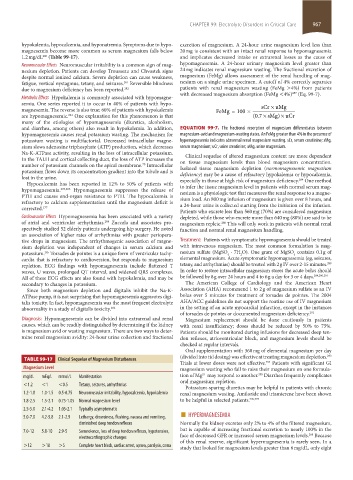
                      taBLE 99-17    Clinical Sequelae of Magnesium Disturbances  (divided into tid dosing) was effective at treating magnesium depletion.
                                                                          Trials at lower doses were not effective.  Patients with significant GI
                                                                                                       294
                    Magnesium Level                                       magnesium wasting who fail to raise their magnesium on one formula-
                                                                                                    295
                                                                                 2+
                    mg/dL  mEq/L  mmol/L  Manifestation                   tion of Mg  may respond to another.  Diarrhea frequently complicates
                                                                          oral magnesium repletion.
                    <1.2  <1    <0.5   Tetany, seizures, arrhythmias       Potassium-sparing diuretics may be helpful in patients with chronic
                    1.2-1.8  1.0-1.5 0.5-0.75  Neuromuscular irritability, hypocalcemia, hypokalemia  renal magnesium wasting. Amiloride and triamterene have been shown
                    1.8-2.5  1.5-2.1 0.75-1.05 Normal magnesium level     to be helpful in selected patients. 296,297
                    2.5-5.0  2.1-4.2 1.05-2.1  Typically asymptomatic         ■
                    5.0-7.0  4.2-5.8 2.1-2.9  Lethargy, drowsiness, flushing, nausea and vomiting,   HYPERMAGNESEMIA
                                       diminished deep tendon reflexes    Normally the kidney excretes only 2% to 4% of the filtered magnesium,
                    7.0-12  5.8-10  2.9-5  Somnolence, loss of deep tendon reflexes, hypotension,   but is capable of increasing fractional excretion to nearly 100% in the
                                                                                                                     268
                                       electrocardiographic changes       face of decreased GFR or increased serum magnesium levels.  Because
                    >12   >10   >5     Complete heart block, cardiac arrest, apnea, paralysis, coma  of this renal reserve, significant hypermagnesemia is rarely seen. In a
                                                                          study that looked for magnesium levels greater than 6 mg/dL, only eight


            section08.indd   967                                                                                       1/19/2015   11:09:54 PM

