


Page 1400 - Hall et al (2015) Principles of Critical Care-McGraw-Hill
P. 1400
CHAPTER 100: Acid-Base Balance  973


                    the classic distal RTA is a hyperkalemic form, which is actually more     increases in cations (rare). Metabolic alkaloses can be divided into those
                    common than the classic type. The central defect here appears to be   in which Cl  losses are temporary and can be effectively replaced (chlo-
                                                                                  −
                    impaired Na  transport in the cortical collecting duct. These patients   ride responsive) and those in which hormonal mechanisms produce
                             +
                    also respond to NaHCO  replacement. Proximal (type II) RTA is   ongoing losses that can, at best, be offset temporarily by Cl  admin-
                                                                                                                      −
                                       3
                    characterized by both Na  and K  reabsorption defects. The disorder   istration (chloride resistant) (Fig. 100-2). Similar to hyperchloremic
                                      +
                                            +
                    is uncommon and usually part of the Fanconi syndrome, where reab-  acidosis, these disorders can be distinguished by examination of the
                    sorption of glucose, phosphate, urate, and amino acids is also impaired.   urine [Cl ]. Although much more investigation has focused on acidosis,
                                                                                −
                    Treatment of this disorder with NaHCO  is ineffective because increased   alkalosis appears to be associated with poor prognosis as well. In a pro-
                                                3
                    ion delivery merely results in increased excretion. Thiazide diuretics   spective study, Anderson and Henrich  looked at 409 patients with an
                                                                                                      38
                    have been used to treat this disorder with varying success.  arterial pH of greater than 7.48. Of these patients, 213 were medical and
                     Type IV RTA is caused by aldosterone deficiency or resistance. This   196 were surgical. Overall, hospital mortality was 27.9% and increased
                    disorder is diagnosed by the high serum K  and low urine pH (<5.5).   as pH values rose, reaching 48.5% when the pH was greater than 7.60.
                                                   +
                    Treatment is usually most effective if the cause can be removed. The   While only 2% had pure metabolic alkalosis, patients at greatest risk
                    most common causes are drugs such as nonsteroidal anti-inflammatory   were those with a mixed respiratory and metabolic alkalosis, having a
                    agents, heparin, or potassium-sparing diuretics. Occasionally, mineralo-  mortality of 44.2%.
                    corticoid replacement is required.
                        ■  GASTROINTESTINAL ACIDOSIS                      CHLORIDE-RESPONSIvE DISORDERS
                    Fluid secreted into the gut lumen contains higher amounts of Na  than   These disorders usually occur as a result of Cl  losses from the stomach,
                                                                   +
                                                                                                          −
                    Cl , similar to the differences in plasma. Extremely large losses of these   such  as  from  vomiting  or gastric drainage.  The treatment  involves
                     −
                    fluids, particularly if volume is replaced with fluids containing equal   lowering the SID, by giving NaCl (since serum [Cl ] will rise greater
                                                                                                                −
                    amounts of Na  and Cl , will result in a decrease in the plasma [Na ]   than serum [Na ]), KCl, or even HCl (which is most potent because it
                              +
                                     −
                                                                      +
                                                                                     +
                    relative to [Cl ] and a decrease in the SID.          contains only strong anions). Saline plus KCl is usually the treatment of
                             −
                        ■  IATROGENIC ACIDOSIS                            choice because volume depletion usually coexists with these disorders.
                                                                          Volume depletion, in turn, stimulates aldosterone secretion, which
                                                                                                          +
                                                                                                                −
                    Two of the most common causes of a hyperchloremic metabolic acidosis   results in Na  reabsorption and the loss of K  and Cl .
                                                                                   +
                    are iatrogenic, and both are due to administration of chloride. Modern   Diuretics and other forms of volume contraction produce meta-
                    parenteral nutrition formulas contain weak anions such as acetate in addi-  bolic alkalosis predominantly by stimulating aldosterone, as discussed
                    tion to Cl , and the balance of each anion can be adjusted depending on   earlier. However, diuretics also induce K  and Cl  excretion directly,
                                                                                                              −
                                                                                                        +
                          −
                    the acid-base status of the patient. If sufficient amounts of weak anions   further complicating the problem and inducing metabolic alkalosis
                    are not provided, the plasma [Cl ] will increase, decreasing the SID and   more rapidly.
                                           −
                    resulting in acidosis. As already discussed, administration of normal
                    saline can cause a decrease in the SID and, subsequently, an acidosis.  CHLORIDE-RESISTANT DISORDERS
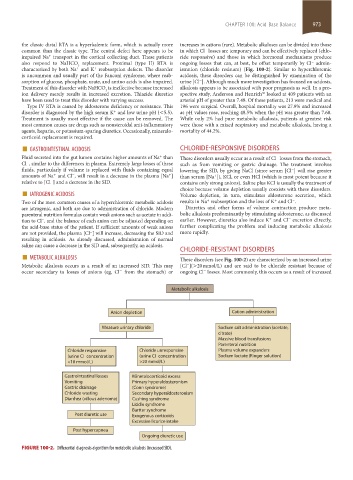
                        ■  METABOLIC ALKALOSIS                            These disorders (see Fig. 100-2) are characterized by an increased urine
                    Metabolic  alkalosis  occurs  as  a result  of  an increased SID.  This  may   [Cl ](>20 mmol/L) and are said to be chloride resistant because of
                                                                            −
                    occur secondary to losses of anions (eg, Cl  from the stomach) or   ongoing Cl  losses. Most commonly, this occurs as a result of increased
                                                                                  −
                                                     −
                                                                       Metabolic alkalosis
                                                  Anion depletion                          Cation administration
                                               Measure urinary chloride                Sodium salt administration (acetate,
                                                                                       citrate)
                                                                                       Massive blood transfusions
                                                                                       Parenteral nutrition
                                   Chloride responsive      Chloride unresponsive      Plasma volume expanders
                                                                 –
                                         –
                                   (urine CI concentration  (urine CI concentration    Sodium lactate (Ringer solution)
                                   <10 mmol/L)              >20 mmol/L)
                                  Gastrointestinal losses  Mineralocorticoid excess
                                  Vomiting               Primary hyperaldosteronism
                                  Gastric drainage       (Conn syndrome)
                                  Chloride wasting       Secondary hyperaldosteronism
                                  Diarrhea (villous adenoma)  Cushing syndrome
                                                         Liddle syndrome
                                                         Bartter syndrome
                                      Post diuretic use  Exogenous corticoids
                                                         Excessive licorice intake
                                     Post hypercapnea
                                                             Ongoing diuretic use
                    FIGURE 100-2.  Differential diagnosis algorithm for metabolic alkalosis (increased SID).


            section08.indd   973                                                                                       1/14/2015   8:28:27 AM

