


Page 1404 - Hall et al (2015) Principles of Critical Care-McGraw-Hill
P. 1404
CHAPTER 101: Hyperglycemic Crisis and Hypoglycemia   977


                    Dysglycemia:  Iatrogenic hypoglycemia is a common occurrence during     measurements), and 2 hourly electrolyte profiles should be performed.
                    the course of treatment of hyperglycemia. Frequent blood glucose   It is extremely helpful to have charts prepared to monitor these variables
                    monitoring and using low-dose insulin therapy lessen the risk of this   in graphical format either by hand or in the electronic medical record.
                    complication. Rebound hyperglycemia and ketosis may arise from
                    either inappropriate overlap of intravenous with subcutaneous insulin   Potassium:  HHS and DKA often result in a 3 to 5 mEq/L total body
                    or failure to continue insulin therapy long enough. Twenty-four to     potassium deficit.      +
                    48 hours of IV therapy may be needed to completely “turn off” ketone-  IV insulin therapy promotes an intracellular shift of K  through the
                                                                                 +
                                                                                    +
                                                                                                                       +
                    generating enzymes in the liver.                      glucose Na /K  transporter. Large volumes of IV saline without K  supple-
                                                                          mentation can further lower serum K . Concomitant hypomagnesemia
                                                                                                     +
                    Other Complications:  Rhabdomyolysis is a rare but potentially fatal   can exacerbate hypokalemia through increased renal K  loss.  Untreated
                                                                                                                     59
                                                                                                                +
                    finding in hyperglycemic crisis.  Serum creatine kinase measurement   hypomagnesemia can render hypokalemia refractory to  treatment with
                                           26
                    should be performed on all patients presenting with HHS. Acute lung   potassium supplementation. Careful monitoring and supplementation of
                    injury is also an established complication. Changes in alveolar capil-  K  is required. If patients are hypokalemic on presentation, potassium can
                                                                           +
                    lary permeability coupled with overzealous fluid resuscitation may   be given along with IV insulin. 60
                    result in noncardiogenic pulmonary edema. 57          Phosphate:  Profound hypophosphatemia is associated with muscle
                        ■  MANAGEMENT                                     weakness (cardiac and skeletal), hemolysis, and rhabdomyolysis.
                    HHS and DKA are medical emergencies and should be managed in a   Hypophosphatemia as a consequence of hyperglycemic crisis is  relative
                                                                          common, usually mild and self-limiting. Phosphate supplementation
                    unit with                                             during DKA has not shown any significant clinical benefit.  Indeed
                                                                                                                      61
                      • Experienced nursing and medical staff, trained in the management   phosphate therapy during DKA has been associated with hypocal-
                                                                                                62
                       of hyperglycemic emergencies                       cemia and hypomagnesemia.  Therapy with IV phosphate should
                      • Regularly updated guidelines for DKA and HHS treatment  therefore be reserved for patients with profound (<0.32 mmol/L or
                                                                          1 mg/dL) hypomagnesemia, rhabdomyolysis, or hemolytic anemia.
                      • Access to frequent and timely biochemical investigations
                                                                          Bicarbonate:  Many international and local guidelines have incorporated
                    Goals of Therapy                                      intravenous bicarbonate use to correct profound diabetic ketoacidosis in
                                                                                                                     63
                      • Restoration of circulatory volume and improved tissue perfusion  adults. Alkalization is felt to improve myocardial contractility.  However,
                                                                          bicarbonate use may lower serum potassium and ionized calcium levels
                      • Steady reduction of serum glucose and osmolality/ketonemia  and decrease peripheral tissue oxygenation by increasing the affinity
                      • Correction of electrolyte imbalances              between hemoglobin and oxygen.  There are few randomized control
                                                                                                   64
                                                                                                   65
                      • Identification and treatment of precipitant factors  trials to assess any clinical benefits.  Its use remains contentious.
                                                                           Bicarbonate use in children and adolescence is not recommended and
                      • Identification and treatment of potential complications  there is evidence to suggest it may worsen cerebral edema and cause a
                     There are multiple local and international guidelines available. 13,58    paradoxical drop in the pH of cerebrospinal fluid. 33,66
                    The key principles of treatment will be outlined here. Local guidelines/  Predisposing Factors:  Insulin omission and new presentation with DM
                    protocols should be available and adhered to. However, the ability for   (usually type 1 DM but also type 2 DM and in rare cases of MODY)
                    senior medical staff to individualize therapy and modify guidelines in   represent a large portion of the cases of hyperglycemic crisis, but
                    the patient with a complex presentation is also important.
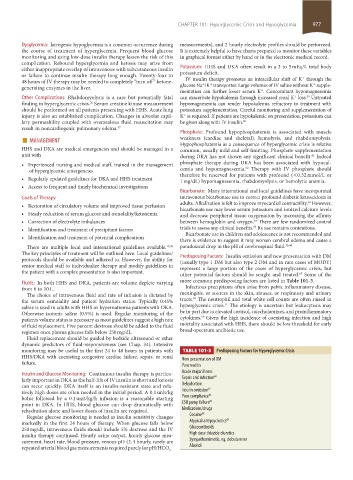
                                                                          other potential factors should be sought and treated.  Some of the
                                                                                                                  67
                    Fluids:  In both HHS and DKA, patients are volume deplete varying   more common predisposing factors are listed in Table 101-3.
                    from 6 to 10 L.                                        Infectious precipitants often arise from pelvic inflammatory disease,
                     The choice of intravenous fluid and rate of infusion is dictated by   meningitis, or sources in the skin, sinuses, or respiratory and urinary
                                                                              68
                    the serum osmolality and patient hydration status. Typically 0.45%   tracts.  The neutrophil and total white cell counts are often raised in
                                                                                         11
                    saline is used in adults with HHS or hypernatremia patients with DKA.   hyperglycemic crisis.  The etiology is uncertain but leukocytosis may
                    Otherwise isotonic saline (0.9%) is used. Regular monitoring of the   be in part due to elevated cortisol, catecholamines, and proinflammatory
                                                                                 69
                    patients volume status is necessary as most guidelines suggest a high rate   cytokines.  Given the high  incidence of coexisting infection and high
                    of fluid replacement. Five percent dextrose should be added to the fluid   mortality associated with HHS, there should be low threshold for early
                    regimen once plasma glucose falls below 250 mg/dL.    broad-spectrum antibiotic use.
                     Fluid replacement should be guided by bedside ultrasound or other
                    dynamic predictors of fluid-responsiveness (see Chap. 34). Intensive
                    monitoring may be useful in the first 24 to 48 hours in patients with     TABLE 101-3    Predisposing Factors for Hyperglycemic Crisis
                    HHS/DKA with coexisting congestive cardiac failure, sepsis, or renal   New presentation of DM
                    failure.                                              Pancreatitis
                    Insulin and Glucose Monitoring:  Continuous insulin therapy is particu-  Acute major illness  68
                    larly important in DKA as the half-life of IV insulin is short and ketosis   Sepsis and infection
                    can recur quickly. DKA itself is an insulin-resistant state and rela-  Dehydration  67
                    tively high doses are often needed in the initial period. A 0.1 unit/kg    Insulin omission
                    bolus followed by a 0.1 unit/kg/h infusion is a reasonable starting   Poor compliance 86 87
                    point  in  DKA. In  HHS,  blood  glucose  can  drop  dramatically  with   CSII pump failure
                    rehydration alone and lower doses of insulin are required.  Medications/drugs
                                                                                 88
                     Regular glucose monitoring is needed as insulin sensitivity changes   Cocaine
                    markedly in the first 24 hours of therapy. When glucose falls below   Atypical antipsychotics 89
                    250 mg/dL, intravenous fluids should include 5% dextrose and the IV   Glucocorticoids
                    insulin therapy continued. Hourly urine output, hourly glucose mea-  High dose thiazide diuretics
                    surement, heart rate, blood pressure, venous pH (2-4 hourly, rarely are   Sympathomimetic, eg, dobutamine
                    repeated arterial blood gas measurements required purely for pH/HCO     Alcohol
                                                                      −
                                                                      3


            section08.indd   977                                                                                       1/14/2015   8:28:29 AM

