


Page 1405 - Hall et al (2015) Principles of Critical Care-McGraw-Hill
P. 1405
978     PART 8: Renal and Metabolic Disorders


                   In many cases, the precipitating factor for the hyperglycemia is clear.   In spontaneous hypoglycemia, the goal is identification of the etiology
                 Despite this, chest radiograph, blood and urine cultures are almost   and treatment. Hypoglycemic disorders are rare aside from critically ill
                 always indicated following the initial clinical assessment and initiation   patients or those with an obvious drug cause.
                 of therapy. More than one etiology or a second infection as a complica-    ■
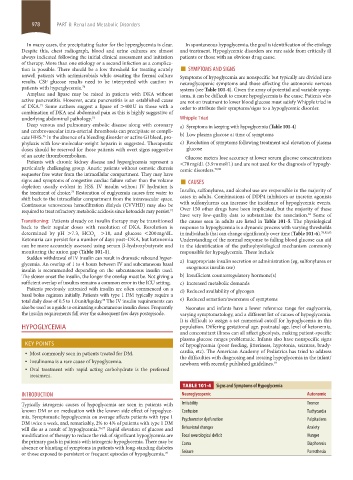
                 tion is possible. There should be a low threshold for treating acutely   SYMPTOMS AND SIGNS
                 unwell patients with antimicrobials while awaiting the formal culture   Symptoms of hypoglycemia are nonspecific but typically are divided into
                 results. CSF glucose results need to be interpreted with caution in   neuroglycopenic symptoms and those affecting the autonomic nervous
                 patients with hyperglycemia. 70                       system (see Table 101-4). Given the array of potential and variable symp-
                   Amylase and lipase may be raised in patients with DKA without   toms, it can be difficult to ensure hypoglycemia is the cause. Patients who
                 active pancreatitis. However, acute pancreatitis is an established cause   are not on treatment to lower blood glucose must satisfy Whipple triad in
                 of DKA.  Some authors suggest a lipase of  >400 U in those with a   order to attribute their symptoms/signs to a hypoglycemic disorder.
                        71
                 combination of DKA and abdominal pain as this is highly suggestive of
                 underlying abdominal pathology. 72                    Whipple Triad
                   Deep venous and pulmonary embolic disease along with coronary   a)  Symptoms in keeping with hypoglycemia (Table 101-4)
                 and cerebrovascular intra-arterial thrombosis can precipitate or compli-
                 cate HHS.  In the absence of a bleeding disorder or active GI bleed, pro-  b) Low plasma glucose at time of symptoms
                        26
                 phylaxis with low-molecular-weight heparin is suggested. Therapeutic   c)  Resolution of symptoms following treatment and elevation of plasma
                 doses should be reserved for those patients with overt signs suggestive   glucose
                 of an acute thromboembolism.                            Glucose meters lose accuracy at lower serum glucose concentrations
                   Patients with chronic kidney disease and hyperglycemia represent a   <70 mg/dL (3.9 mmol/L) and are not used for the diagnosis of hypogly-
                 particularly challenging group. Anuric patients without osmotic diuresis   cemic disorders. 79,80
                 sequester free water from the intracellular compartment. They may have
                 signs and symptoms of congestive cardiac failure rather than the volume     ■  CAUSES
                 depletion  usually  evident  in  HSS.  IV  insulin  without  IV  hydration  is
                 the treatment of choice.  Restoration of euglycemia causes free water to   Insulin, sulfonylurea, and alcohol use are responsible in the majority of
                                  73
                 shift back to the intracellular compartment from the intravascular space.   cases in adults. Combinations of DDP4 inhibitors or incretin agonists
                 Continuous venovenous hemofiltration dialysis  (CVVHD)  may also  be   with sulfonylureas can increase the incidence of hypoglycemic events.
                 required to treat refractory metabolic acidosis since ketoacids may persist. 74  Over 150 other drugs have been implicated, but the majority of these
                                                                       have very low-quality data to substantiate the association.  Some of
                                                                                                                   81
                 Transitioning:  Patients already on insulin therapy may be transitioned   the causes seen in adults are listed in Table 101-5. The physiological
                 back to their regular doses with resolution of DKA. Resolution is   response to hypoglycemia is a dynamic process with varying thresholds
                 determined by pH  >7.3, HCO   >18, and glucose  <200 mg/dL.   in individuals that can change significantly over time (Table 101-6). 78,82,83
                                          −
                                          3
                 Ketonuria can persist for a number of days post–DKA, but ketonemia   Understanding of the normal response to falling blood glucose can aid
                 can be more accurately assessed using serum β-hydroxybutyrate and   in the identification of the pathophysiological mechanism commonly
                 monitoring the anion gap (Table 101-1).               responsible for hypoglycemia. These include
                   Sudden withdrawal of IV insulin can result in dramatic rebound hyper-
                 glycemia. An overlap of 1 to 4 hours between IV and subcutaneous basal   a)  Inappropriate insulin secretion or administration (eg, sulfonylurea or
                                                                         exogenous insulin use)
                 insulin is recommended depending on the subcutaneous insulin used.
                 The slower onset the insulin, the longer the overlap must be. Not giving a   b) Insufficient counterregulatory hormone(s)
                 sufficient overlap of insulins remains a common error in the ICU setting.  c)  Increased metabolic demands
                   Patients  previously  untreated  with  insulin  are  often  commenced  on  a   d) Reduced availability of glycogen
                 basal bolus regimen initially. Patients with type 1 DM typically require a
                 total daily dose of 0.5 to 1.0 unit/kg/day.  The IV insulin requirements can   e)  Reduced sensation/awareness of symptoms
                                             75
                 also be used as a guide to estimating subcutaneous insulin doses. Frequently   Neonates and infants have a lower reference range for euglycemia,
                 the insulin requirements fall over the subsequent few days postepisode.  varying symptomatology, and a different list of causes of hypoglycemia.
                                                                       It is difficult to assign a set numerical cutoff for hypoglycemia in this
                 HYPOGLYCEMIA                                          population. Differing gestational age, postnatal age, level of ketonemia,
                                                                       and concomitant illness can all affect glycolysis, making patient-specific
                                                                       plasma glucose ranges problematic. Infants also have nonspecific signs
                  KEY POINTS                                           of hypoglycemia (poor feeding, jitteriness, hypotonia, seizures, brady-
                     • Most commonly seen in patients treated for DM.  cardia, etc). The American Academy of Pediatrics has tried to address
                                                                       the difficulties with diagnosing and treating hypoglycemia in the infant/
                     • Insulinoma is a rare cause of hypoglycemia.
                                                                       newborn with recently published guidelines. 84
                     • Oral treatment with rapid acting carbohydrate is the preferred
                    treatment.
                                                                         TABLE 101-4    Signs and Symptoms of Hypoglycemia
                 INTRODUCTION                                           Neuroglycopenic                            Autonomic
                 Typically iatrogenic causes of hypoglycemia are seen in patients with   Irritability              Tremor
                 known DM or on medication with the known side effect of hypoglyce-  Confusion                     Tachycardia
                 mia. Symptomatic hypoglycemia on average affects patients with type 1   Psychomotor dysfunction   Palpitations
                 DM twice a week, and, remarkably, 2% to 4% of patients with type 1 DM
                 will die as a result of hypoglycemia. 76,77  Rapid elevation of glucose and   Behavioral changes  Anxiety
                 modification of therapy to reduce the risk of significant hypoglycemia are   Focal neurological deficit  Hunger
                 the primary goals in patients with iatrogenic hypoglycemia. There may be   Coma                   Diaphoresis
                 absence or blunting of symptoms in patients with long-standing diabetes
                 or those exposed to persistent or frequent episodes of hypoglycemia. 78  Seizure                  Paresthesia


            section08.indd   978                                                                                       1/14/2015   8:28:29 AM

