


Page 1408 - Hall et al (2015) Principles of Critical Care-McGraw-Hill
P. 1408
CHAPTER 102: Critical Illness–Related Corticosteroid Insufficiency  981


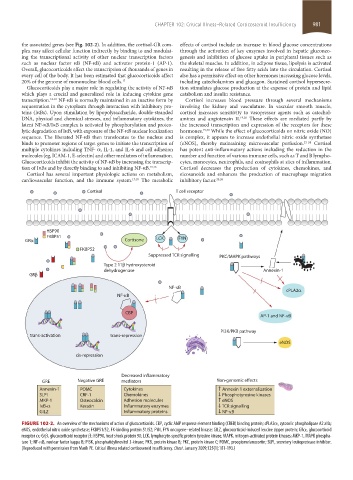
                    the associated genes (see Fig. 102-2). In addition, the cortisol-GR com-  effects of cortisol include an increase in blood glucose concentrations
                    plex may affect cellular function indirectly by binding to and modulat-  through  the activation  of key  enzymes  involved in  hepatic  gluconeo-
                    ing  the  transcriptional  activity  of  other  nuclear  transcription  factors   genesis and inhibition of glucose uptake in peripheral tissues such as
                    such as nuclear factor  κB (NF-κB) and activator protein-1 (AP-1).   the skeletal muscles. In addition, in adipose tissue, lipolysis is activated
                    Overall, glucocorticoids effect the transcription of thousands of genes in   resulting in the release of free fatty acids into the circulation. Cortisol
                    every cell of the body. It has been estimated that glucocorticoids affect   also has a permissive effect on other hormones increasing glucose levels,
                    20% of the genome of mononuclear blood cells. 13      including catecholamines and glucagon. Sustained cortisol hypersecre-
                     Glucocorticoids play a major role in regulating the activity of NF-κB   tion stimulates glucose production at the expense of protein and lipid
                    which  plays  a  crucial  and  generalized  role in inducing  cytokine  gene   catabolism and insulin resistance.
                    transcription. 14-16  NF-κB is normally maintained in an inactive form by   Cortisol increases blood pressure through several mechanisms
                    sequestration in the cytoplasm through interaction with inhibitory pro-  involving the kidney and vasculature. In vascular smooth muscle,
                    teins (IκBs). Upon stimulation by lipopolysaccharide, double-stranded   cortisol increases sensitivity to vasopressor agents such as catechol-
                    DNA, physical and chemical stresses, and inflammatory cytokines, the   amines and angiotensin II. 19,20  These effects  are mediated partly by
                    latent NF-κB/IκB complex is activated by phosphorylation and proteo-  the increased transcription and expression of the receptors for these
                    lytic degradation of IκB, with exposure of the NF-κB nuclear localization   hormones. 19,20  While the effect of glucocorticoids on nitric oxide (NO)
                    sequence. The liberated NF-κB then translocates to the nucleus and   is  complex,  it  appears  to  increase  endothelial  nitric  oxide  synthetase
                    binds to promoter regions of target genes to initiate the transcription of   (eNOS), thereby maintaining microvascular perfusion. 21-24  Cortisol
                    multiple cytokines including TNF- α, IL-1, and IL-6 and cell adhesion     has potent   anti-inflammatory actions including the reduction in the
                    molecules (eg, ICAM-1, E-selectin) and other mediators of inflammation.    number and function of various immune cells, such as T and B lympho-
                    Glucocorticoids inhibit the activity of NF-κB by increasing the transcrip-  cytes, monocytes, neutrophils, and eosinophils at sites of  inflammation.
                    tion of IκBs and by directly binding to and inhibiting NF-κB. 15,16  Cortisol decreases the production of cytokines, chemokines, and
                     Cortisol has several important physiologic actions on metabolism,   eicosanoids and  enhances the  production of  macrophage  migration
                    cardiovascular function, and the immune system. 17,18  The metabolic   inhibitory factor. 25,26

                                          Cortisol                      T cell receptor


                            HSP90
                            FKBP51
                     GR                                Cortisone  LCK    FYN
                                       FKBP52
                                                               Suppressed TCR signalling  PKC/MAPK pathways
                                                Type 2 11  hydroxysteroid
                                                dehydrogenase                                         Annexin-1
                      GR
                                                                      NF- B
                                                                                                              cPLA2
                                                    NF- B


                                                       CBP
                                                                                                     AP-1 and NF- B
                                                                                       PI3K/PKB pathway
                      trans-activation            trans-repression
                                                                                                           eNOS

                                      cis-repression


                                                      Decreased inflammatory
                           GRE         Negative GRE   mediators                       Non-genomic effects
                          Annexin-1     POMC          Cytokines                          Annexin 1 externalization
                          SLPI          CRF-1         Chemokines                         Phosphotyrosine kinases
                          MKP-1         Osteocalcin   Adhesion molecules                 eNOS
                          I B-          Keratin       Inflammatory enzymes               TCR signalling
                          GILZ                        Inflammatory proteins              NF- B
                    FIGURE 102-2.  An overview of the mechanisms of action of glucocorticoids. CBP, cyclic AMP response element binding (CREB) binding protein; cPLA2α, cytosolic phospholipase A2 alfa;
                    eNOS, endothelial nitric oxide synthetase; FKBP51/52, FK-binding protein 51/52; FYN, FYN oncogene–related kinase; GILZ, glucocorticoid-induced leucine zipper protein; GRα, glucocorticoid
                    receptor α; Grβ, glucocorticoid receptor β; HSP90, heat shock protein 90; LCK, lymphocyte-specific protein tyrosine kinase; MAPK, mitogen-activated protein kinases; MKP-1, MAPK phospha-
                    tase 1; NF-κB, nuclear factor kappa B; PI3K, phosphatidylinositol 3-kinase; PKB, protein kinase B; PKC, protein kinase C; POMC, proopiomelanocortin; SLPI, secretory leukoprotease inhibitor.
                    (Reproduced with permission from Marik PE. Critical illness related corticoseroid insufficiency. Chest. January 2009;135(1):181-193.)


            section08.indd   981                                                                                       1/14/2015   8:28:32 AM

