


Page 1406 - Hall et al (2015) Principles of Critical Care-McGraw-Hill
P. 1406
CHAPTER 101: Hyperglycemic Crisis and Hypoglycemia   979


                                                                           Further information can be derived from the response of plasma glu-
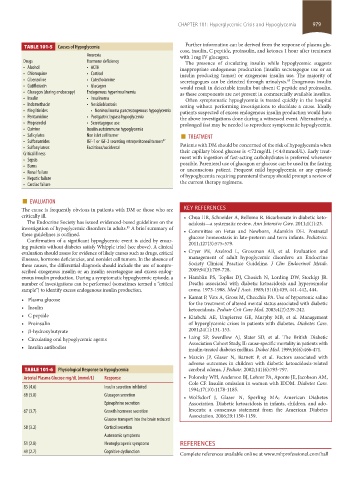
                      TABLE 101-5    Causes of Hypoglycemia
                                                                          cose, insulin, C peptide, proinsulin, and ketones 1 hour after treatment
                                          Anorexia                        with 1 mg IV glucagon.
                    Drugs                 Hormone deficiency               The presence of circulating insulin while hypoglycemic suggests
                    •  Alcohol            •  ACTH                         inappropriate endogenous production (insulin secretagogue use or an
                    •  Chloroquine        •  Cortisol                     insulin  producing  tumor)  or  exogenous  insulin  use.  The  majority  of
                    •  Cibenzoline        •  Catecholamine                secretagogues can be detected through urinalysis.  Exogenous insulin
                                                                                                              85
                    •  Gatifloxacin       •  Glucagon                     would result in detectable insulin but absent C peptide and proinsulin,
                    •  Glucagon (during endoscopy)  Endogenous hyperinsulinemia  as these components are not present in commercially available insulins.
                    •  Insulin            •  Insulinoma                    Often symptomatic hypoglycemia is treated quickly in the hospital
                    •  Indomethacin       •  Nesidioblastosis             setting without performing investigations to elucidate a cause. Ideally
                    •  Meglitinides        •  Noninsulinoma pancreatogenous hypoglycemia  patients suspected of excess endogenous insulin production would have
                    •  Pentamidine        •  Postgastric bypass hypoglycemia  the above investigations done during a witnessed event. Alternatively, a
                    •  Propranolol        •  Secretagogue use             prolonged fast may be needed to reproduce symptomatic hypoglycemia.
                    •  Quinine            Insulin autoimmune hypoglycemia
                    •  Salicylates        Non islet cell tumor                ■  TREATMENT
                    •  Sulfonamides       IGF-1 or IGF-2 secreting retroperitoneal tumors 82  Patients with DM should be concerned of the risk of hypoglycemia when
                    •  Sulfonylureas      Factitious/accidental
                    Critical illness                                      their capillary blood glucose is <72 mg/dL (<4.0 mmol/L). Early treat-
                                                                          ment with ingestion of fast-acting carbohydrates is preferred whenever
                    •  Sepsis
                    •  Burns                                              possible. Parenteral use of glucagon or glucose can be used in the fasting
                                                                          or unconscious patient. Frequent mild hypoglycemia or any episode
                    •  Renal failure
                    •  Hepatic failure                                    of hypoglycemia requiring parenteral therapy should prompt a review of
                                                                          the current therapy regimens.
                    •  Cardiac failure
                        ■  EVALUATION
                    The cause is frequently obvious in patients with DM or those who are   KEY REFERENCES
                    critically ill.                                           • Chua HR, Schneider A, Bellomo R. Bicarbonate in diabetic keto-
                     The Endocrine Society has issued evidenced-based guidelines on the   acidosis—a systematic review. Ann Intensive Care. 2011;1(1):23.
                    investigation of hypoglycemic disorders in adults.  A brief summary of     • Committee on Fetus and Newborn, Adamkin DH. Postnatal
                                                       85
                    these guidelines is outlined.                            glucose homeostasis in late-preterm and term infants. Pediatrics.
                     Confirmation of a significant hypoglycemic event is aided by ensur-  2011;127(3):575-579.
                    ing patients without diabetes satisfy Whipple triad (see above). A clinical
                    evaluation should assess for evidence of likely causes such as drugs, critical     • Cryer PE, Axelrod L, Grossman AB, et al. Evaluation and
                    illnesses, hormone deficiencies, and nonislet cell tumors. In the absence of   management of adult hypoglycemic disorders: an Endocrine
                    these causes, the differential diagnosis should include the use of nonpre-  Society Clinical  Practice  Guideline.  J  Clin  Endocrinol  Metab.
                    scribed exogenous insulin or an insulin secretagogue and excess endog-  2009;94(3):709-728.
                    enous insulin production. During a symptomatic hypoglycemic episode, a     • Hamblin PS, Topliss DJ, Chosich N, Lording DW, Stockigt JR.
                    number of investigations can be performed (sometimes termed a “critical   Deaths associated with diabetic ketoacidosis and hyperosmolar
                    sample”) to identify excess endogenous insulin production.  coma. 1973-1988. Med J Aust. 1989;151(8):439, 441-442, 444.
                      • Plasma glucose                                        • Kamat P, Vats A, Gross M, Checchia PA. Use of hypertonic saline
                                                                             for the treatment of altered mental status associated with diabetic
                      • Insulin                                              ketoacidosis. Pediatr Crit Care Med. 2003;4(2):239-242.
                      • C peptide                                             • Kitabchi AE, Umpierrez GE, Murphy MB, et al. Management
                      • Proinsulin                                           of hyperglycemic crises in patients with diabetes. Diabetes Care.
                      • β-hydroxybutyrate                                    2001;24(1):131-153.
                      • Circulating oral hypoglycemic agents                  • Laing SP, Swerdlow AJ, Slater SD, et al. The British Diabetic
                                                                             Association Cohort Study, II: cause-specific mortality in patients with
                      • Insulin antibodies                                   insulin-treated diabetes mellitus. Diabet Med. 1999;16(6):466-471.
                                                                              • Marcin  JP,  Glaser  N,  Barnett  P,  et  al.  Factors  associated  with
                                                                             adverse outcomes in children with diabetic ketoacidosis-related
                      TABLE 101-6    Physiological Response to Hypoglycemia  cerebral edema. J Pediatr. 2002;141(6):793-797.
                    Arterial Plasma Glucose mg/dL (mmol/L)  Response          • Polonsky WH, Anderson BJ, Lohrer PA, Aponte JE, Jacobson AM,
                                                                             Cole CF. Insulin omission in women with IDDM. Diabetes Care.
                    83 (4.6)                    Insulin secretion inhibited  1994;17(10):1178-1185.
                    68 (3.8)                    Glucagon secretion            • Wolfsdorf J, Glaser N, Sperling MA; American Diabetes
                                                Epinephrine secretion        Association. Diabetic ketoacidosis in infants, children, and ado-
                    67 (3.7)                    Growth hormone secretion     lescents: a consensus statement from the American Diabetes
                                                                             Association. 2006;29:1150-1159.
                                                Glucose transport into the brain reduced
                    58 (3.2)                    Cortisol secretion
                                                Autonomic symptoms
                    51 (2.8)                    Neuroglycopenic symptoms  REFERENCES
                    49 (2.7)                    Cognitive dysfunction     Complete references available online at www.mhprofessional.com/hall


            section08.indd   979                                                                                       1/14/2015   8:28:30 AM

