


Page 1407 - Hall et al (2015) Principles of Critical Care-McGraw-Hill
P. 1407
980     PART 8: Renal and Metabolic Disorders


                   CHAPTER   Critical Illness–Related                  secretion from the paraventricular nucleus of the hypothalamus of
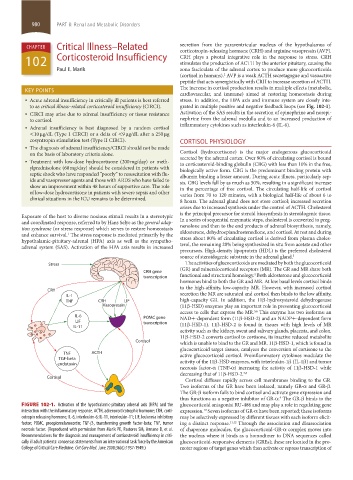
                                                                         corticotropin-releasing hormone (CRH) and arginine vasopressin (AVP).
                  102        Corticosteroid Insufficiency              CRH plays a pivotal integrative role in the response to stress. CRH
                                                                       stimulates the production of ACTH by the anterior pituitary, causing the
                             Paul E. Marik                             zona fasciculata of the adrenal cortex to produce more glucocorticoids
                                                                       (cortisol in humans).  AVP is a weak ACTH secretagogue and vasoactive
                                                                                      2
                                                                       peptide that acts synergistically with CRH to increase secretion of ACTH.
                                                                       The increase in cortisol production results in multiple effects (metabolic,
                  KEY POINTS
                                                                       cardiovascular, and immune) aimed at restoring homeostasis during
                     • Acute adrenal insufficiency in critically ill patients is best referred   stress. In addition, the HPA axis and immune system are closely inte-
                    to as critical illness–related corticosteroid insufficiency (CIRCI).  grated in multiple positive and negative feedback loops (see Fig. 102-1).
                     • CIRCI may arise due to adrenal insufficiency or tissue resistance   Activation of the SAS results in the secretion of epinephrine and norepi-
                    to cortisol.                                       nephrine from the adrenal medulla and to an increased production of
                     • Adrenal insufficiency is best diagnosed by a random cortisol   inflammatory cytokines such as interleukin-6 (IL-6).
                    <10 µg/dL (Type 1 CIRCI) or a delta of <9 µg/dL after a 250 µg
                    cosyntropin stimulation test (Type II CIRCI).      CORTISOL PHYSIOLOGY
                     • The diagnosis of adrenal insufficiency/CIRCI should not be made
                    on the basis of laboratory criteria alone.         Cortisol (hydrocortisone) is the major endogenous glucocorticoid
                                                                       secreted by the adrenal cortex. Over 90% of circulating cortisol is bound
                     • Treatment with low-dose hydrocortisone (200 mg/day) or meth-  to corticosteroid-binding globulin (CBG) with less than 10% in the free,
                    ylprednisolone (60 mg/day) should be considered in patients with   biologically active form. CBG is the predominant binding protein with
                    septic shock who have responded “poorly” to resuscitation with flu-  albumin binding a lesser amount. During acute illness, particularly sep-
                    ids and vasopressor agents and those with ARDS who have failed to   sis, CBG levels fall by as much as 50%, resulting in a significant increase
                    show an improvement within 48 hours of supportive care. The role   in the percentage of free cortisol. The circulating half-life of cortisol
                    of low-dose hydrocortisone in patients with severe sepsis and other   varies from 70 to 120 minutes, with a biological half-life of about 6 to
                    clinical situations in the ICU remains to be determined.
                                                                       8 hours. The adrenal gland does not store cortisol; increased secretion
                                                                       arises due to increased synthesis under the control of ACTH. Cholesterol
                                                                       is the principal precursor for steroid biosynthesis in steroidogenic tissue.
                 Exposure of the host to diverse noxious stimuli results in a stereotypic   In a series of sequential enzymatic steps, cholesterol is converted to preg-
                 and coordinated response, referred to by Hans Selye as the general adap-
                 tion syndrome (or stress response) which serves to restore homeostasis   nenolone and then to the end products of adrenal biosynthesis, namely,
                                                                       aldosterone, dehydroepiandrostenedione, and cortisol. At rest and during
                 and enhance survival.  The stress response is mediated primarily by the
                                 1
                 hypothalamic-pituitary-adrenal (HPA) axis as well as the sympatho-  stress about 80% of circulating cortisol is derived from plasma choles-
                                                                       terol, the remaining 20% being synthesized in situ from acetate and other
                 adrenal system (SAS). Activation of the HPA axis results in increased
                                                                       precursors. High-density lipoprotein (HDL) is the preferred cholesterol
                                                                       source of steroidogenic substrate in the adrenal gland. 3
                                                                         The activities of glucocorticoids are mediated by both the glucocorticoid
                          Stress                                       (GR) and mineralocorticoid receptors (MR). The GR and MR share both
                                                           CRH gene                             4
                                                           transcription  functional and structural homology.  Both aldosterone and glucocorticoid
                                                                       hormones bind to both the GR and MR. At low basal levels cortisol binds
                                                                       to the high-affinity, low-capacity MR. However, with increased cortisol
                          CRH                                          secretion the MR are saturated and cortisol then binds to the low affinity,
                                IL-1
                                TNF        CRH      LIF                high-capacity GR. In addition, the 11β-hydroxysteroid dehydrogenase
                                             Vasopressin               (11β-HSD) enzymes play an important role in preventing glucocorticoid
                                                                       access to cells that express the MR.  This enzyme has two isoforms: an
                                                                                                5,6
                                   IL-6                    POMC gene   NAD+-dependent form (11β-HSD-2) and an NADP+-dependent form
                                    LIF                    transcription  (11β-HSD-1). 11β-HSD-2 is found in tissues with high levels of MR
                                   IL-11
                                                                       activity such as the kidney, sweat and salivary glands, placenta, and colon.
                                                                       11β-HSD-2 converts cortisol to cortisone, its inactive reduced metabolite
                                                        Cortisol       which is unable to bind to the GR and MR. 11β-HSD-1, which is found in
                                                                       glucocorticoid target tissues, catalyzes the conversion of cortisone to the
                               TNF       ACTH                          active glucocorticoid cortisol. Proinflammatory cytokines modulate the
                              TGF-beta                                 activity of the 11β-HSD enzymes, with interleukin-1β (IL-1β) and tumor
                             endotoxin
                                                                       necrosis  factor-α  (TNF-α)  increasing  the activity  of  11β-HSD-1  while
                                                                       decreasing that of 11β-HSD-2. 7,8
                          Cortisol
                                                                         Cortisol diffuses rapidly across cell membranes binding to the GR.
                                                                       Two isoforms of the GR have been isolated, namely GR-α and GR-β.
                                                                       The GR-β isoform fails to bind cortisol and activate gene expression and
                                                                       thus functions as a negative inhibitor of GR-α.  The GR-β binds to the
                                                                                                         9
                 FIGURE 102-1.  Activation of the hypothalamic-pituitary adrenal axis (HPA) and the   glucocorticoid antagonist RU-486 and may play a role in regulating gene
                 interaction with the inflammatory response. ACTH, adrenocorticotrophic hormone; CRH, corti-  expression.  Seven isoforms of GR-α have been reported; these isoforms
                                                                               10
                 cotropin releasing hormone; IL-6, interleukin-6; IL-11, interleukin-11; LIF, leukemia inhibitory   may be selectively expressed by different tissues with each isoform elicit-
                 factor; POMC, proopiomelanocortin; TGF-β, transforming growth factor-beta; TNF, tumor   ing a distinct response. 11,12  Through the association and disassociation
                 necrosis factor. (Reproduced with permission from Marik PE, Pastores SM, Annane D, et al.   of chaperone molecules, the glucocorticoid-GR-α complex moves into
                 Recommendations for the diagnosis and management of corticosteroid insufficiency in criti-  the nucleus where it binds as a homodimer to DNA sequences called
                 cally ill adult patients: consensus statements from an international task force by the American     glucocorticoid-responsive elements (GREs); these are located in the pro-
                 College of Critical Care Medicine. Crit Care Med. June 2008;36(6):1937-1949.)  moter regions of target genes which then activate or repress transcription of


            section08.indd   980                                                                                       1/14/2015   8:28:31 AM

