


Page 1576 - Hall et al (2015) Principles of Critical Care-McGraw-Hill
P. 1576
CHAPTER 115: The Transplant Patient  1095


                    Endobronchial surfactant: The use of exogenous surfactant has been   score (between 0 and 99—based on the percent of the population that
                     shown to reduce PGD in animal models and in some preliminary   recipient’s blood would react with) is assigned. However, controversy
                     studies in humans. Further research is underway to determine if    exists surrounding how to manage the patient with an elevated PRA. In
                     surfactant has any effect on patient-relevant outcomes. 52-55  the Toronto Lung Transplant program, if a patient has a positive PRA,
                                                                          virtual donor–specific antibody test, as well as positive cross match, we
                    Acute Rejection:  The incidence of hyperacute rejection, acute rejec-  proceed with the administration of plasma exchange intraoperatively
                    tion,  and chronic  rejection has  declined  since  the improvement in   and on days 1, 2, 3, and 5 followed by administration of intravenous
                    immunosuppressive  regimens.  Hyperacute  rejection  is  currently  a   immunoglobulin  and  MMF  (in  lieu  of  azathioprine)  as  consolidation
                    rare complication due to improvements in detecting HLA antibodies.     therapy. Antithymocyte globulin follows intravenous immunoglobulin
                    Thirty  six  percent  of  patients  will  experience  at  least  one episode   in the absence of evidence of infection.
                    of rejection.  While chronic rejection could cause complications at
                             31
                    a later time in the life of a transplant recipient, it is not commonly    Bleeding:  One of the most common complications requiring a return to
                    seen in the ICU as the primary etiology for presentation; however,   the OR is postoperative bleeding. An unexplained drop in hemoglobin
                    beyond the first year of transplant, chronic rejection accounts for   even in the absence of blood loss through thoracostomy tube drain-
                    25% of deaths. 56                                     age should raise this as a consideration. Fortunately, it has not been
                    Hyperacute Rejection  Hyperacute rejection occurs when the recipient   associated with an increase in perioperative mortality. Risk factors for
                    has  preformed  antibodies  to  antigens  on  donor  tissue  (alloantigens).   postoperative hemorrhage include the presence of pleural adhesions
                    Fulminant rejection occurs within minutes of reperfusion. It manifests   in the recipient (more commonly seen in patients with cystic fibrosis,
                    as acute respiratory failure, gross pulmonary edema with airway hemor-  eosinophilic granuloma, or lymphangioleiomyomatosis) and the use of
                    rhage, and thrombosis within the graft. With improvement in screen-  cardiopulmonary bypass.
                    ing techniques for preformed antihuman leukocyte antigen antibodies   Airway Complications:  Six different airway complications of post-lung
                    before transplant and the use of plasma exchange and thymoglobulin in   transplant include bronchial dehiscence, endobronchial infections, exo-
                    a highly sensitized patient, the incidence has decreased. It is uncommon   phytic excessive granulation tissue formation, tracheobronchomalacia,
                    as it is only encountered when there is ABO incompatibility or if the   bronchial fistulas, and bronchial stenosis. Bronchial dehiscence and
                    recipient is sensitized to alloantigens from previous blood transfusions.   endobronchial infections can arise in the immediate posttransplant
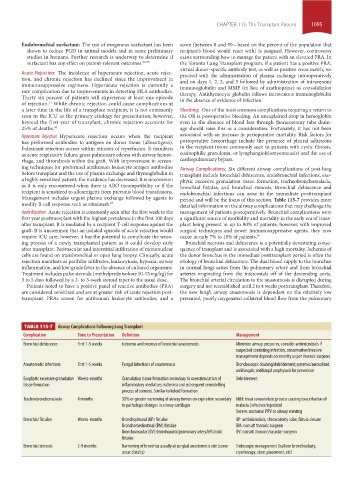
                    Management includes urgent plasma exchange followed by agents to   period and will be the focus of this section. Table 115-7 provides more
                    modify B-cell response such as rituximab. 57          detailed information on the airway complications that may challenge the
                    Acute Rejection  Acute rejection is commonly seen after the first week to the   management of patients postoperatively. Bronchial complications were
                    first year posttransplant with the highest prevalence in the first 100 days   a significant source of morbidity and mortality in the early era of trans-
                    after transplant. It is mediated by a recipient T-cell response against the   plant being present in up to 80% of patients; however, with improved
                    graft. It is uncommon that an isolated episode of acute rejection would   surgical techniques and newer immunosuppressive agents, they now
                    require ICU care; however, it has the potential to complicate the wean-  occur in only 7% to 18% of patients. 58
                    ing process of a newly transplanted patient as it could develop early   Bronchial necrosis and dehiscence is a potentially devastating conse-
                    after transplant. Perivascular and interstitial infiltration of mononuclear   quence of transplant and is associated with a high mortality. Ischemia of
                    cells are found on transbronchial or open lung biopsy. Clinically, acute   the donor bronchus in the immediate posttransplant period is often the
                    rejection manifests as perihilar infiltrates, leukocytosis, hypoxia, airway   etiology of bronchial dehiscence. The dual blood supply to the bronchus
                    inflammation, and low-grade fever in the absence of cultured organisms.   in normal lungs arises from the pulmonary artery and from bronchial
                    Treatment includes pulse steroids (methylprednisolone 10-15 mg/kg) for   arteries originating from the intercostals off of the descending aorta.
                    3 to 5 days followed by a 2- to 3-week steroid taper to the usual dose.  The bronchial arterial circulation to the anastomosis is disrupted during
                     Patients noted to have a positive panel of reactive antibodies (PRA)   surgery and not reestablished until 2 to 4 weeks posttransplant. Therefore,
                    are considered sensitized and are at greater risk of acute rejection post-  the new lung’s airway anastomosis is dependent on the relatively low
                    transplant. PRAs screen for antihuman leukocyte antibodies, and a   pressured, poorly oxygenated collateral blood flow from the pulmonary


                      TABLE 115-7    Airway Complications Following Lung Transplant
                    Complication       Time to Presentation  Definition                      Management
                    Bronchial dehiscence  First 1-5 weeks  Ischemia and necrosis of bronchial anastomosis  Minimize airway pressures, consider antimicrobials if
                                                                                             suspected coexisting infection, conservative/invasive
                                                                                             management depends on severity as per thoracic surgeon
                    Anastomotic infections  First 1-5 weeks  Fungal Infections of anastomosis  Bronchoscopic draining/debridement; systemic/aerosolized
                                                                                             antifungals; antifungal prophylaxis for prevention
                    Exophytic excessive granulation  Weeks-months  Granulation tissue formation secondary to overstimulation of   Debridement
                    tissue formation                  inflammatory mediators; ischemia and subsequent remodelling
                                                      process of stenosis. Similar to keloid formation
                    Tracheobronchomalacia  4 months   50% or greater narrowing of airway lumen on expiration secondary  Mild: treat concomitant process causing exacerbation of
                                                      to pathologic changes in airway cartilages  malacia (infection/rejection)
                                                                                             Severe: nocturnal PPV or airway stenting
                    Bronchial fistulae  Weeks-months  Bronchopleural (BP) fistulae           BP: antimicrobials, thoracotomy tube, fistula closure
                                                      Bronchomediastinal (BM) fistulae       BM: consult thoracic surgeon
                                                      Bronchovascular (BV): bronchoaortic/pulmonary artery/left atrial   BV: consult thoracic/vascular surgeon
                                                      fistulae
                    Bronchial stenosis  2-9 months    Narrowing of bronchus usually at surgical anastomotic site (some   Endoscopic management (balloon bronchoplasty,
                                                      occur distally)                        cryotherapy, stent placement, etc)


            section10.indd   1095                                                                                      1/20/2015   9:19:55 AM

