


Page 1575 - Hall et al (2015) Principles of Critical Care-McGraw-Hill
P. 1575
1094     PART 10: The Surgical Patient


                   TABLE 115-4    Postoperative Management of Lung Transplant Recipient    TABLE 115-6     Risk Factors independently Associated With Primary Graft
                  Ventilation        Lung-protective ventilation:                   Dysfunction
                                     6 cc/kg, plateau pressures <30 mm Hg  Donor Risk Factors        Recipient Risk Factors
                                     Minimization of high airway pressures  Donor age >45            Recipient BMI >25
                  Fluid              Judicious fluid administration     Head trauma                  Recipient female sex
                                     Attempt to achieve dry weight without compromising   EuroCollins preservation solution  Recipient diagnosis: primary or
                                     end-organ function                 Single lung transplant       secondary pulmonary fibrosis
                  Immunosuppressive medications Maintenance: triple drug therapy with a calcineurin   Increased ischemic time
                                     inhibitor, an antimetabolite, and a corticosteroid; avoid   a
                                     mTOR inhibitors in early posttransplant phase (risk of   Elevated recipient PAP  at time of transplant
                                     airway dehiscence)                a PAP, pulmonary artery pressure 6
                                     Induction: some centers adopted use of polyclonal   Boffini et al. 28
                                     antibodies
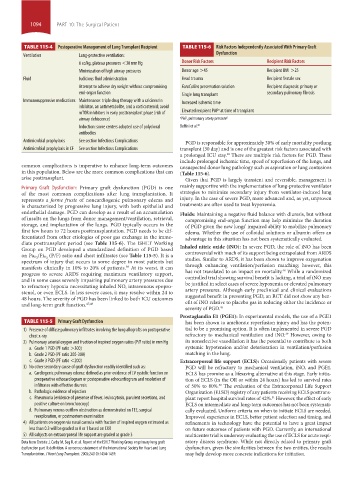
                  Antimicrobial prophylaxis  See section Infectious Complications   PGD is responsible for approximately 30% of early mortality postlung
                  Antimicrobial prophylaxis in CF  See section Infectious Complications   transplant (30 day) and is one of the greatest risk factors associated with
                                                                       a prolonged ICU stay.  There are multiple risk factors for PGD. These
                                                                                       28
                                                                       include prolonged ischemic time, speed of reperfusion of the lungs, and
                 common complications is imperative to enhance long-term outcomes   unsuspected donor lung pathology such as aspiration or lung contusions
                 in this population. Below are the more common complications that can   (Table 115-6).
                 arise posttransplant.                                   Given that PGD is largely transient and reversible, management is
                 Primary Graft Dysfunction:  Primary  graft  dysfunction  (PGD)  is  one   mainly supportive with the implementation of lung-protective ventilator
                 of the most common complications after lung transplantation. It   strategies to minimize secondary injury from ventilator-induced lung
                 represents a  forme fruste of noncardiogenic pulmonary edema and   injury. In the case of severe PGD, more advanced and, as yet, unproven
                 is characterized by progressive lung injury, with both epithelial and   treatments are often used to treat hypoxemia.
                 endothelial damage. PGD can develop as a result of an accumulation   Fluids: Maintaining a negative fluid balance with diuresis, but without
                 of insults on the lungs from donor management/ventilation, retrieval,   compromising end-organ function may help minimize the duration
                 storage, and implantation of the lungs. PGD typically occurs in the   of PGD given the new lungs’ impaired ability to mobilize pulmonary
                 first few hours to 72 hours posttransplantation. PGD needs to be dif-  edema. Whether the use of colloidal solutions or albumin offers an
                 ferentiated from other etiologies of poor gas exchange in the imme-  advantage in this situation has not been systematically evaluated.
                 diate posttransplant period (see Table 115-6). The ISHLT Working
                 Group on PGD developed a standardized definition of PGD based   Inhaled nitric oxide (iNO): In severe PGD, the role of iNO has been
                           (P/F) ratio and chest infiltrates (see Table 115-5). It is a   controversial with much of its support being extrapolated from ARDS
                 on Pa O 2 /Fi O 2                                       studies. Similar to ARDS, it has been shown to improve oxygenation
                 spectrum of injury that occurs to some degree in most patients but
                 manifests clinically in 10% to 20% of patients.  At its worst, it can   through enhancing ventilation/perfusion matching; however, this
                                                     39
                                                                                                          48
                 progress to severe ARDS requiring maximum ventilatory support,   has not translated to an impact on mortality.  While a randomized
                 and in some cases severely impairing pulmonary artery pressures due   controlled trial showing survival benefit is lacking, a trial of iNO may
                 to refractory hypoxia necessitating inhaled NO, intravenous epopro-  be justified in select cases of severe hypoxemia or elevated pulmonary
                 stenol, or even ECLS. In less severe cases, it may resolve within 24 to   artery pressures. Although early preclinical and clinical evaluations
                 48 hours. The severity of PGD has been linked to both ICU outcomes   suggested benefit in preventing PGD, an RCT did not show any ben-
                 and long-term graft function. 47,48                     efit of iNO relative to placebo gas in reducing either the incidence or
                                                                         severity of PGD. 49
                                                                       Prostaglandin E1 (PGE1): In experimental models, the use of a PGE1
                   TABLE 115-5    Primary Graft Dysfunction              has been shown to ameliorate reperfusion injury and has the poten-
                  1)   Presence of diffuse pulmonary infiltrates involving the lung allografts on postoperative   tial to be a promising option. It is often implemented in severe PGD
                                                                                                           39
                    chest x-ray                                          refractory to mechanical ventilation and iNO.  However, owing to
                  2)  Pulmonary arterial oxygen and fraction of inspired oxygen ratios (P/F ratio) in mm Hg  its nonselective vasodilation it has the potential to contribute to both
                    a.  Grade 1 PGD (PF ratio >300)                      systemic hypotension and/or deterioration in ventilation/perfusion
                    b.  Grade 2 PGD (PF ratio 200-300)                   matching in the lung.
                     c.  Grade 3 PGD (PF ratio <200)                   Extracorporeal life support (ECLS): Occasionally patients with severe
                  3)  No other secondary cause of graft dysfunction readily identified such as:  PGD will be refractory to mechanical ventilation, iNO, and PGE1.
                    a.  Cardiogenic pulmonary edema: defined as prior evidence of LV systolic function on   ECLS has promise as a lifesaving alternative at this stage. Early initia-
                      preoperative echocardiogram or postoperative echocardiogram and resolution of   tion of ECLS (in the OR or within 24 hours) has led to survival rates
                      infiltrates with effective diuresis                of 50% to 80%.  The evaluation of the Extracorporeal Life Support
                                                                                    50
                    b.  Pathologic evidence of rejection                 Organization (ELSO) registry of any patients receiving ECLS posttrans-
                     c.  Pneumonia (evidence of presence of fever, leukocytosis, purulent secretions, and   plant report hospital survival rates of 42%.  However, the effect of early
                                                                                                      51
                      positive culture on bronchoscopy)                  ECLS on intermediate and long-term outcomes has not been systemati-
                    d.  Pulmonary venous outflow obstruction as demonstrated on TEE, surgical    cally evaluated. Uniform criteria on when to initiate ECLS are needed.
                      reexploration, or postmortem examination           Improved experience in ECLS, better patient selection and timing, and
                  4)   All patients on oxygen via nasal cannula with fraction of inspired oxygen estimated as   refinements in technology have the potential to have a great impact
                    less than 0.3 will be graded as 0 or 1 based on CXR  on future outcomes of patients with PGD. Currently, an international
                  5)  All subjects on extracorporeal life support are graded as grade 3  multicenter trial is underway evaluating the use of ECLS for acute respi-
                 Data from Christie J, Carby M, Bag R, et al. Report of the ISHLT Working Group on primary lung graft   ratory distress syndrome. While not directly related to primary graft
                   dysfunction part II: definition. A consensus statement of the International Society for Heart and Lung   dysfunction, given the similarities between the two entities, the results
                 Transplantation. J Heart Lung Transplant. 2005;24(10):1454-1459.  may help develop more concrete indications for initiation.


            section10.indd   1094                                                                                      1/20/2015   9:19:55 AM

