


Page 1577 - Hall et al (2015) Principles of Critical Care-McGraw-Hill
P. 1577
1096     PART 10: The Surgical Patient


                 artery. Hypotension, compression from high airway pressures, and reper-  Infectious Complications in this chapter). Computed tomographic
                 fusion injury leading to airway edema may also compromise flow and   (CT) scanning of the chest and bronchoscopic sampling of the distal
                 can contribute to ischemia. Ultimately this can lead to an environment   airways may assist in ruling out an infectious cause. A trial of diuresis,
                 for infection, extensive necrosis and then dehiscence. Late complications   echocardiogram, or placement of a pulmonary arterial catheter may
                 of stenosis can arise as healing and remodeling takes place. Necrosis and   be required to evaluate the contribution of volume overload to the
                 dehiscence is suspected in the setting of persistent air leak, lung collapse,   opacities. The role of lung biopsy in establishing the cause of radio-
                 difficulty weaning from the ventilator, subcutaneous emphysema, pneu-  graphic worsening is controversial. Transbronchial lung biopsy may
                 momediastinum, and pneumothorax. The anastomosis must be carefully   lack sufficient sensitivity in the perioperative setting.  However, the
                                                                                                                60
                 examined with flexible bronchoscopy. In addition, dehiscence may be   utility of open lung biopsy (OLB) is variable, 61,62  and hence it should be
                 further complicated by peribronchial abscess formation; therefore, a CT   carefully considered if the etiology of the lung infiltrates remains uncer-
                 scan to rule out mediastinal air or surrounding infection/abscess should   tain. In one retrospective series of 48 open biopsies from 42 patients,
                 also be performed. Management includes minimizing high airway     32 (67%) of the biopsies confirmed the clinicians’ initial suspicions and
                 pressures, initiating appropriate antimicrobials if suspicion of secondary   prompted the initiation of “new therapy” in 30 (71%) of the patients.
                                                                                                                          61
                 infection exists and either conservative management, endobronchial   A new diagnosis  was made  following 14  of the  biopsies (29%).  Only
                 repair, or open repair depending on the severity.     two patients (4% of all OLBs) had a nondiagnostic OLB. Four biopsies
                   Endobronchial infections occur due to the impairment of regional   (8% of all OLBs), including the two nondiagnostic OLBs, did not result
                 defense mechanisms (from ischemia, decreased mucociliary clearance,   in any change in therapy. Complications of the  procedure were rare,
                 minimized cough reflex) and influenced by the ongoing use of high-  though three (7%) patients developed an air leak, which persisted more
                 dose immunosuppressant medications. This regional and systemic effect   than 7 days. In contrast, an earlier report of 38 biopsies (representing
                 on immunological integrity fosters a rich environment for bacterial   32 patients) found that early open lung biopsies (performed <45 days
                 and fungal overgrowth. Saprophytic infections are the most frequently   after transplant) were not useful, and resulted in a change in therapy for
                 seen organisms as they are airborne and maintain nourishment from   only 1 of 11 cases. 62
                   nonliving organic material in ischemic and necrotic debris. Aspergillus
                 is the most frequently seen organism. Treatment includes a combination   Long-Term Complications/Chronic Lung Allograft Dysfunction:  Chronic
                 of bronchoscopic drainage, debridement, and systemic as well as inhaled   lung allograft dysfunction (CLAD) is a long-term complication and the
                 antifungals. Antifungal prophylaxis has been advocated to minimize the   forme fruste of chronic rejection in the transplant recipient. Previously,
                 risk of fungal anastomotic infections and is used in greater than 70% of   chronic rejection was termed as bronchiolitis obliterans syndrome
                 the transplant programs within 24 hours after the procedure. 58  (BOS) which was characterized by obliterative bronchiolitis resulting
                 Arrhythmias:  Atrial fibrillation is seen in 20% of patients in the postop-  in a progressive fall in FEV  over time that was not attributed to acute
                                                                                           1
                                                                       rejection, infection of mechanical obstruction. However, in recent
                 erative period with the peak incidence at 2 to 4 days.  For most patients   years, an additional form of chronic rejection was identified char-
                                                       59
                 (93%), the arrhythmia is isolated to the postoperative period and most   acterized by fibrosis in peripheral tissues and restrictive physiology,
                 revert back to normal sinus rhythm before discharge. Risk factors for   termed restrictive allograft syndrome (RAS). Additional long-term
                 atrial fibrillation include older age, IPAH, and extremes of weight. There   complications are outlined in Table 115-9. In one series that followed
                 is considerable debate regarding the management of atrial fibrillation in   patients over  a  10-year  period  74% of  patients  had  developed BOS.
                                                                                                                          43
                 the postoperative period and no consensus has been established on the   Chronic rejection remains one of the most common causes of death
                 optimal management. Rationale for cardioversion follows the reasoning   and disability in the posttransplant period. Causes for CLAD are not
                 that patients are often refractory to rate control attempts and that the   completely understood but believed to be related to both alloimmune
                 short cardiac filling time in the immediate postoperative period leads to   and nonimmune mechanisms. Risk factors include more frequent epi-
                 further pulmonary congestion which is poorly tolerated in these patients.   sodes of acute rejection, gastroesophageal reflux, and CMV infection.
                 However, there are no clinical data to support this notion. Furthermore,   Clinically BOS patients have predominantly a progressive obstructive
                 concern about amiodarone-induced lung toxicity may restrict therapeutic   disease pattern and RAS patients have predominantly a restrictive
                 choices. Unless poorly tolerated, rate control may be safely and  effectively   lung disease pattern that could progress to end-stage lung disease and
                 pursued with β-blockers, calcium-channel blockers, or digoxin.  be exacerbated by infections prompting bouts of acute respiratory
                 New Airspace Opacities in the Perioperative Period:  Defining the etiol-  failure. Management includes the use of bronchodilators, corticoste-
                 ogy of new or progressive airspace opacities in the perioperative lung   roids, aggressive treatment of reflux, and modification of immuno-
                 transplant period is a frequent dilemma. The differential diagnosis   suppressive agents. Ventilatory management of these patients may be
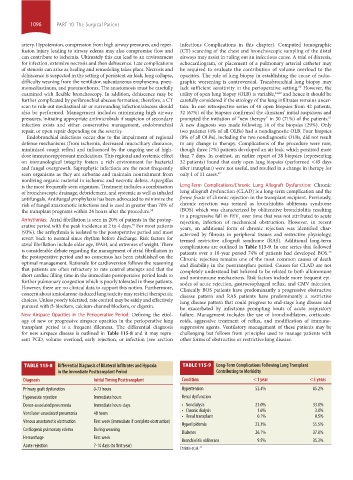
                 for new airspace disease is outlined in Table 115-8 and it may repre-  challenging but follows from principles used to manage patients with
                 sent PGD, volume overload, early rejection, or infection (see  section   other forms of obstructive or restrictive lung disease.


                   TABLE 115-8     Differential Diagnosis of Bilateral infiltrates and Hypoxia      TABLE 115-9     Long-Term Complications Following Lung Transplant
                              in the immediate Posttransplant Period                Contributing to Morbidity
                  Diagnosis               initial Timing Posttransplant  Condition              <1 year            <5 years
                  Primary graft dysfunction   0-72 hours                Hypertension             52.4%              85.2%
                  Hyperacute rejection    Immediate hours               Renal dysfunction
                  Donor-associated pneumonia  Immediate hours-days      •  Nondialysis           23.0%              33.0%
                                                                        •  Chronic dialysis       1.6%               3.0%
                  Ventilator-associated pneumonia  48 hours
                                                                        •  Renal transplant       0.1%               0.5%
                  Venous anastomotic obstruction  First week (immediate if complete obstruction)
                                                                        Hyperlipidemia           23.3%              55.5%
                  Cardiogenic pulmonary edema  During weaning
                                                                        Diabetes                 26.1%              37.0%
                  Hemorrhage              First week
                                                                        Bronchiolitis obliterans  9.5%              35.3%
                  Acute rejection         7-10 days (to first year)
                                                                       Christie et al.  31


            section10.indd   1096                                                                                      1/20/2015   9:19:55 AM

