


Page 1809 - Hall et al (2015) Principles of Critical Care-McGraw-Hill
P. 1809
1278     PART 11: Special Problems in Critical Care


                                                                       thigh) than when it is administered either subcutaneously or intra-
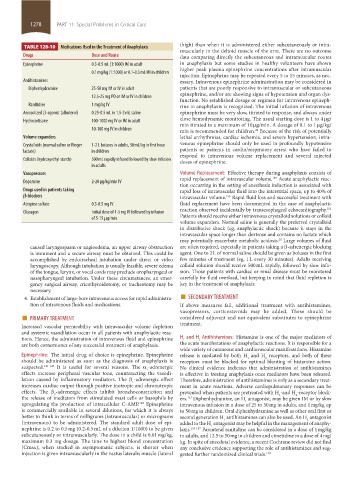
                   TABLE 128-10    Medications Used in the Treatment of Anaphylaxis
                                                                       muscularly in the deltoid muscle of the arm. There are no outcome
                  Drugs                  Dose and Route                data comparing directly the subcutaneous and intramuscular routes
                  Epinephrine            0.3-0.5 mL (1:1000) IM in adult  in anaphylaxis but some studies in healthy volunteers have shown
                                                                       higher peak  plasma  epinephrine concentrations after intramuscular
                                         0.1 mg/kg (1:1000) or 0.1-0.3 mL IM in children
                                                                       injection. Epinephrine may be repeated every 5 to 15 minutes, as nec-
                  Antihistamines                                       essary. Intravenous epinephrine administration may be considered in
                    Diphenhydramine      25-50 mg IM or IV in adult    patients that are poorly responsive to intramuscular or subcutaneous
                                                                       epinephrine, and/or are showing signs of hypotension and organ dys-
                                         12.5-25 mg PO or IM or IV in children
                                                                       function. No established dosage or regimen for intravenous epineph-
                    Ranitidine           1 mg/kg IV                    rine in anaphylaxis is recognized. The initial infusion of intravenous
                  Aerosolized β-agonist (albuterol)  0.25-0.5 mL in 1.5-2 mL saline   epinephrine must be very slow, titrated to response, and always under
                                                                       close hemodynamic monitoring. The usual starting dose is 1 to 4 µg/
                  Hydrocortisone         100-1000 mg IV or IM in adult
                                                                       min titrated to a maximum of 10 µg/min. A dosage of 0.1 to 1 µg/kg/
                                         10-100 mg IV in children      min is recommended for children.  Because of the risk of potentially
                                                                                                 20
                  Volume expanders                                     lethal arrhythmias, cardiac ischemia, and severe hypertension, intra-
                  Crystalloids (normal saline or Ringer   1-2 L boluses in adults, 30 mL/kg in first hour   venous epinephrine should only be used in profoundly hypotensive
                  lactate)               in children                   patients or patients in cardio/respiratory arrest who have failed to
                                                                       respond to intravenous volume replacement and several injected
                  Colloids (hydroxyethyl starch)  500 mL rapidly infused followed by slow infusion   doses of epinephrine.
                                         in adults
                  Vasopressors                                         Volume Replacement:  Effective therapy during anaphylaxis consists of
                                                                       rapid replacement of intravascular volume.  Acute anaphylactic reac-
                                                                                                       149
                  Dopamine               2-20 µg/kg/min IV
                                                                       tion occurring in the setting of anesthesia induction is associated with
                  Drugs used in patients taking                        rapid loss of intravascular fluid into the interstitial space, up to 40% of
                  β-blockers                                           intravascular volume.  Rapid fluid loss and successful treatment with
                                                                                       150
                  Atropine sulfate       0.3-0.5 mg IV                 fluid replacement have been documented in the case of anaphylactic
                                                                       reaction observed incidentally by transesophageal echocardiography.
                                                                                                                         151
                  Glucagon               Initial dose of 1-5 mg IV followed by infusion
                                         of 5-15 µg/min                Patients should receive either intravenous crystalloid solutions or colloid
                                                                       volume expanders. Normal saline is generally the preferred crystalloid
                                                                       in distributive shock (eg, anaphylactic shock) because it stays in the
                                                                       intravascular space longer than dextrose and contains no lactate which
                                                                       may potentially exacerbate metabolic acidosis.  Large volumes of fluid
                                                                                                         20
                    caused laryngospasm or angioedema, an upper airway obstruction   are often required, especially in patients taking a β-adrenergic blocking
                    is imminent and a secure airway must be obtained. This could be   agent. One to 2 L of normal saline should be given as boluses in the first
                    accomplished by endotracheal intubation under direct or video   few minutes of treatment (eg, 1 L every 30 minutes). Adults receiving
                    laryngoscopy. Although intubation is usually feasible, severe edema   colloid solution should receive 500 mL rapidly, followed by slow infu-
                    of the tongue, larynx, or vocal cords may preclude oropharyngeal or   sion. Those patients with cardiac or renal disease must be monitored
                    nasopharyngeal intubation. Under these circumstances, an emer-  carefully for fluid overload, but keeping in mind that fluid repletion is
                    gency surgical airway, cricothyroidotomy, or tracheotomy may be   key in the treatment of anaphylaxis.
                   4.  Establishment of large-bore intravenous access for rapid administra-  ■  SECONDARY TREATMENT
                    necessary.
                    tion of intravenous fluids and medications.        If above measures fail, additional treatment with antihistamines,
                     ■  PRIMARY TREATMENT                                vasopressors, corticosteroids may be added. These should be
                                                                       considered adjuvant and not equivalent substitutes to epinephrine
                 Increased vascular  permeability  with  intravascular  volume depletion   treatment.
                 and systemic vasodilation occur in all patients with anaphylactic reac-
                 tions. Hence, the administration of intravenous fluid and epinephrine   H  and H  Antihistamines:  Histamine is one of the major mediators of
                                                                              2
                                                                        1
                 are both cornerstones of any successful treatment of anaphylaxis.  the acute manifestations of anaphylactic reactions. It is responsible for a
                                                                       wide variety of cutaneous and cardiovascular manifestations. Histamine
                 Epinephrine:  The initial drug of choice is epinephrine. Epinephrine   release  is  mediated  by  both  H   and  H   receptors,  and  both  of  these
                                                                                                    2
                                                                                              1
                 should be administered as soon as the diagnosis of anaphylaxis is   receptors must be blocked for optimal blunting of histamine action.
                 suspected. 141-147  It is useful for several reasons. The  α -adrenergic   No clinical evidence indicates that administration of antihistamines
                                                            1
                 effects  increase  peripheral  vascular  tone,  counteracting  the  vasodi-  is effective in treating anaphylaxis once mediators have been released.
                 lation caused by inflammatory mediators. The  β -adrenergic effect   Therefore, administration of antihistamines is only as a secondary treat-
                                                       1
                 increases cardiac output through positive inotropic and chronotropic   ment in acute reactions. Adverse cardiopulmonary responses can be
                 effects. The  β -adrenergic effects inhibit bronchoconstriction and   prevented when patients are pretreated with H -and H -receptor block-
                            2
                                                                                                               2
                                                                                                         1
                 the  release  of  mediators  from  stimulated  mast  cells  or  basophils  by   ers.  Diphenhydramine, an H  antagonist, may be given IM or by slow
                                                                          152
                                                                                             1
                 upregulating the production of intracellular C-AMP.  Epinephrine   intravenous infusion in a dose of 25 to 50 mg in adults, and 1 mg/kg up
                                                         148
                 is commercially available in several dilutions, for which it is always   to 50 mg in children. Oral diphenhydramine as well as other oral first or
                 better to think in terms of milligrams (intramuscular) or micrograms   second generation H  antihistamines can also be used. An H  antagonist
                                                                                                                  2
                                                                                      1
                 (intravenous) to be administered. The standard adult dose of epi-  added to the H  antagonist may be helpful in the management of anaphy-
                                                                                  1
                 nephrine is 0.2 to 0.5 mg (0.2-0.5 mL of a dilution 1/1000) to be given   laxis. 153-157  Parenteral ranitidine can be considered in a dose of 1 mg/kg
                 subcutaneously or intramuscularly. The dose in a child is 0.01 mg/kg,    in adults, and 12.5 to 50 mg in children and cimetidine in a dose of 4 mg/
                 maximum 0.3 mg dosage. The time to highest blood concentration   kg. In spite of anecdotal evidence, a recent Cochrane review did not find
                 (Cmax), when studied in asymptomatic subjects, is shorter when   any conclusive evidence supporting the role of antihistamines and sug-
                 injection is given intramuscularly in the vastus lateralis muscle (lateral   gested further randomized clinical trials. 158
            section11.indd   1278                                                                                      1/19/2015   10:52:29 AM

