


Page 1808 - Hall et al (2015) Principles of Critical Care-McGraw-Hill
P. 1808
CHAPTER 128: Anaphylactic and Anaphylactoid Reactions  1277


                    hydroxyindoleacetic acid can be measured if one is considering flush-  by administering .01 to .05 mL of more diluted allergen intracutane-
                    ing due to the carcinoid syndrome. The measurement of various   ously using a 26- to 27-gauge needle. A test is positive if the diameter
                    gastrointestinal vasopeptides, for example, substance P, neurokinins,   of the wheal of the test allergen is ≥3 mm of the control. Skin tests may
                    vasointestinal polypeptide, pancreastatin is available as well. These   be useful when drugs are suspected. 132,133  Skin testing to latex products
                    measurements may be useful to rule out the presence of a vasoactive   may also be helpful.  Latex-specific serum IgE antibodies can also be
                                                                                        134
                    peptide secreting tumor. Octreotide assisted CT scanning is also useful   measured.
                    in this regard. Plasma-free metanephrine and urinary vanilmandelic   Allergen-specific serum IgE antibody is an alternative to the skin test.
                    acid  are  employed  if  one  is  considering  a  paradoxical  response  to  a   The serum-specific IgE assay was originally performed using a radio-
                    pheochromocytoma.                                     activity detecting procedure, and was referred to as radioallergsorbent
                                                                          (RAST) tests. The RAST has been replaced with a second generation
                    LABORATORY TESTINGS FOR TRIGGERS                      assay employing an enzyme-linked detection agent (ELISA). In general,
                    OF ANAPHYLAXIS                                        the ELISA assay is less sensitive but more specific than the intradermal
                                                                          test. 45,135,136
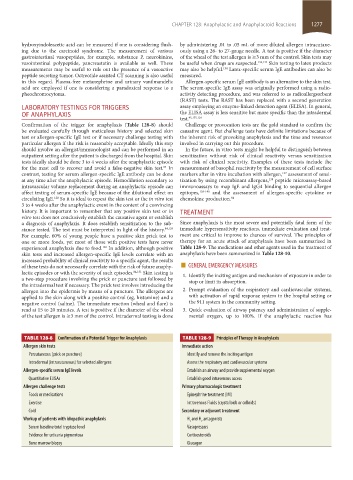
                    Confirmation of the trigger for anaphylaxis (Table  128-8) should   Challenge or provocation tests are the gold standard to confirm the
                    be evaluated carefully through meticulous history and selected skin   causative agent. But challenge tests have definite limitations because of
                    test or allergen-specific IgE test or if necessary challenge testing with   the inherent risk of provoking anaphylaxis and the time and resources
                    particular allergen if the risk is reasonably acceptable. Ideally this step   involved in carrying out this procedure.
                    should involve an allergist/immunologist and can be performed in an   In the future, in vitro tests might be helpful to distinguish between
                    outpatient setting after the patient is discharged from the hospital. Skin   sensitization  without  risk  of  clinical  reactivity  versus  sensitization
                    tests ideally should be done 3 to 4 weeks after the anaphylactic episode   with risk of clinical reactivity. Examples of these tests include the
                    for the mast cell to recover and avoid a false-negative skin test.  In   measurement of basophil reactivity by the measurement of cell surface
                                                                    84
                    contrast, testing for serum allergen-specific IgE antibody can be done   markers after in vitro incubation with allergen,  assessment of sensi-
                                                                                                            137
                    at any time after the anaphylactic episode. Hemodilution secondary to   tization by using recombinant allergens,  peptide microassay-based
                                                                                                        138
                    intravascular volume replacement during an anaphylactic episode can   immunoassays to map IgE and IgG4 binding to sequential allergen
                    affect testing of serum-specific IgE because of the dilutional effect on   epitopes, 138-140  and the assessment of allergen-specific cytokine or
                    circulating IgE.  So it is ideal to repeat the skin test or the in vitro test   chemokine production. 84
                               128
                    3 to 4 weeks after the anaphylactic event in the context of a convincing
                    history. It is important to remember that any positive skin test or in   TREATMENT
                    vitro test does not conclusively establish the causative agent or establish
                    a diagnosis of anaphylaxis. It does establish sensitization to the sub-  Since anaphylaxis is the most severe and potentially fatal form of the
                    stance tested. The test must be interpreted in light of the history. 84,129    immediate hypersensitivity reactions, immediate evaluation and treat-
                    For example, 60% of young people have a positive skin prick test to   ment are critical to improve to chances of survival. The principles of
                    one or more foods, yet most of those with positive tests have never   therapy for an acute attack of anaphylaxis have been summarized in
                    experienced anaphylaxis due to food.  In addition, although positive   Table 128-9. The medications and other agents used in the treatment of
                                               130
                    skin tests and increased allergen-specific IgE levels correlate with an   anaphylaxis have been summarized in Table 128-10.
                    of these tests do not necessarily correlate with the risk of future anaphy-  ■  GENERAL EMERGENCY MEASURES
                    increased probability of clinical reactivity to a specific agent, the results
                    lactic episodes or with the severity of such episodes. 84,131  Skin testing is     1.  Identify the inciting antigen and mechanism of exposure in order to
                    a two-step procedure involving the prick or puncture test followed by   stop or limit its absorption.
                    the intradermal test if necessary. The prick test involves introducing the
                    allergen into the epidermis by means of a puncture. The allergens are     2.  Prompt evaluation of the respiratory and cardiovascular systems,
                    applied to the skin along with a positive control (eg, histamine) and a   with activation of rapid response system in the hospital setting or
                    negative control (saline). The immediate reaction (wheal and flare) is   the 911 system in the community setting.
                    read at 15 to 20 minutes. A test is positive if the diameter of the wheal     3.  Quick evaluation of airway patency and administration of supple-
                    of the test allergen is ≥3 mm of the control. Intradermal testing is done   mental oxygen, up to 100%. If the anaphylactic reaction has


                      TABLE 128-8    Confirmation of a Potential Trigger for Anaphylaxis    TABLE 128-9    Principles of Therapy in Anaphylaxis
                    Allergen skin tests                                   Immediate action
                      Percutaneous (prick or puncture)                      Identify and remove the inciting antigen
                      Intradermal (intracutaneous) for selected allergens     Assess the respiratory and cardiovascular systems
                    Allergen-specific serum IgE levels                      Establish an airway and provide supplemental oxygen
                      Quantitative ELISAs                                   Establish good intravenous access
                    Allergen challenge tests                              Primary pharmacologic treatment
                      Foods or medications                                  Epinephrine treatment (IM)
                      Exercise                                              Intravenous Fluids (crystalloids or colloids)
                      Cold                                                Secondary or adjuvant treatment
                    Workup of patients with idiopathic anaphylaxis          H  and H  antagonists
                                                                             1   2
                      Serum baseline total tryptase level                   Vasopressors
                      Evidence for urticaria pigmentosa                     Corticosteroids
                      Bone marrow biopsy                                    Glucagon


            section11.indd   1277                                                                                      1/19/2015   10:52:29 AM

