


Page 1823 - Hall et al (2015) Principles of Critical Care-McGraw-Hill
P. 1823
1292     PART 11: Special Problems in Critical Care


                 middle and older age groups. Table 129-11 outlines the histopathology
                 and immunofluorescence findings.
                   Before the advent of corticosteroids, PV carried a high mortality
                 rate. At present, patients are typically started on doses of at least 1 to
                 2 mg/kg per day of prednisone to halt progression of the disease.
                 Azathioprine may be started concurrently at a dose of 50 to 100 mg/day.
                 The dose is calculated based on the red blood cell concentration of
                 thiopurine methyltransferase, an enzyme involved in the metabolism
                 of the thiopurine drugs. Low concentrations of this enzyme may lead
                 to  serious  side  effects,  such  as  excessive  myelosuppression,  whereas
                 high concentrations may lead to rapid metabolism of azathioprine and
                 potential underdosing.  Immunosuppressants should be initiated early
                                  71
                 in the course of the disease to allow time for their immunosuppressant
                 actions to take effect which may take up to 6 weeks. Current thera-
                 peutic regimens also include parenteral gold, dapsone, plasmapher-
                 esis, intravenous immune globulin, and other immunosuppressant
                 agents, such as cyclosporine, cyclophosphamide, and mycophenolate
                 mofetil. 72,73
                     ■  BULLOUS PEMPHIGOID

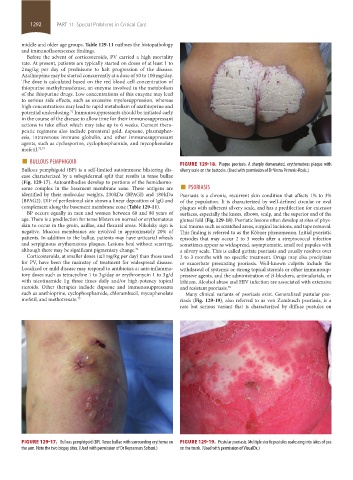
                 Bullous pemphigoid (BP) is a self-limited autoimmune blistering dis-  FIGURE 129-18.  Plaque psoriasis. A sharply demarcated, erythematous plaque with
                                                                       silvery scale on the buttocks. (Used with permission of Dr Vesna Petronic-Rosic.)
                 ease characterized by a subepidermal split that results in tense bullae
                 some  complex  in the basement membrane zone. These  antigens  are   ■  PSORIASIS
                 (Fig. 129-17). Autoantibodies develop to portions of the hemidesmo-
                 identified  by  their  molecular  weights,  230 kDa  (BPAGI)  and 180 kDa   Psoriasis is a chronic, recurrent skin condition that affects 1% to 3%
                 (BPAG2). DIF of perilesional skin shows a linear deposition of IgG and   of the population. It is characterized by well-defined circular or oval
                 complement along the basement membrane zone (Table 129-11).  plaques with adherent silvery scale, and has a predilection for extensor
                   BP occurs equally in men and women between 60 and 80 years of   surfaces, especially the knees, elbows, scalp, and the superior end of the
                 age. There is a predilection for tense blisters on normal or erythematous   gluteal fold (Fig. 129-18). Psoriatic lesions often develop at sites of phys-
                 skin to occur in the groin, axillae, and flexural areas. Nikolsky sign is   ical trauma such as scratched areas, surgical incisions, and tape removal.
                 negative. Mucous membranes are involved in approximately 20% of   This finding is referred to as the Köbner phenomenon. Initial psoriatic
                 patients. In addition to the bullae, patients may have urticarial wheals   episodes that may occur 2 to 3 weeks after a streptococcal infection
                 and serpiginous erythematous plaques. Lesions heal without scarring,   sometimes appear as widespread, asymptomatic, small red papules with
                 although there may be significant pigmentary change. 74  a silvery scale. This is called guttate psoriasis and usually resolves over
                   Corticosteroids, at smaller doses (≤1 mg/kg per day) than those used   2 to 3 months with no specific treatment. Drugs may also precipitate
                 for PV, have been the mainstay of treatment for widespread disease.   or exacerbate preexisting psoriasis. Well-known culprits include the
                 Localized or mild disease may respond to antibiotics at anti-inflamma-  withdrawal of systemic or strong topical steroids or other immunosup-
                 tory doses such as tetracycline 1 to 3 g/day or erythromycin 1 to 3 g/d   pressive agents, and the administration of β-blockers, antimalarials, or
                 with nicotinamide 1 g three times daily and/or high-potency topical   lithium. Alcohol abuse and HIV infection are associated with extensive
                 steroids. Other therapies include dapsone and immunosuppressants   and resistant psoriasis. 76
                 such as azathioprine, cyclophosphamide, chlorambucil, mycophenolate   Many  clinical  variants  of psoriasis  exist.  Generalized  pustular  pso-
                 mofetil, and methotrexate. 75                         riasis (Fig.  129-19), also referred to as von Zumbusch psoriasis, is a
                                                                       rare but serious variant that is characterized by diffuse pustules on


                 FIGURE 129-17.  Bullous pemphigoid (BP). Tense bullae with surrounding erythema on   FIGURE 129-19.  Pustular psoriasis. Multiple sterile pustules coalescing into lakes of pus
                 the arm. Note the two biopsy sites. (Used with permission of Dr Keyoumars Soltani.)  on the trunk. (Used with permission of VisualDx.)


            section11.indd   1292                                                                                      1/19/2015   10:54:12 AM

