


Page 1825 - Hall et al (2015) Principles of Critical Care-McGraw-Hill
P. 1825
1294     PART 11: Special Problems in Critical Care

                     ■  PURPURA                                        purpura, because these patients are unable to mount the appropriate

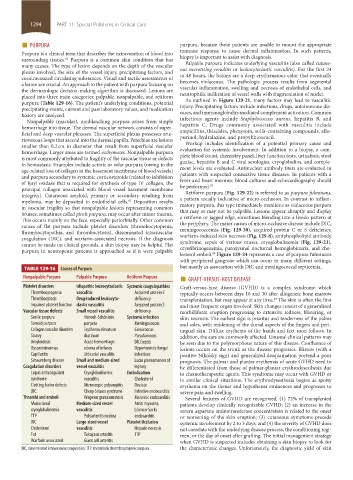
                 Purpura is a clinical term that describes the extravasation of blood into   immune response to cause dermal inflammation. In such patients,
                                                                       biopsy is important to assist with diagnosis.
                 surrounding  tissues.  Purpura is a common skin condition that has
                                81
                                                                         Palpable purpura indicates underlying vasculitis (also called cutane-
                 many causes. The type of lesion depends on the depth of the vascular   ous necrotizing venulitis  or leukocytoclastic vasculitis).  For  the  first  24
                 plexus involved, the size of the vessel injury, precipitating factors, and
                 coextravasated circulating substances. Visual and tactile assessments of   to 48 hours, the lesions are a deep erythematous color that eventually
                                                                       becomes violaceous. The pathologic process results from segmental
                 a lesion are crucial. An approach to the patient with purpura focusing on
                 the dermatologic decision-making algorithm is discussed. Lesions are   vascular inflammation, swelling and necrosis of endothelial cells, and
                                                                       neutrophilic infiltration of vessel walls with fragmentation of nuclei.
                 placed into three main categories: palpable, nonpalpable, and retiform
                                                                         As outlined in  Figure 129-21, many factors may lead to vasculitic
                 purpura (Table 129-16). The patient’s underlying conditions, potential   injury. Precipitating factors include infections, drugs, autoimmune dis-
                 precipitating events, current and past laboratory values, and medication
                 history are analyzed.                                 eases, and immunoglobulin-mediated complement activation. Common
                                                                       infectious agents include  Staphylococcus aureus, hepatitis B, and
                   Nonpalpable  (macular),  nonblanching  purpura  arises  from  simple
                 hemorrhage into tissue. The dermal vascular network consists of super-  hepatitis C. Drugs commonly associated with vasculitis include
                                                                       ampicillins, thiazides, phenytoin, sulfa-containing compounds, allo-
                 ficial and deep vascular plexuses. The superficial plexus possesses arte-
                 riovenous loops that ascend into the dermal papilla. Petechiae are lesions   purinol, hydralazine, and propylthiouracil.
                                                                         Workup  includes  identification  of  a potential  primary  cause  and
                 smaller than 0.2 cm in diameter that result from superficial vascular
                 hemorrhage. Larger areas are termed ecchymoses. Nonpalpable purpura   evaluation for systemic involvement. In addition to a biopsy, a com-
                                                                       plete blood count, chemistry panel, liver function tests, urinalysis, stool
                 is most commonly attributed to fragility of the vascular tissue or defects
                 in hemostasis. Examples include actinic or solar purpura (owing to the   guaiac, hepatitis B and C viral serologies, cryoglobulins, and comple-
                                                                       ment levels are evaluated. Antinuclear antibody titers are evaluated in
                 age-related loss of collagen in the basement membrane of blood vessels)
                 and purpura secondary to systemic corticosteroids (related to inhibition   patients with suspected connective tissue diseases. In patients with a
                                                                       fever and heart murmur, blood cultures and echocardiography should
                 of lysyl oxidase that is required for synthesis of type IV collagen, the   83
                 principal collagen associated with blood vessel basement membrane   be performed.
                                                                         Retiform purpura (Fig. 129-22) is referred to as purpura fulminans,
                 integrity). Cutaneous amyloid, primary or secondary resulting from
                 myeloma, may be deposited in endothelial cells.  Deposition results   a pattern usually indicative of micro-occlusion. In contrast to inflam-
                                                      82
                                                                       matory purpura, this type immediately manifests as violaceous purpura
                 in vascular fragility so that nonpalpable lesions representing common
                 bruises, sometimes called pinch purpura, may occur after minor trauma.   that may or may not be palpable. Lesions appear abruptly and display
                                                                       a retiform or jagged edge, sometimes blending into a livedo pattern at
                 This occurs mainly on the face, especially periorbitally. Other common
                 causes of flat purpura include platelet disorders (thrombocytopenia,   the periphery. The major causes of micro-occlusive disease include DIC,
                                                                       meningococcemia (Fig. 129-30), acquired protein C or  S deficiency,
                 thrombocytopathia, and thrombocytosis), disseminated intravascular
                 coagulation (DIC), and warfarin-associated necrosis. If the diagnosis   warfarin-induced skin necrosis (Fig. 129-8), antiphospholipid antibody
                                                                       syndrome, sepsis of various causes, cryoglobulinemia (Fig. 129-23),
                 cannot be made on clinical grounds, a skin biopsy may be helpful. Flat
                 purpura in neutropenic patients is approached as if it were palpable   cryofibrinogenemia, paroxysmal nocturnal hemoglobinuria, and cho-
                                                                       lesterol emboli.  Figure 129-24 represents a case of purpura fulminans
                                                                                  84
                                                                       with peripheral gangrene which can occur in many different settings,
                   TABLE 129-16    Causes of Purpura                   but mostly in association with DIC and meningococcal septicemia.
                  Nonpalpable Purpura  Palpable Purpura  Retiform Purpura    ■  GRAFT-VERSUS-HOST DISEASE
                  Platelet disorders  Idiopathic leukocytoclastic  Systemic coagulopathies  Graft-versus-host disease (GVHD) is a complex syndrome which
                    Thrombocytopenia  vasculitis        Acquired protein C   typically occurs between days 10 and 30 after allogeneic bone marrow
                    Thrombocytosis  Drug-induced leukocyto-  deficiency  transplantation, but may appear at any time.  The skin is often the first
                                                                                                       85
                    Impaired platelet function clastic vasculitis  Acquired protein S    and most frequent organ involved. Skin changes consist of a generalized
                  Vascular tissue defects  Small vessel vasculitis  deficiency  morbilliform eruption progressing to extensive redness, blistering, or
                    Senile purpura     Henoch-Schönlein   Systemic infection  skin necrosis. The earliest sign is pruritus and tenderness of the palms
                    Steroid purpura    purpura          Meningococcus  and soles, with reddening of the dorsal aspects of the fingers and peri-
                    Collagen vascular disorders  Erythema elevatum   Gonococcus  ungual skin. Diffuse erythema of the hands and feet soon follows. In
                    Scurvy             diutinum         Pseudomonas    addition, the ears are commonly affected. Unusual clinical patterns may
                    Amyloidosis        Acute hemorrhagic   DIC/sepsis  be seen due to the polymorphous nature of this disease. Confluence of
                    Dysproteinemias    edema of infancy  Opportunistic fungal   lesions occurs on the trunk as the disease progresses. Blisters (with a
                    Capillaritis       Urticarial vasculitis  infections  positive Nikolsky sign) and generalized desquamation portend a poor
                    Schaumberg disease  Small and medium-sized   Lucio phenomenon of   prognosis. The palmar and plantar erythemas of acute GVHD need to
                  Coagulation disorders  vessel vasculitis  leprosy    be differentiated from those of palmar-plantar erythrodysesthesia due
                    Lupus anticoagulant   Cryoglobulinemic    Embolization  to chemotherapeutic agents. This syndrome may occur with GVHD or
                    syndrome           vasculitis       Cholesterol    in similar clinical situations. The erythrodysesthesia begins as spotty
                    Clotting factor defects  Microscopic polyangiitis  Oxalate  erythema on the thenar and hypothenar eminences and progresses to
                    DIC                Churg-Strauss syndrome  Infective endocarditis  severe pain and swelling.
                  Thrombi and emboli   Wegener granulomatosis  Marantic endocarditis   Several features  of  GVHD  are  recognized: (1)  72%  of transplanted
                    Monoclonal      Medium-sized vessel   Atrial myxoma  patients develop clinically recognizable GVHD; (2) an increase in the
                    cryoglobulinemia  vasculitis        Libman-Sacks    serum aspartate aminotransferase concentration is related to the onset
                    TTP                Polyarteritis nodosa  endocarditis  or  worsening  of  the  skin  eruption;  (3)  cutaneous  symptoms  precede
                    DIC             Large-sized vessel    Platelet Occlusion  systemic involvement by 2 to 3 days; and (4) the severity of GVHD does
                    Cholesterol     vasculitis          Heparin necrosis  not correlate with the underlying disease process, the conditioning regi-
                    Fat                Takayasu arteritis  TTP         men, or the day of onset after grafting. The initial management strategy
                    Warfarin associated  Giant cell arteritis          when GVHD is suspected includes obtaining a skin biopsy to look for
                 DIC, disseminated intravascular coagulation; TTP, thrombotic thrombocytopenic purpura.  the characteristic changes. Unfortunately, the diagnostic yield of skin


            section11.indd   1294                                                                                      1/19/2015   10:54:16 AM

