


Page 1828 - Hall et al (2015) Principles of Critical Care-McGraw-Hill
P. 1828
CHAPTER 129: Dermatologic Conditions  1297


                                                                          strawberry tongue.  The rash desquamates 7 to 14 days after the onset
                                                                                       96
                                                                          of the illness.  Complications from TSS, such as renal failure and ARDS,
                                                                                   97
                                                                          are related to the severity of hypotension.
                                                                           The diagnostic criteria for streptococcal and staphylococcal TSS are
                                                                          presented in Table 129-17. 98,99  Streptococcal TSS is mediated by one or
                                                                          more of the streptococcal pyrogenic exotoxins (types A, B, or C). Type A
                                                                          exotoxin has the most potent inflammatory and cytotoxic properties and
                                                                          is most closely associated with TSS.  Staphylococcal TSS is caused by S
                                                                                                   100
                                                                          aureus strains that produce one or more exotoxins, such as TSS toxin 1.
                                                                          These toxins may act as superantigens by stimulating the production of
                                                                          TNF and IL-1, which lead to capillary leak and shock. 101
                                                                           Treatment of TSS consists of supportive care including fluids, vaso-
                                                                          pressors, and antibiotics. Aggressive fluid repletion is necessary to
                                                                          maintain intravascular volume in the setting of diffuse capillary leak and
                                                                          shock. Adequate antimicrobial coverage for S aureus and Streptococcus
                                                                          should be initiated, with additional consideration for clindamycin which
                                                                          can inhibit further toxin production.  Treatment with IVIG or plasma-
                                                                                                    102
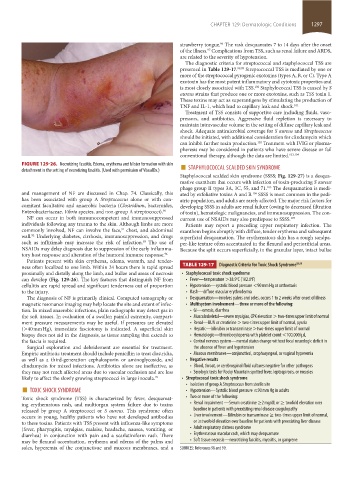
                                                                          pheresis may be considered in patients who have severe disease or fail
                                                                          conventional therapy, although the data are limited. 103,104
                    FIGURE 129-26.  Necrotizing fasciitis. Edema, erythema and blister formation with skin     ■  STAPHYLOCOCCAL SCALDED SKIN SYNDROME
                    detachment in the setting of necrotizing fasciitis. (Used with permission of VisualDx.)
                                                                          Staphylococcal scalded skin syndrome (SSSS; Fig. 129-27) is a desqua-
                                                                          mative exanthem that occurs with infection of toxin-producing S aureus
                                                                          phage group II types 3A, 3C, 55, and 71.  The desquamation is medi-
                                                                                                       105
                    and management of NF are discussed in Chap. 74. Classically, this   ated by exfoliative toxins A and B.  SSSS is most common in the pedi-
                                                                                                  106
                    has been associated  with group A  Streptococcus alone or with con-  atric population, and adults are rarely affected. The major risk factors for
                    comitant facultative and anaerobic bacteria (Clostridium, bacteroides,   developing SSSS in adults are renal failure (owing to decreased filtration
                    Enterobacteriaceae, Vibrio species, and non-group A streptococci). 90  of toxin), hematologic malignancies, and immunosuppression. The con-
                     NF can occur in both immunocompetent and immunosuppressed   current use of NSAIDs may also predispose to SSSS. 107
                    individuals following any trauma to the skin. Although limbs are more   Patients may report a preceding upper respiratory infection. The
                    commonly involved, NF can involve the face,  chest, and abdominal   exanthem begins abruptly with diffuse, tender erythema and subsequent
                                                      91
                    wall.  Underlying diabetes,  cirrhosis,  immunosuppression, and drugs   superficial desquamation. The erythematous skin has a rough sandpa-
                       92
                    such as infliximab may increase the risk of infection.  The use of   per-like texture often accentuated in the flexural and periorificial areas.
                                                             93
                    NSAIDs may delay diagnosis due to suppression of the early inflamma-  Because the split occurs superficially, in the granular layer, intact bullae
                    tory host response and alteration of the humoral immune response. 94
                     Patients  present  with  skin  erythema,  edema,  warmth,  and  tender-
                    ness often localized to one limb. Within 24 hours there is rapid spread     TABLE 129-17    Diagnostic Criteria for Toxic Shock Syndrome 98,99
                    proximally and distally along the limb, and bullae and areas of necrosis   •  Staphylococcal toxic shock syndrome
                    can develop (Fig. 129-26). The key features that distinguish NF from   •  Fever—temperature >38.9 C (102.0 F)
                                                                                             o
                                                                                                  o
                    cellulitis are rapid spread and significant tenderness out of proportion   •  Hypotension—systolic blood pressure <90 mm Hg or orthostasis
                    to the injury.                                          •  Rash—diffuse macular erythroderma
                     The diagnosis of NF is primarily clinical. Computed tomography or   •  Desquamation—involves palms and soles, occurs 1 to 2 weeks after onset of illness
                    magnetic resonance imaging may help locate the site and extent of infec-  •  Multisystem involvement—three or more of the following:
                    tion. In mixed anaerobic infections, plain radiographs may detect gas in   •  GI—emesis, diarrhea
                    the soft tissues. In evaluation of a swollen painful extremity, compart-  •  Musculoskeletal—severe myalgias, CPK elevation > two-times upper limit of normal
                    ment pressure measurements may be useful. If pressures are elevated   •  Renal—BUN or creatinine > two-times upper limit of normal, pyuria
                    (>40 mm Hg), immediate fasciotomy is indicated. A superficial skin   •  Hepatic—bilirubin or transaminase >two-times upper limit of normal
                    biopsy does not aid in the diagnosis, as tissue sampling that extends to   •  Hematologic—thrombocytopenia with platelet count <100,000/µL
                    the fascia is required.                                  •   Central nervous system—mental status change without focal neurologic deficit in
                     Surgical exploration and debridement are essential for treatment.   the absence of fever and hypotension
                    Empiric antibiotic treatment should include penicillin to treat clostridia,   •  Mucous membranes—conjunctival, oropharyngeal, or vaginal hyperemia
                    as well as a third-generation cephalosporin or aminoglycoside, and   •  Negative results
                    clindamycin for mixed infections. Antibiotics alone are ineffective, as   •   Blood, throat, or cerebrospinal fluid cultures negative for other pathogens
                    they may not reach affected areas due to vascular occlusion and are less   •  Serologic tests for Rocky Mountain spotted fever, leptospirosis, or measles
                    likely to affect the slowly growing streptococci in large inocula. 95  •  Streptococcal toxic shock syndrome
                        ■  TOXIC SHOCK SYNDROME                             •  Isolation of group A Streptococcus from sterile site
                                                                            •  Hypotension—Systolic blood pressure ≤90 mm Hg in adults
                    Toxic shock syndrome (TSS) is characterized by fever, desquamat-  •  Two or more of the following:
                    ing erythematous rash, and multiorgan system failure due to toxins   •   Renal impairment —Serum creatinine ≥2 mg/dL or ≥ twofold elevation over
                    released by group A streptococci or  S aureus. This syndrome often   baseline in patients with preexisting renal disease coagulopathy
                    occurs in young, healthy patients who have not developed antibodies   •   Liver involvement—Bilirubin or transaminase ≥ two-times upper limit of normal,
                    to these toxins. Patients with TSS present with influenza-like symptoms   or ≥twofold elevation over baseline for patients with preexisting liver disease
                    (fever, pharyngitis, myalgias, malaise, headache, nausea, vomiting, or   •  Adult respiratory distress syndrome
                    diarrhea) in conjunction with pain and a scarlatiniform rash. There   •  Erythematous macular rash, which may desquamate
                    may be flexural accentuation, erythema and edema of the palms and   •  Soft tissue necrosis—necrotizing fasciitis, myositis, or gangrene
                    soles, hyperemia of the conjunctivae and mucous membranes, and a   SOURCES: References 98 and 99.


            section11.indd   1297                                                                                      1/19/2015   10:55:12 AM

