


Page 1824 - Hall et al (2015) Principles of Critical Care-McGraw-Hill
P. 1824
CHAPTER 129: Dermatologic Conditions  1293


                    erythematous plaques,  which may coalesce  to form  “lakes  of pus.”   often accompanied by fever, chills, and lymphadenopathy, follow.
                    Nails,  palms,  and  soles  are  often  affected.  Fever,  hypocalcemia,  and    The percutaneous absorption barrier is lost and blood flow to the
                    leukocytosis may accompany the outbreak. Precipitating factors include   skin increases, which may lead to serious complications such as
                    drugs, infection, pregnancy, exertion, and menstruation. The differential   hypoalbuminemia, peripheral edema, loss of muscle mass, and
                    diagnosis in a patient with diffuse pustules and fever includes infection,   high-output cardiac failure, with as much as 8% of the total cardiac
                    drug reaction, acute generalized exanthematous pustulosis, pustular   output being directed at the inflamed cutaneous vasculature. Causes
                    psoriasis, and subcorneal pustular dermatosis. 77,78  of exfoliative dermatitis include inflammatory conditions, drug
                     Psoriasis may be treated initially with a variety of topical medications,   eruptions, cutaneous T-cell lymphoma, and systemic  neoplasms
                    either as monotherapy or in combination. These include corticosteroids,   (Table  129-15). Common inflammatory conditions include psoria-
                    calcipotriene, tar, anthralin, and topical retinoids. Systemic drugs are   sis, atopic dermatitis, contact dermatitis, and pityriasis rubra pila-
                    reserved for extensive or disabling disease and include methotrexate,   ris.  Antiepileptic  medications (carbamazepine,  phenobarbital, or
                    cyclosporine, and oral retinoids. Ultraviolet (UV) light therapy, which   phenytoin), antihypertensive medications (captopril or chlorothia-
                    has been a mainstay of treatment for years, is often used in combination   zide), antibiotics (cephalosporins, dapsone, isoniazid, or mino-
                    with topical or systemic agents. This includes natural sunshine, broad-  cycline),  and  calcium  channel blockers have been associated with
                    band UVB (280-20 nm), UVA (320-400 nm), and a single-wavelength   exfoliative erythroderma.  Lymphomas and hematologic malignancies
                                                                                            80
                    light narrowband UVB (311 nm). Psoralen, a photosensitizer, is used   are common systemic neoplasms that may cause erythroderma. Sézary
                    to potentiate the UVA effects in a regimen called PUVA. Acitretin, a    syndrome is the leukemic form of cutaneous T-cell lymphoma, which is
                    systemic retinoid, may be used alone or in combination with photo-  characterized by circulating atypical lymphocytes with hyperconvoluted
                    therapy. Biologic therapy that targets specific cytokines and intercellular   nuclei (Sézary cells). These atypical cells are identified on blood smear or
                    adhesion  molecules  has  recently  been  introduced.  Biologics  include   in skin biopsies. Internal malignancies occasionally cause erythroderma.
                    TNF-α inhibitors (etanercept, adalimumab, infliximab) and T-cell   The  erythrodermic  patient  should  be  monitored  with  specific
                    modulators (alefacept, efalizumab). Acitretin, narrowband UVB, PUVA,   attention to fluid and electrolyte balance, temperature regulation, and
                    methotrexate, and cyclosporine have been used effectively in the treat-  nutritional status. Skin biopsy may help identify the underlying cause of
                    ment of generalized pustular psoriasis. 79            the dermatosis and thus direct specific treatment. Initial management
                        ■  ERYTHRODERMA                                   includes the use of medium potency topical steroid ointments covered
                                                                          with a bland ointment, such as zinc oxide ointment and wrapped with
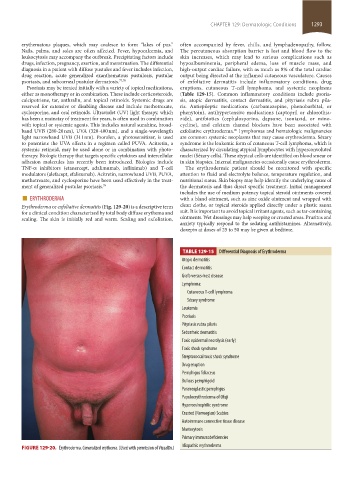
                    Erythroderma or exfoliative dermatitis (Fig. 129-20) is a descriptive term   clean cloths, or topical steroids applied directly under a plastic sauna
                    for a clinical condition characterized by total body diffuse erythema and   suit. It is important to avoid topical irritant agents, such as tar-containing
                    scaling. The skin is initially red and warm. Scaling and  exfoliation,   ointments. Wet dressings may help weeping or crusted areas. Pruritus and
                                                                          anxiety typically respond to the sedating antihistamines.  Alternatively,
                                                                          doxepin at doses of 25 to 50 may be given at bedtime.


                                                                            TABLE 129-15    Differential Diagnosis of Erythroderma
                                                                          Atopic dermatitis
                                                                          Contact dermatitis
                                                                          Graft-versus-host disease
                                                                          Lymphoma:
                                                                            Cutaneous T-cell lymphoma
                                                                            Sézary syndrome
                                                                          Leukemia
                                                                          Psoriasis
                                                                          Pityriasis rubra pilaris
                                                                          Seborrheic dermatitis
                                                                          Toxic epidermal necrolysis (early)
                                                                          Toxic shock syndrome
                                                                          Streptococcal toxic shock syndrome
                                                                          Drug eruption
                                                                          Pemphigus foliaceus
                                                                          Bullous pemphigoid
                                                                          Paraneoplastic pemphigus
                                                                          Papuloerythroderma of Ofuji
                                                                          Hypereosinophilic syndrome
                                                                          Crusted (Norwegian) Scabies
                                                                          Autoimmune connective tissue disease
                                                                          Mastocytosis
                                                                          Primary immunodeficiencies
                    FIGURE 129-20.  Erythroderma. Generalized erythema. (Used with permission of VisualDx.)  Idiopathic erythroderma


            section11.indd   1293                                                                                      1/19/2015   10:54:16 AM

