


Page 617 - Clinical Hematology_ Theory _ Procedures ( PDFDrive )
P. 617
CHAPTER 29  ■  Body Fluid Analysis                        601


                   o  demonstrating pericardial e  usion and are less subject to                                               ( microhematocrit),  however,  can  be  valuable  in  distin-

                   the limitations o  echocardiography in localized  e  usions.                                                guishing a hemorrhagic e  usion  rom aspirated blood in a

                   Pericardial  disease  causes  e  usions  that  are  le    sided  or                                         specimen. T e quantity o  erythrocytes is usually lower in a

                    bilateral; they are rarely exclusively right sided. Patients with                                          hemorrhagic e  usion than in a simultaneously assayed cir-

                   congestive  heart   ailure  typically  mani est  right-sided  or                                            culating blood specimen. In contrast, aspirated blood, i  su -

                   bilateral e  usions.                                                                                          cient in quantity, will exhibit an erythrocyte volume that is

                                                                                                                               comparable to that in the circulating blood.
                   Causes of Pericardial Effusion                                                                                   Pericardial f uid is relatively acellular. An increase (more


                   A wide variety o  diseases and disorders can produce peri-                                                  than  1  ×  10 /L)  is  suggestive  o   microbial  in ection  or
                                                                                                                                                      9
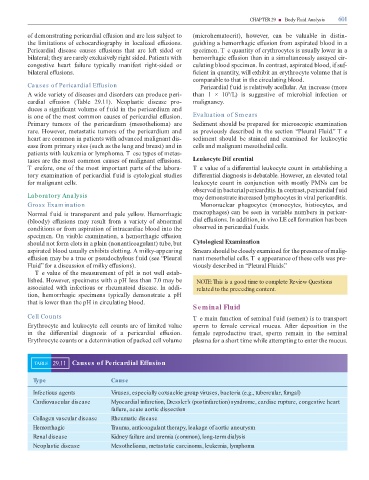
                   cardial  e  usion  (  able  29.11).  Neoplastic  disease  pro-                                              malignancy.

                   duces a signi  cant volume o  f uid in the pericardium and

                   is one o  the most common causes o  pericardial e  usion.                                                   Evaluation of Sm ears

                   Primary  tumors  o   the  pericardium  (mesothelioma)  are                                                  Sediment should be prepared  or microscopic examination

                   rare. However, metastatic tumors  o  the pericardium  and                                                   as previously described in the section “Pleural Fluid.” T e

                   heart are common in patients with advanced malignant dis-                                                   sediment  should  be  stained  and  examined   or  leukocytic

                   ease  rom primary sites (such as the lung and breast) and in                                                cells and malignant mesothelial cells.

                   patients with leukemia or lymphoma. T ese types o  metas-

                   tases are the most common causes o  malignant e  usions.                                                    Leukocyte Dif erential

                   T ere ore, one o  the most important parts o  the labora-                                                   Te value o  a di  erential leukocyte count in establishing a

                   tory examination o  pericardial f uid is cytological studies                                                di  erential diagnosis is debatable. However, an elevated total

                    or malignant cells.                                                                                        leukocyte count in conjunction with mostly PMNs can be

                                                                                                                               observed in bacterial pericarditis. In contrast, pericardial f uid
                   Laboratory Analysis                                                                                         may demonstrate increased lymphocytes in viral pericarditis.


                   Gross Exam ination                                                                                               Mononuclear  phagocytes  (monocytes,  histiocytes,  and


                   Normal f uid is transparent and pale yellow. Hemorrhagic                                                    macrophages) can be seen in variable numbers in pericar-

                   (bloody)  e  usions  may  result   rom  a  variety  o   abnormal                                            dial e  usions. In addition, in vivo LE cell  ormation has been

                   conditions or  rom aspiration o  intracardiac blood into the                                                observed in pericardial f uids.

                   specimen. On visible examination, a hemorrhagic e  usion

                   should not  orm clots in a plain (nonanticoagulant) tube, but                                               Cytological Examination

                   aspirated blood usually exhibits clotting. A milky-appearing                                                Smears should be closely examined  or the presence o  malig-

                   e  usion may be a true or pseudochylous f uid (see “Pleural                                                 nant mesothelial cells. T e appearance o  these cells was pre-

                   Fluid”  or a discussion o  milky e  usions).                                                                viously described in “Pleural Fluids.”

                        T e value o  the measurement o  pH is not well estab-

                   lished. However, specimens with a pH less than 7.0 may be                                                     NOTE: This is a good time to complete Review Questions

                   associated with in ectious or rheumatoid disease. In addi-                                                    related to the preceding content.

                   tion,  hemorrhagic  specimens  typically  demonstrate  a  pH

                   that is lower than the pH in circulating blood.
                                                                                                                               Seminal Fluid


                   Cell Counts                                                                                                 T e main  unction o  seminal f uid (semen) is to transport

                   Erythrocyte and leukocyte cell counts are o  limited value                                                  sperm  to   emale  cervical  mucus.  A  er  deposition  in  the

                   in  the  di  erential  diagnosis  o   a  pericardial  e  usion.                                              emale  reproductive  tract,  sperm  remain  in  the  seminal

                   Erythrocyte counts or a determination o  packed cell  volume                                                plasma  or a short time while attempting to enter the mucus.


                       TABLE       29.11        Causes of Pericardial Effusion


                       Type                                               Cause


                       Infectious agents                                  Viruses, especially coxsackie group viruses, bacteria (e.g., tubercular, fungal)

                       Cardiovascular disease                             Myocardial infarction, Dressler’s (postinfarction) syndrome, cardiac rupture, congestive heart

                                                                          failure, acute aortic dissection


                       Collagen vascular disease                          Rheumatic disease


                       Hemorrhagic                                        Trauma, anticoagulant therapy, leakage of aortic aneurysm


                       Renal disease                                      Kidney failure and uremia (common), long-term dialysis

                       Neoplastic disease                                 Mesothelioma, metastatic carcinoma, leukemia, lymphoma

