


Page 616 - Clinical Hematology_ Theory _ Procedures ( PDFDrive )
P. 616
600            PART 8  ■  Fundamentals of Hematological Analysis


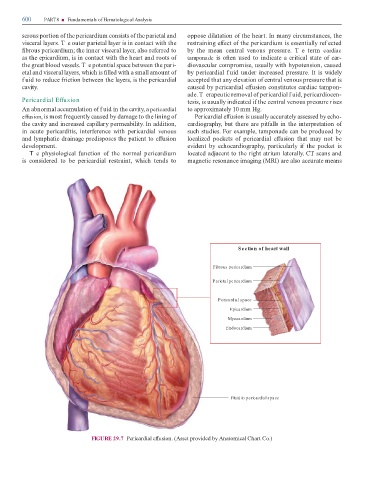
               serous portion o  the pericardium consists o  the parietal and                                              oppose dilatation o  the heart. In many circumstances, the

               visceral layers. T e outer parietal layer is in contact with the                                             restraining e  ect o  the pericardium is essentially ref ected

                 brous pericardium; the inner visceral layer, also re erred to                                             by  the  mean  central  venous  pressure.  T e  term  cardiac

               as the epicardium, is in contact with the heart and roots o                                                   tamponade is o  en used to indicate a critical state o  car-

               the great blood vessels. T e potential space between the pari-                                              diovascular compromise, usually with hypotension, caused

               etal and visceral layers, which is   lled with a small amount o                                             by pericardial f uid under increased pressure. It is widely

               f uid to reduce  riction between the layers, is the pericardial                                             accepted that any elevation o  central venous pressure that is

               cavity.                                                                                                     caused by pericardial e  usion constitutes cardiac tampon-

                                                                                                                           ade. T erapeutic removal o  pericardial f uid, pericardiocen-
               Pericardial Effusion                                                                                        tesis, is usually indicated i  the central venous pressure rises


               An abnormal accumulation o  f uid in the cavity, a pericardial                                              to approximately 10 mm Hg.

               effusion, is most  requently caused by damage to the lining o                                                    Pericardial e  usion is usually accurately assessed by echo-

               the cavity and increased capillary permeability. In addition,                                               cardiography, but there are pit alls in the interpretation o

               in  acute  pericarditis,  inter erence  with  pericardial  venous                                           such studies. For example, tamponade can be produced by

               and lymphatic drainage predisposes the patient to e  usion                                                  localized  pockets  o   pericardial  e  usion  that  may  not  be

               development.                                                                                                evident  by  echocardiography,  particularly  i   the  pocket  is

                    T e  physiological   unction  o   the  normal  pericardium                                             located adjacent to the right atrium laterally. C   scans and

               is  considered  to  be  pericardial  restraint,  which  tends  to                                           magnetic resonance imaging (MRI) are also accurate means


                                                                                                                                                             Section of heart wall


                                                                                                                                            Fibrous pericardium


                                                                                                                                            Parietal pericardium


                                                                                                                                                Pericardial space


                                                                                                                                                       Epicardium


                                                                                                                                                      Myocardium


                                                                                                                                                     Endocardium


                                                                                                                                                        Fluid in pericardial space


                                                             FIGURE 29.7  Pericardial e  usion. (Asset provided by Anatomical Chart Co.)

