


Page 620 - Clinical Hematology_ Theory _ Procedures ( PDFDrive )
P. 620
604            PART 8  ■  Fundamentals of Hematological Analysis


               Microscopic Exam ination                                                                                    determine whether the sperm cells are able to penetrate the


               Several microscopic procedures may be valuable in the assess-                                               cervical mucus.

               ment o  seminal f uid. Tese procedures, in CLSI  ormat, are                                                      In medicolegal cases, identi  cation and security are para-

               provided on this book’s companion Web site at thepoint.lww.                                                 mount, and the procedural protocol is determined by local

               com/  urgeon6e. Enumeration o  the number o  sperm and                                                      jurisdiction.  In  cases  o   alleged  rape  or  suspected  sexual

               examination o  the morphological characteristics o  the cells                                               assault, vaginal smears may be submitted  or evaluation o

               are routinely per ormed procedures. Other microscopic pro-                                                  the presence o  sperm. Sperm can be detected in the vagina

               cedures include motility, viability, and agglutination studies.                                              or 24 to 72 hours a  er intercourse. However, the absence o

                    Agglutination may indicate sperm-agglutinating antibodies                                              sperm does not mean that intercourse has not taken place.

               or prostatitis. A signi  cant increase in abnormal movements                                                Procedures  or the identi  cation o  semen stains on cloth-

               o  sperm, notably immobilizing-type motion, is highly sugges-                                               ing  may  also  be  requested.  T ese  procedures  can  include

               tive o  the presence o  sperm-immobilizing antibodies in the                                                screening  or A, B, or H blood group substances, the labile

               f uid. Viability and mobility studies should also be correlated.                                            enzyme  marker  peptidase  A,  and  phosphoglucomutase

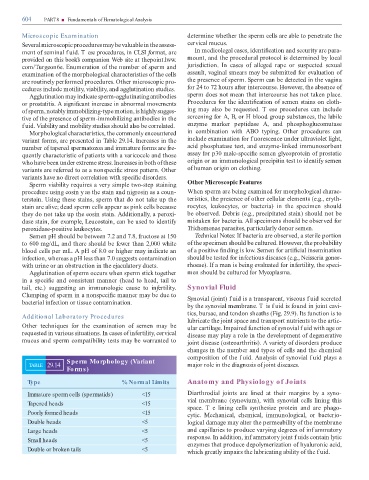
                    Morphological characteristics, the commonly encountered                                                in  combination  with  ABO  typing.  Other  procedures  can

               variant  orms, are presented in   able 29.14. Increases in the                                              include examination  or f uorescence under ultraviolet light,

               number o  tapered spermatozoa and immature  orms are  re-                                                   acid phosphatase test, and enzyme-linked immunosorbent

               quently characteristic o  patients with a varicocele and those                                              assay  or p30 male-speci  c semen glycoprotein o  prostatic

               who have been under extreme stress. Increases in both o  these                                              origin or an immunological precipitin test to identi y semen

               variants are re erred to as a nonspeci  c stress pattern. Other                                             o  human origin on clothing.

               variants have no direct correlation with speci  c disorders.

                    Sperm viability requires a very simple two-step staining                                               Other Microscopic Features

               procedure using eosin y as the stain and nigrosin as a coun-                                                When sperm are being examined  or morphological charac-

               terstain. Using these stains, sperm that do not take up the                                                 teristics, the presence o  other cellular elements (e.g., eryth-

               stain are alive; dead sperm cells appear as pink cells because                                              rocytes,  leukocytes,  or  bacteria)  in  the  specimen  should

               they do not take up the eosin stain. Additionally, a peroxi-                                                be observed. Debris (e.g., precipitated stain) should not be

               dase stain,  or example, Leucostain, can be used to identi y                                                mistaken  or bacteria. All specimens should be observed  or

               peroxidase-positive leukocytes.                                                                               richomonas parasites, particularly donor semen.

                    Semen pH should be between 7.2 and 7.8,  ructose at 150                                                      echnical Notes: I  bacteria are observed, a sterile portion

               to 600 mg/dL, and there should be  ewer than 2,000 white                                                    o  the specimen should be cultured. However, the probability

               blood cells per mL. A pH o  8.0 or higher may indicate an                                                   o  a positive   nding is low. Semen  or arti  cial insemination

               in ection, whereas a pH less than 7.0 suggests contamination                                                should be tested  or in ectious diseases (e.g., Neisseria gonor-

               with urine or an obstruction in the ejaculatory ducts.                                                      rhoeae). I  a man is being evaluated  or in ertility, the speci-

                    Agglutination o  sperm occurs when sperm stick together                                                men should be cultured  or Mycoplasma.

               in a speci  c and consistent manner (head to head, tail to

               tail,  etc.)  suggesting  an  immunologic  cause  to  in ertility.                                          Synovial Fluid

               Clumping o  sperm in a nonspeci  c manner may be due to                                                     Synovial (joint) f uid is a transparent, viscous f uid secreted

               bacterial in ection or tissue contamination.
                                                                                                                           by the synovial membrane. T is f uid is  ound in joint cavi-

                                                                                                                           ties, bursae, and tendon sheaths (Fig. 29.9). Its  unction is to
               Additional Laboratory Procedures
                                                                                                                           lubricate the joint space and transport nutrients to the artic-
               Other  techniques   or  the  examination  o   semen  may  be                                                ular cartilage. Impaired  unction o  synovial f uid with age or

               requested in various situations. In cases o  in ertility, cervical                                          disease may play a role in the development o  degenerative

               mucus and sperm compatibility tests may be warranted to                                                     joint disease (osteoarthritis). A variety o  disorders produce


                                                                                                                           changes in the number and types o  cells and the chemical

                                                                                                                           composition o  the f uid. Analysis o  synovial f uid plays a
                                             Sperm Morphology (Variant
                    TABLE       29.14                                                                                      major role in the diagnosis o  joint diseases.
                                             Forms)


                   Type                                                          % Normal Limits                           Anatomy and Physiology of Joints


                   Immature sperm cells (spermatids)                                          <15                          Diarthrodial  joints  are  lined  at  their  margins  by  a  syno-

                                                                                                                           vial membrane (synovium), with synovial cells lining this
                   Tapered heads                                                              <15
                                                                                                                           space.  T e  lining  cells  synthesize  protein  and  are  phago-
                   Poorly formed heads                                                        <15                          cytic.  Mechanical,  chemical,  immunological,  or  bacterio-


                   Double heads                                                               <5                           logical damage may alter the permeability o  the membrane

                   Large heads                                                                <5                           and capillaries to produce varying degrees o  inf ammatory

                                                                                                                           response. In addition, inf ammatory joint f uids contain lytic
                   Small heads                                                                <5
                                                                                                                           enzymes that produce depolymerization o  hyaluronic acid,
                   Double or broken tails                                                     <5                           which greatly impairs the lubricating ability o  the f uid.

