


Page 653 - Clinical Hematology_ Theory _ Procedures ( PDFDrive )
P. 653
CHAPTER 30  ■  Instrumentation in Hematology                             637


                   cytoplasmic   immunoglobulins  (kappa  and  lambda  light

                   chains, M heavy chain).

                        Research  applications  o   immunocytochemistry  (IC)

                   immunophenotyping  include  IC  cytokine  expression  to

                   examine  unctional subtypes o  lymphocytes in acquired and

                   primary  immunode  ciencies  and  to  measure  engra  ment

                   success  a  er  a  transplant  procedure.  Detection  o   cancer-

                   related  markers  in  tumors  as  prognostic  indicators  (e.g.,

                   estrogen and progesterone receptors, oncoproteins, p53) is

                   an additional application.


                   DNA Ploidy and Cell Cycling


                   One o  the earliest clinical applications o  f ow cytometry

                   was the detection o  aneuploidy and cell cycling status o

                   solid tumors, particularly selected breast tumors. Since 1996,                                                                        G

                   the use o  DNA analysis has signi  cantly decreased. It is now                                                                          1

                   most o  en per ormed in patients with node-negative breast                                                                                                   S

                   cancer and other tumors in which the clinical correlation

                   prognostic  signi  cance  is  strongest.  Recent  technological

                                                                                                                                         i m e                                8 or more hours                         6-8 hours
                   innovations may lead to a revival o  interest in clinical DNA                                                           T i t e  G                             G 2
                   analysis.                                                                                                              f i n e                                                            2 - 5   h o u r s
                                                                                                                                           d    0                 M I T O S I S
                        Because approximately a 2-week lag exists between bone                                                              I n

                   marrow activity and its resultant expression in the peripheral

                   blood, it is important to assess the current status o  the bone                                                                       T         A         M         P

                   marrow cells under certain conditions (i.e., cell cycle kinet-

                   ics). Flow cytometry allows  or analysis o  the bone marrow

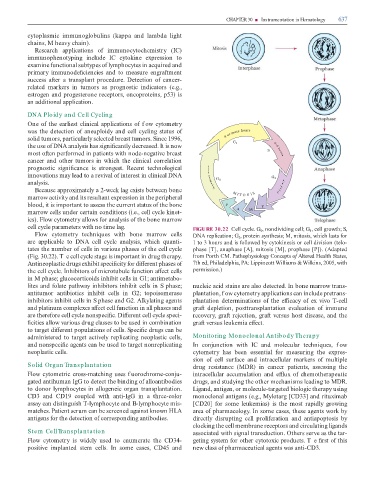
                   cell cycle parameters with no time lag.                                                                     FIGURE 30.22  Cell cycle. G , nondividing cell; G , cell growth; S,
                                                                                                                                                                                                            1
                                                                                                                                                                           0
                        Flow  cytometry  techniques  with  bone  marrow  cells                                                 DNA replication; G , protein synthesis; M, mitosis, which lasts  or
                                                                                                                                                             2
                   are  applicable  to  DNA  cell  cycle  analysis,  which  quanti-                                            1 to 3 hours and is  ollowed by cytokinesis or cell division (telo-

                   tates the number o  cells in various phases o  the cell cycle                                               phase [  ], anaphase [A], mitosis [M], prophase [P]). (Adapted

                   (Fig. 30.22). T e cell cycle stage is important in drug therapy.                                             rom Porth CM. Pathophysiology Concepts o  Altered Health States,

                   Antineoplastic drugs exhibit speci  city  or di  erent phases o                                             7th ed, Philadelphia, PA: Lippincott Williams & Wilkins, 2005, with

                   the cell cycle. Inhibitors o  microtubule  unction a  ect cells                                             permission.)

                   in M phase; glucocorticoids inhibit cells in G1; antimetabo-

                   lites and  olate pathway inhibitors inhibit cells in S phase;                                               nucleic acid stains are also detected. In bone marrow trans-

                   antitumor  antibiotics  inhibit  cells  in  G2;  topoisomerase                                              plantation, f ow cytometry applications can include pretrans-

                   inhibitors inhibit cells in S phase and G2. Alkylating agents                                               plantation determinations o  the e  cacy o  ex vivo   -cell

                   and platinum complexes a  ect cell  unction in all phases and                                               gra   depletion, posttransplantation evaluation  o   immune

                   are there ore cell cycle nonspeci  c. Di  erent cell cycle speci-                                           recovery, gra   rejection, gra   versus host disease, and the

                     cities allow various drug classes to be used in combination                                               gra   versus leukemia e  ect.

                   to target di  erent populations o  cells. Speci  c drugs can be

                   administered to target actively replicating neoplastic cells,                                               Monitoring Monoclonal Antibody Therapy

                   and nonspeci  c agents can be used to target nonreplicating                                                 In  conjunction  with  IC  and  molecular  techniques,  f ow

                   neoplastic cells.                                                                                           cytometry  has  been  essential   or  measuring  the  expres-

                                                                                                                               sion  o   cell  sur ace  and  intracellular  markers  o   multiple
                   Solid Organ Transplantation                                                                                 drug  resistance  (MDR)  in  cancer  patients,  assessing  the


                   Flow cytometric cross-matching uses f uorochrome-conju-                                                     intracellular accumulation and e  ux o  chemotherapeutic

                   gated antihuman IgG to detect the binding o  alloantibodies                                                 drugs, and studying the other mechanisms leading to MDR.

                   to donor lymphocytes in allogeneic organ transplantation.                                                   Ligand, antigen, or molecule-targeted biologic therapy using

                   CD3  and  CD19  coupled  with  anti-IgG  in  a  three-color                                                 monoclonal antigens (e.g., Mylotarg [CD33] and rituximab

                   assay can distinguish   -lymphocyte and B-lymphocyte mis-                                                   [CD20]   or  some  leukemias)  is  the  most  rapidly  growing

                   matches. Patient serum can be screened against known HLA                                                    area o  pharmacology. In some cases, these agents work by

                   antigens  or the detection o  corresponding antibodies.                                                     directly  disrupting  cell  proli eration  and  antiapoptosis  by

                                                                                                                               clocking the cell membrane receptors and circulating ligands
                   Stem  Cell Transplantation                                                                                  associated with signal transduction. Others serve as the tar-


                   Flow  cytometry  is  widely  used  to  enumerate  the  CD34-                                                geting system  or other cytotoxic products. T e   rst o  this

                   positive  implanted  stem  cells.  In  some  cases,  CD45  and                                              new class o  pharmaceutical agents was anti-CD3.

