Page 652 - Clinical Hematology_ Theory _ Procedures ( PDFDrive )
P. 652
636            PART 8  ■  Fundamentals of Hematological Analysis


                                                                                                                           and may be used as a guide  or timing the administration
                                             Examples of Commonly Used


                    TABLE        30.6        Monoclonal Antibodies in Flow                                                 o  antiretroviral therapy as well as monitoring the level o
                                                                                                                           immune reconstitution  ollowing initiation o  therapy.
                                             Cytometry


                                                                                                                           Basic Lym phocyte Screening Panel
                   CD Designation                    Target Cell
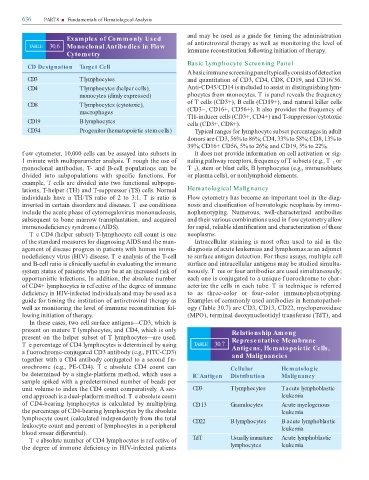
                                                                                                                           A basic immune screening panel typically consists o  detection

                   CD3                               T lymphocytes                                                         and quantitation o  CD3, CD4, CD8, CD19, and CD16/56.


                   CD4                               T lymphocytes (helper cells),                                         Anti-CD45/CD14 is included to assist in distinguishing lym-

                                                     monocytes (dimly expressed)                                           phocytes  rom monocytes. T is panel reveals the  requency
                                                                                                                           o     cells (CD3+), B cells (CD19+), and natural killer cells
                   CD8                               T lymphocytes (cytotoxic),

                                                     macrophages                                                           (CD3−, CD16+, CD56+). It also provides the  requency o
                                                                                                                             H-inducer cells (CD3+, CD4+) and   -suppressor/cytotoxic
                   CD19                              B lymphocytes                                                         cells (CD3+, CD8+).


                   CD34                              Progenitor (hematopoietic stem cells)                                        ypical ranges  or lymphocyte subset percentages in adult

                                                                                                                           donors are CD3, 56% to 86%; CD4, 33% to 58%; CD8, 13% to

                                                                                                                           39%; CD16+ CD56, 5% to 26%; and CD19, 5% to 22%.

               f ow cytometer, 10,000 cells can be assayed into subsets in                                                      It does not provide in ormation on cell activation or sig-

               1 minute with multiparameter analysis. T rough the use o                                                    naling pathway receptors,  requency o     subsets (e.g., T  or
                                                                                                                                                                                                                           1
               monoclonal  antibodies,    -  and  B-cell  populations  can  be                                             T ), stem or blast cells, B lymphocytes (e.g., immunoblasts
                                                                                                                                2
               divided  into  subpopulations  with  speci  c   unctions.  For                                              or plasma cells), or nonlymphoid elements.

               example,    cells are divided into two  unctional subpopu-

               lations,   -helper (  H) and   -suppressor (  S) cells. Normal                                              Hem atological Malignancy

               individuals  have  a    H/  S  ratio  o   2  to  3:1.  T is  ratio  is                                      Flow cytometry has become an important tool in the diag-

               inverted in certain disorders and diseases. T ese conditions                                                nosis and classi  cation o  hematologic neoplasia by immu-

               include the acute phase o  cytomegalovirus mononucleosis,                                                   nophenotyping.  Numerous,  well-characterized  antibodies

               subsequent to bone marrow transplantation, and acquired                                                     and their various combinations used in f ow cytometry allow

               immunode  ciency syndrome (AIDS).                                                                            or rapid, reliable identi  cation and characterization o  these

                    T e CD4 (helper subset)   -lymphocyte cell count is one                                                neoplasms.

               o  the standard measures  or diagnosing AIDS and the man-                                                        Intracellular staining is most o  en used to aid in the

               agement o  disease progress in patients with human immu-                                                    diagnosis o  acute leukemias and lymphomas as an adjunct

               node  ciency virus (HIV) disease. T e analysis o  the   -cell                                               to sur ace antigen detection. For these assays, multiple cell

               and B-cell ratio is clinically use ul in evaluating the immune                                              sur ace and intracellular antigens may be studied simulta-

               system status o  patients who may be at an increased risk o                                                 neously. T ree or  our antibodies are used simultaneously;

               opportunistic in ections. In addition, the absolute number                                                  each one is conjugated to a unique f uorochrome to char-

               o  CD4+ lymphocytes is ref ective o  the degree o  immune                                                   acterize the cells in each tube. T is technique is re erred

               de  ciency in HIV-in ected individuals and may be used as a                                                 to  as  three-color  or   our-color  immunophenotyping.

               guide  or timing the institution o  antiretroviral therapy as                                               Examples o  commonly used antibodies in hematopathol-

               well as monitoring the level o  immune reconstitution  ol-                                                  ogy (  able 30.7) are CD3, CD13, CD22, myeloperoxidase

               lowing initiation o  therapy.                                                                               (MPO), terminal deoxynucleotidyl trans erase (  d  ), and

                    In these cases, two cell sur ace antigens—CD3, which is

               present on mature    lymphocytes, and CD4, which is only                                                                                 Relationship Among

               present on the helper subset o     lymphocytes—are used.                                                                                 Representative Membrane

               T e percentage o  CD4 lymphocytes is determined by using                                                         TABLE        30.7       Antigens, Hematopoietic Cells,

               a f uorochrome-conjugated CD3 antibody (e.g., FI  C-CD3)                                                                                 and Malignancies

               together with a CD4 antibody conjugated to a second f u-

               orochrome  (e.g.,  PE-CD4).  T e  absolute  CD4  count  can                                                                              Cellular                         Hematologic

               be determined by a single-plat orm method, which uses a                                                         IC Antigen               Distribution                     Malignancy

               sample spiked with a predetermined number o  beads per

               unit volume to index the CD4 count comparatively. A sec-                                                        CD3                      T lymphocytes                    T acute lymphoblastic

               ond approach is a dual-plat orm method. T e absolute count                                                                                                                leukemia

               o   CD4-bearing  lymphocytes  is  calculated  by  multiplying                                                   CD 13                    Granulocytes                     Acute myelogenous

               the percentage o  CD4-bearing lymphocytes by the absolute                                                                                                                 leukemia

               lymphocyte count (calculated independently  rom the total                                                       CD22                     B lymphocytes                    B acute lymphoblastic

               leukocyte count and percent o  lymphocytes in a peripheral                                                                                                                leukemia

               blood smear di  erential).

                    T e absolute number o  CD4 lymphocytes is ref ective o                                                     TdT                      Usually immature                 Acute lymphoblastic

               the degree o  immune de  ciency in HIV-in ected patients                                                                                 lymphocytes                      leukemia
   647   648   649   650   651   652   653   654   655   656   657