


Page 648 - Clinical Hematology_ Theory _ Procedures ( PDFDrive )
P. 648
632            PART 8  ■  Fundamentals of Hematological Analysis


               3.  Algorithms  convert  these  measurements  into   amil-

                     iar results  or cell classi  cation, cell count, cell size, and

                     hemoglobinization.


                    T e  instrument’s  sampling  mechanism  divides  blood
               samples into aliquots that are treated in  our separate reac-


               tion chambers:


               1.  Hemoglobin

               2.  Red cell/platelet

               3.  Peroxidase

               4.  Basophil/lobularity or nuclear channel


               Red Blood Cells/ Platelets


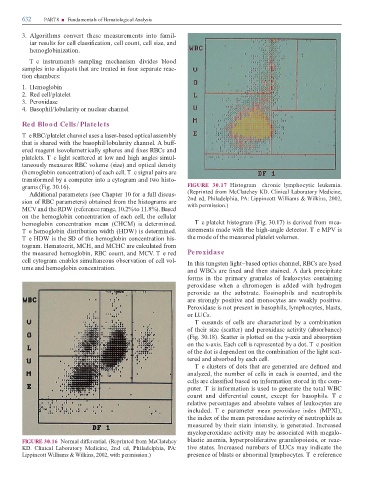
               T e RBC/platelet channel uses a laser-based optical assembly

               that is shared with the basophil/lobularity channel. A bu  -

               ered reagent isovolumetrically spheres and   xes RBCs and

               platelets. T e light scattered at low and high angles simul-

               taneously measures RBC volume (size) and optical density

               (hemoglobin concentration) o  each cell. T e signal pairs are

               trans ormed by a computer into a cytogram and two histo-

               grams (Fig. 30.16).                                                                                         FIGURE  30.17  Histogram—chronic  lymphocytic  leukemia.

                    Additional parameters (see Chapter 10  or a  ull discus-                                               (Reprinted  rom McClatchey KD. Clinical Laboratory Medicine,

               sion o  RBC parameters) obtained  rom the histograms are                                                    2nd ed, Philadelphia, PA: Lippincott Williams & Wilkins, 2002,
                                                                                                                           with permission.)
               MCV and the RDW (re erence range, 10.2% to 11.8%). Based

               on the hemoglobin concentration o  each cell, the cellular

               hemoglobin  concentration  mean  (CHCM)  is  determined.                                                         T e platelet histogram (Fig. 30.17) is derived  rom mea-

               T e hemoglobin distribution width (HDW) is determined.                                                      surements made with the high-angle detector. T e MPV is

               T e HDW is the SD o  the hemoglobin concentration his-                                                      the mode o  the measured platelet volumes.

               togram. Hematocrit, MCH, and MCHC are calculated  rom

               the measured hemoglobin, RBC count, and MCV. T e red                                                        Peroxidase

               cell cytogram enables simultaneous observation o  cell vol-                                                 In this tungsten light–based optics channel, RBCs are lysed

               ume and hemoglobin concentration.                                                                           and WBCs are   xed and then stained. A dark precipitate


                                                                                                                            orms  in  the  primary  granules  o   leukocytes  containing

                                                                                                                           peroxidase  when  a  chromogen  is  added  with  hydrogen

                                                                                                                           peroxide  as  the  substrate.  Eosinophils  and  neutrophils

                                                                                                                           are strongly positive and monocytes are weakly positive.

                                                                                                                           Peroxidase is not present in basophils, lymphocytes, blasts,

                                                                                                                           or LUCs.

                                                                                                                                T ousands  o   cells  are  characterized  by  a  combination

                                                                                                                           o  their size (scatter) and peroxidase activity (absorbance)

                                                                                                                           (Fig. 30.18). Scatter is plotted on the y-axis and absorption

                                                                                                                           on the x-axis. Each cell is represented by a dot. T e position

                                                                                                                           o  the dot is dependent on the combination o  the light scat-

                                                                                                                           tered and absorbed by each cell.

                                                                                                                                Te clusters o  dots that are generated are de  ned and

                                                                                                                           analyzed, the number o  cells in each is counted, and the

                                                                                                                           cells are classi  ed based on in ormation stored in the com-

                                                                                                                           puter. T is in ormation is used to generate the total WBC

                                                                                                                           count  and  di  erential  count,  except   or  basophils.  T e

                                                                                                                           relative percentages and absolute values o  leukocytes are

                                                                                                                           included.  T e  parameter  mean  peroxidase  index (MPXI),

                                                                                                                           the index o  the mean peroxidase activity o  neutrophils as

                                                                                                                           measured by their stain intensity, is generated. Increased

                                                                                                                           myeloperoxidase activity may be associated with megalo-


               FIGURE 30.16  Normal di  erential. (Reprinted  rom McClatchey                                               blastic anemia, hyperproli erative granulopoiesis, or reac-
               KD.  Clinical  Laboratory  Medicine,  2nd  ed,  Philadelphia,  PA:                                          tive states. Increased numbers o  LUCs may indicate the

               Lippincott Williams & Wilkins, 2002, with permission.)                                                      presence o  blasts or abnormal lymphocytes. T e re erence

