


Page 679 - Clinical Hematology_ Theory _ Procedures ( PDFDrive )
P. 679
CHAPTER 31  ■  Molecular Diagnostic Techniques and Applications                                      663


                                                                                                                               1.    emplate preparation

                                                                                                                               2.  Sequencing and imaging

                                                                                                                               3.  Data analysis


                                                                                                                                     emplate Preparation. T is step consists o  building a DNA
                                                                                                                               or complementary DNA (cDNA) library and  ampli  cation


                                                                                                                               o   that  library.  A  sequencing  library  is  constructed  by
                                                                                                                                ragmenting  the  DNA  or  cDNA  specimen  and  attaching


                                                                                                                               adapter  sequences,  synthetic  oligonucleotides  o   a  known
                                                                                                                               sequence, to the ends o  the DNA  ragments. A constructed


                                                                                                                               library is clonally ampli  ed in preparation  or sequencing.
                                                                                                                               Ampli  cation o  single library  ragment on microbeads is


                                                                                                                               unique  to  the  One    ouch  system;  bridge  ampli  cation  is
                                                                                                                               used to  orm template clusters on a f ow cell by the Illumina
                   FIGURE  31.11  FISH  technique  demonstrates  trisomy  12  in  a

                   case o  CLL with prolymphocytoid trans ormation. (From Sun   .                                              system.

                   Flow Cytometry, Immunohistochemistry, and Molecular Genetics                                                     Sequencing and Imaging. For the next step, the two com-
                    or Hematologic Neoplasms, 2nd ed, Philadelphia, PA: Lippincott                                             mercial systems rely on sequencing by synthesis. T e library

                   Williams & Wilkins, 2012.)                                                                                   ragments act as a template  rom which a new DNA  rag-

                                                                                                                               ment is synthesized. Sequencing occurs through a cycle o
                                                                                                                               washing and f ooding the  ragments with the known nucle-


                   cally used assay is based on DNA sequencing. Commercial                                                     otides  in  a  sequential  order.  As  nucleotides  incorporate
                   panels  available  through  Ion    orrent  PGM  One    ouch                                                 into a growing DNA strand, they are digitally recorded as


                     system and Illumina are popular or design own panels based                                                sequence. One system, PGM, does semiconductor sequenc-
                   on genes o  interest. NCS permits analysis o  all the exomes                                                ing that relies on detection o  pH changes induced by the


                   or even entire genes. T is has led to expansion o  the number                                               release o  a hydrogen ion upon the incorporation o  a nucle-
                   o  genes that can be analyzed at one time and identi  cation                                                otide into a growing strand o  DNA. T e Illumina MiSeq


                   o  patients at risk.                                                                                        relies on detection o  f uorescence generated by the incorpo-
                        Steps in NGS                                                                                           ration o  f uorescently labeled nucleotides into the growing


                        Each  NGS  plat orm  is  unique  in  how  sequencing  is                                               strand o  DNA.
                   accomplished, but the generalized sequencing protocol  or                                                        Data Analysis. T e   nal step a  er sequencing is complete


                   the two commercially available NGS plat orms (Ion   orrent                                                  is  that  raw  sequence  data  must  undergo  several  analysis
                   PGM One   ouch system and Illumina) includes                                                                steps. Preprocessing o  data removes adapter sequences and


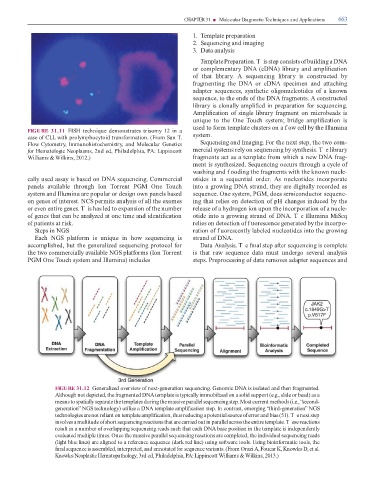
                                     FIGURE 31.12  Generalized overview o  next-generation sequencing. Genomic DNA is isolated and then  ragmented.

                                     Although not depicted, the  ragmented DNA template is typically immobilized on a solid support (e.g., slide or bead) as a
                                     means to spatially separate the templates during the massive parallel sequencing step. Most current methods (i.e., “second-

                                     generation” NGS technology) utilize a DNA template ampli  cation step. In contrast, emerging “third-generation” NGS

                                     technologies are not reliant on template ampli  cation, thus reducing a potential source o  error and bias (51). T e next step

                                     involves a multitude o  short sequencing reactions that are carried out in parallel across the entire template. T ese reactions

                                     result in a number o  overlapping sequencing reads such that each DNA base position in the template is independently
                                     evaluated multiple times. Once the massive parallel sequencing reactions are completed, the individual sequencing reads

                                     (light blue lines) are aligned to a re erence sequence (dark red line) using so  ware tools. Using bioin ormatic tools, the

                                       nal sequence is assembled, interpreted, and annotated  or sequence variants. (From Orazi A, Foucar K, Knowles D, et al.
                                     Knowles Neoplastic Hematopathology, 3rd ed, Philadelphia, PA: Lippincott Williams & Wilkins, 2013.)

