


Page 681 - Clinical Hematology_ Theory _ Procedures ( PDFDrive )
P. 681
CHAPTER 31  ■  Molecular Diagnostic Techniques and Applications                                      665


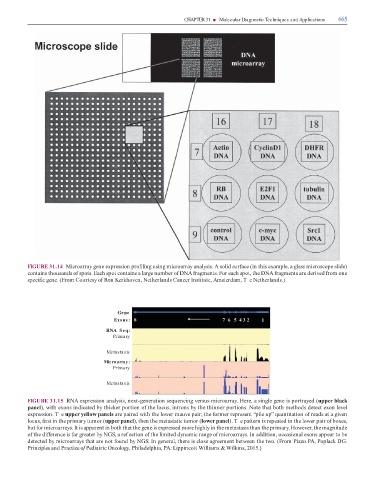
                   FIGURE 31.14  Microarray gene expression pro  ling using microarray analysis. A solid sur ace (in this example, a glass microscope slide)

                   contains thousands o  spots. Each spot contains a large number o  DNA  ragments. For each spot, the DNA  ragments are derived  rom one

                   speci  c gene. (From Courtesy o  Ron Kerkhoven, Netherlands Cancer Institute, Amsterdam, T e Netherlands.)


                                                                              Gene

                                                                           Exons : 8                                                              7 6 5 4 3 2               1


                                                                      RNA  Seq:
                                                                           Primary


                                                                       Metastasis


                                                                     Microarray:

                                                                           Primary


                                                                       Metastasis


                   FIGURE 31.15  RNA expression analysis, next-generation sequencing versus microarray. Here, a single gene is portrayed (upper black

                   panel), with exons indicated by thicker portion o  the locus, introns by the thinner portions. Note that both methods detect exon level

                   expression. T e upper yellow panels are paired with the lower mauve pair; the  ormer represent “pile up” quantitation o  reads at a given
                   locus,   rst in the primary tumor (upper panel), then the metastatic tumor (lower panel). T e pattern is repeated in the lower pair o  boxes,

                   but  or microarrays. It is apparent in both that the gene is expressed more highly in the metastasis than the primary. However, the magnitude

                   o  the di  erence is  ar greater by NGS, a ref ection o  the limited dynamic range o  microarrays. In addition, occasional exons appear to be
                   detected by microarrays that are not  ound by NGS. In general, there is close agreement between the two. (From Pizzo PA, Poplack DG.

                   Principles and Practice o  Pediatric Oncology, Philadelphia, PA: Lippincott Williams & Wilkins, 2015.)

