


Page 245 - Review of Medical Microbiology and Immunology ( PDFDrive )
P. 245
mebooksfree.com
mebooksfree.com
mebooksfree.com
mebooksfree.com
mebooksfree.com
mebooksfree.com
mebooksfree.com mebooksfree.com Adenovirus Adsorption Cytoplasm mebooksfree.com mebooksfree.com
mebooksfree.com
mebooksfree.com
PART III Basic Virology
234
1
Nucleus
2
Penetration
9
Release of
Virus and Lysis Viral DNA Uncoating
3
early mRNA mebooksfree.com
mebooksfree.com mebooksfree.com mebooksfree.com mebooksfree.com Viral DNA in mebooksfree.com
of Infected Cell
Early proteins
Viral mRNA
Viral capsid
the nucleus
Viral protein
Ribosomes
4
8
Early
Assembly
Synthesis of late
Transcription
proteins (capsid
Synthesis of early
proteins)
proteins (enzymes such
Synthesis of
as DNA polymerase)
mebooksfree.com mebooksfree.com Translation Synthesis of progeny viral mebooksfree.com mebooksfree.com mebooksfree.com
mebooksfree.com
DNA and late mRNA
5
7
Early
Late
Translation
6
DNA Synthesis
and Late
Transcription
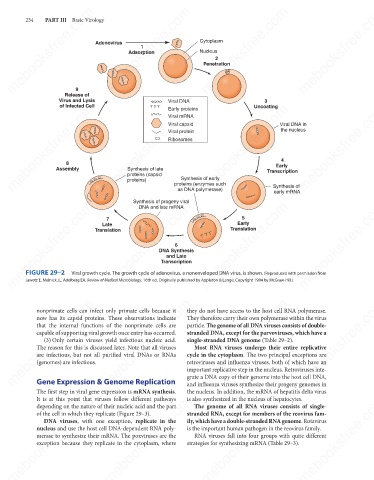
FIGURE 29–2
Viral growth cycle. The growth cycle of adenovirus, a nonenveloped DNA virus, is shown. (Reproduced with permission from
Jawetz E, Melnick JL, Adelberg EA. Review of Medical Microbiology. 16th ed. Originally published by Appleton & Lange. Copyright 1984 by McGraw-Hill.)
mebooksfree.com
mebooksfree.com
mebooksfree.com mebooksfree.com mebooksfree.com they do not have access to the host cell RNA polymerase. mebooksfree.com
nonprimate cells can infect only primate cells because it
now has its capsid proteins. These observations indicate
They therefore carry their own polymerase within the virus
that the internal functions of the nonprimate cells are
particle. The genome of all DNA viruses consists of double-
capable of supporting viral growth once entry has occurred.
stranded DNA, except for the parvoviruses, which have a
(3) Only certain viruses yield infectious nucleic acid.
single-stranded DNA genome (Table 29–2).
The reason for this is discussed later. Note that all viruses
Most RNA viruses undergo their entire replicative
are infectious, but not all purified viral DNAs or RNAs
cycle in the cytoplasm. The two principal exceptions are
retroviruses and influenza viruses, both of which have an
(genomes) are infectious.
grate a DNA copy of their genome into the host cell DNA,
Gene Expression & Genome Replication
and influenza viruses synthesize their progeny genomes in
The first step in viral gene expression is mRNA synthesis. important replicative step in the nucleus. Retroviruses inte-
the nucleus. In addition, the mRNA of hepatitis delta virus
mebooksfree.com mebooksfree.com mebooksfree.com ily, which have a double-stranded RNA genome. Rotavirus mebooksfree.com
mebooksfree.com
It is at this point that viruses follow different pathways
is also synthesized in the nucleus of hepatocytes.
mebooksfree.com
The genome of all RNA viruses consists of single-
depending on the nature of their nucleic acid and the part
stranded RNA, except for members of the reovirus fam-
of the cell in which they replicate (Figure 29–3).
DNA viruses, with one exception, replicate in the
nucleus and use the host cell DNA-dependent RNA poly-
is the important human pathogen in the reovirus family.
merase to synthesize their mRNA. The poxviruses are the
RNA viruses fall into four groups with quite different
exception because they replicate in the cytoplasm, where
strategies for synthesizing mRNA (Table 29–3).
mebooksfree.com mebooksfree.com mebooksfree.com mebooksfree.com mebooksfree.com mebooksfree.com

