


Page 102 - Textbook of Pathology, 6th Edition
P. 102
86 3. Haemodialysis-associated (Aβ M) often severe in the heart, kidney, bowel, skin, peripheral
2
4. Heredofamilial (ATTR, AA, Others) nerves, respiratory tract, skeletal muscle, and other organs.
Recently, it has been possible to reproduce AL amyloid
B. Localised amyloidosis: in mice by repeated injections of human amyloidogenic light
1. Senile cardiac (ATTR)
2. Senile cerebral (Aβ, APrP) chains. Treatment of AL amyloid is targetted at reducing the
3. Endocrine (Hormone precursors) underlying clonal expansion of plasma cells.
4. Tumour-forming (AL) 2. Secondary/Reactive (AA) Systemic Amyloidosis
A. SYSTEMIC AMYLOIDOSIS The second form of systemic or generalised amyloidosis is
SECTION I
reactive or inflammatory or secondary in which the fibril
1. Primary Systemic (AL) Amyloidosis proteins contain AA amyloid. Secondary or reactive
Primary amyloidosis consisting of AL fibril proteins is amyloidosis occurs typically as a complication of chronic
systemic or generalised in distribution. About 30% cases of infectious (e.g. tuberculosis, bronchiectasis, chronic
AL amyloid have some form of plasma cell dyscrasias, most osteomyelitis, chronic pyelonephritis, leprosy, chronic skin
commonly multiple myeloma (in about 10% cases), and less infections), non-infectious chronic inflammatory conditions
often other monoclonal gammopathies such as associated with tissue destruction (e.g. autoimmune
Waldenström’s macroglobulinaemia, heavy chain disease, disorders such as rheumatoid arthritis, inflammatory bowel
solitary plasmacytoma and nodular malignant lymphoma disease), some tumours (e.g. renal cell carcinoma, Hodgkin’s
(B cell lymphoma). The neoplastic plasma cells usually are a disease) and in familial Mediterranean fever, an inherited
single clone and, therefore, produce the same type of disorder (discussed below).
immunoglobulin light chain or part of light chain. Almost Secondary amyloidosis is typically distributed in solid
all cases of multiple myeloma have either λ or κ light chains abdominal viscera like the kidney, liver, spleen and adrenals.
(Bence Jones proteins) in the serum and are excreted in the Secondary reactive amyloidosis is seen less frequently in
urine. However, in contrast to normal or myeloma light developed countries due to containment of infections before
chains, AL is twice more frequently derived from λ light they become chronic but this is the more common type of
chains. amyloidosis in underdeveloped and developing countries
The remaining 70% cases of AL amyloid do not have of the world. Secondary systemic amyloidosis can occur at
evident B-cell proliferative disorder or any other associated any age including children.
diseases and are thus cases of true ‘primary’ (idiopathic) AA amyloid occurs spontaneously in some birds
amyloidosis. However, by more sensitive methods, some and animals; it can also be experimentally induced in
General Pathology and Basic Techniques
plasma cell dyscrasias are detectable in virtually all patients animals.
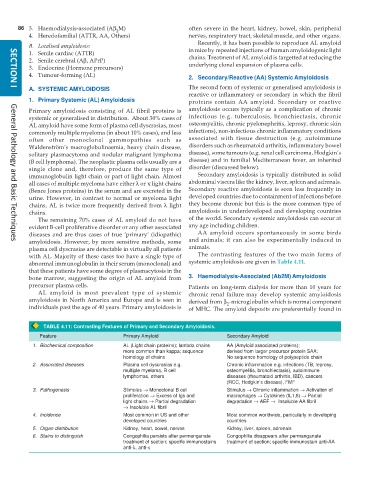
with AL. Majority of these cases too have a single type of The contrasting features of the two main forms of
abnormal immunoglobulin in their serum (monoclonal) and systemic amyloidosis are given in Table 4.11.
that these patients have some degree of plasmacytosis in the
bone marrow, suggesting the origin of AL amyloid from 3. Haemodialysis-Associated (Ab2M) Amyloidosis
precursor plasma cells. Patients on long-term dialysis for more than 10 years for
AL amyloid is most prevalent type of systemic chronic renal failure may develop systemic amyloidosis
amyloidosis in North America and Europe and is seen in derived from β -microglobulin which is normal component
2
individuals past the age of 40 years. Primary amyloidosis is of MHC. The amyloid deposits are preferentially found in
TABLE 4.11: Contrasting Features of Primary and Secondary Amyloidosis.
Feature Primary Amyloid Secondary Amyloid
1. Biochemical composition AL (Light chain proteins); lambda chains AA (Amyloid associated proteins);
more common than kappa; sequence derived from larger precursor protein SAA;
homology of chains No sequence homology of polypeptide chain
2. Associated diseases Plasma cell dyscrasias e.g. Chronic inflammation e.g. infections (TB, leprosy,
multiple myeloma, B cell osteomyelitis, bronchiectasis), autoimmune
lymphomas, others diseases (rheumatoid arthritis, IBD), cancers
(RCC, Hodgkin’s disease), FMF
3. Pathogenesis Stimulus → Monoclonal B cell Stimulus → Chronic inflammation → Activation of
proliferation → Excess of Igs and macrophages → Cytokines (IL1,6) → Partial
light chains → Partial degradation degradation → AEF → Insoluble AA fibril
→ Insoluble AL fibril
4. Incidence Most common in US and other Most common worldwide, particularly in developing
developed countries countries
5. Organ distribution Kidney, heart, bowel, nerves Kidney, liver, spleen, adrenals
6. Stains to distinguish Congophilia persists after permanganate Congophilia disappears after permanganate
treatment of section; specific immunostains treatment of section; specific immunostain anti-AA
anti-λ, anti-κ

