


Page 109 - Textbook of Pathology, 6th Edition
P. 109
93
                                       Derangements of Homeostasis
            Chapter 5
            Chapter 5
                                                  and Haemodynamics                                                   CHAPTER 5


                           HOMEOSTASIS

           Many workers have pointed out that life on earth probably
           arose in the sea, and that the body water which is the
           environment of the cells, consisting of “salt water” is similar
           to the ancient ocean. The sea within us flows through blood
           and lymph vessels, bathes the cells as well as lies within the
           cells. However, water within us contains several salts that
           includes sodium, chloride, potassium, calcium, magnesium,
           phosphate, and other electrolytes. Although it appears quite
           tempting to draw comparison between environment of the
           cell and the ancient oceans, it would be rather an
           oversimplification in considering the cellular environment
           to be wholly fluid ignoring the presence of cells, fibres and
           ground substance.                                                                                          Derangements of Homeostasis and Haemodynamics
              Claude Bernarde (1949) first coined the term  internal
           environment or milieu interieur for the state in the body in
           which the interstitial fluid that bathes the cells and the
           plasma, together maintain the normal morphology and
           function of the cells and tissues of the body. The mechanism
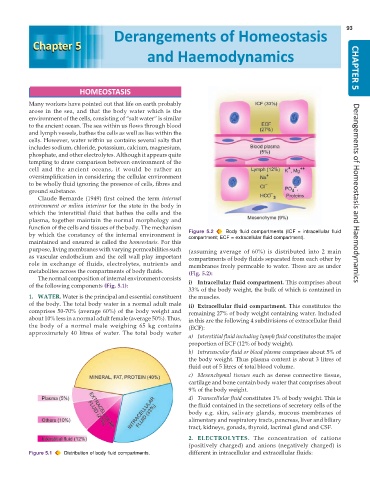
           by which the constancy of the internal environment is  Figure 5.2  Body fluid compartments (ICF = intracellular fluid
                                                               compartment; ECF = extracellular fluid compartment).
           maintained and ensured is called the homeostasis. For this
           purpose, living membranes with varying permeabilities such  (assuming average of 60%) is distributed into 2 main
           as vascular endothelium and the cell wall play important  compartments of body fluids separated from each other by
           role in exchange of fluids, electrolytes, nutrients and  membranes freely permeable to water. These are as under
           metabolites across the compartments of body fluids.  (Fig. 5.2):
              The normal composition of internal environment consists
           of the following components (Fig. 5.1):             i) Intracellular fluid compartment. This comprises about
                                                               33% of the body weight, the bulk of which is contained in
           1. WATER. Water is the principal and essential constituent  the muscles.
           of the body. The total body water in a normal adult male  ii) Extracellular fluid compartment. This constitutes the
           comprises 50-70% (average 60%) of the body weight and  remaining 27% of body weight containing water. Included
           about 10% less in a normal adult female (average 50%). Thus,  in this are the following 4 subdivisions of extracellular fluid
           the body of a normal male weighing 65 kg contains   (ECF):
           approximately 40 litres of water. The total body water
                                                               a) Interstitial fluid including lymph fluid constitutes the major
                                                               proportion of ECF (12% of body weight).
                                                               b) Intravascular fluid or blood plasma comprises about 5% of
                                                               the body weight. Thus plasma content is about 3 litres of
                                                               fluid out of 5 litres of total blood volume.
                                                               c) Mesenchymal tissues such as dense connective tissue,
                                                               cartilage and bone contain body water that comprises about
                                                               9% of the body weight.
                                                               d) Transcellular fluid constitutes 1% of body weight. This is
                                                               the fluid contained in the secretions of secretory cells of the
                                                               body e.g. skin, salivary glands, mucous membranes of
                                                               alimentary and respiratory tracts, pancreas, liver and biliary
                                                               tract, kidneys, gonads, thyroid, lacrimal gland and CSF.

                                                               2. ELECTROLYTES.  The concentration of cations
                                                               (positively charged) and anions (negatively charged) is
           Figure 5.1  Distribution of body fluid compartments.  different in intracellular and extracellular fluids:

