


Page 114 - Textbook of Pathology, 6th Edition
P. 114
98


     SECTION I


     General Pathology and Basic Techniques


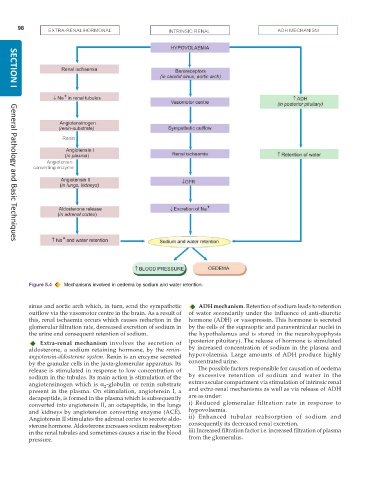
           Figure 5.4  Mechanisms involved in oedema by sodium and water retention.


           sinus and aortic arch which, in turn, send the sympathetic  ADH mechanism. Retention of sodium leads to retention
           outflow via the vasomotor centre in the brain. As a result of  of water secondarily under the influence of anti-diuretic
           this, renal ischaemia occurs which causes reduction in the  hormone (ADH) or vasopressin. This hormone is secreted
           glomerular filtration rate, decreased excretion of sodium in  by the cells of the supraoptic and paraventricular nuclei in
           the urine and consequent retention of sodium.       the hypothalamus and is stored in the neurohypophysis
              Extra-renal mechanism involves the secretion of  (posterior pituitary). The release of hormone is stimulated
           aldosterone, a sodium retaining hormone, by the renin-  by increased concentration of sodium in the plasma and
           angiotensin-aldosterone system. Renin is an enzyme secreted  hypovolaemia. Large amounts of ADH produce highly
           by the granular cells in the juxta-glomerular apparatus. Its  concentrated urine.
           release is stimulated in response to low concentration of  The possible factors responsible for causation of oedema
           sodium in the tubules. Its main action is stimulation of the  by excessive retention of sodium and water in the
           angiotensinogen which is  α -globulin or renin substrate  extravascular compartment via stimulation of intrinsic renal
                                   2
           present in the plasma. On stimulation, angiotensin I, a  and extra-renal mechanisms as well as via release of ADH
           decapeptide, is formed in the plasma which is subsequently  are as under:
           converted into angiotensin II, an octapeptide, in the lungs  i) Reduced glomerular filtration rate in response to
           and kidneys by angiotension converting enzyme (ACE).  hypovolaemia.
           Angiotensin II stimulates the adrenal cortex to secrete aldo-  ii) Enhanced tubular reabsorption of sodium and
           sterone hormone. Aldosterone increases sodium reabsorption  consequently its decreased renal excretion.
           in the renal tubules and sometimes causes a rise in the blood  iii) Increased filtration factor i.e. increased filtration of plasma
           pressure.                                           from the glomerulus.

