


Page 119 - Textbook of Pathology, 6th Edition
P. 119
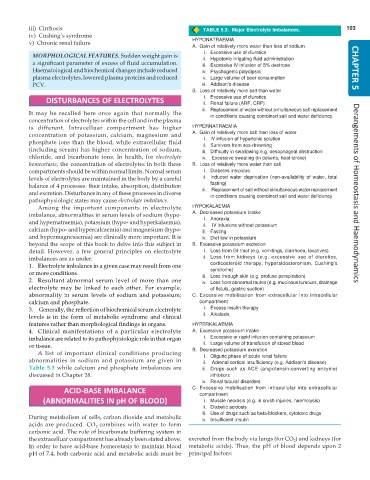
iii) Cirrhosis TABLE 5.3: Major Electrolyte Imbalances. 103
iv) Cushing’s syndrome
v) Chronic renal failure HYPONATRAEMIA
A. Gain of relatively more water than loss of sodium
i. Excessive use of diuretics
MORPHOLOGICAL FEATURES. Sudden weight gain is ii. Hypotonic irrigating fluid administration
a significant parameter of excess of fluid accumulation. iii. Excessive IV infusion of 5% dextrose
Haematological and biochemical changes include reduced iv. Psychogenic polydipsia CHAPTER 5
plasma electrolytes, lowered plasma proteins and reduced v. Large volume of beer consumption
PCV. vi. Addison’s disease
B. Loss of relatively more salt than water
i. Excessive use of diuretics
DISTURBANCES OF ELECTROLYTES ii. Renal failure (ARF, CRF)
iii. Replacement of water without simultaneous salt replacement
It may be recalled here once again that normally the in conditions causing combined salt and water deficiency
concentration of electrolytes within the cell and in the plasma
is different. Intracelluar compartment has higher HYPERNATRAEMIA
concentration of potassium, calcium, magnesium and A. Gain of relatively more salt than loss of water
i. IV infusion of hypertonic solution
phosphate ions than the blood, while extracellular fluid ii. Survivors from sea-drowning
(including serum) has higher concentration of sodium, iii. Difficulty in swallowing e.g. oesophageal obstruction
chloride, and bicarbonate ions. In health, for electrolyte iv. Excessive sweating (in deserts, heat stroke)
homeostasis, the concentration of electrolytes in both these B. Loss of relatively more water than salt
compartments should be within normal limits. Normal serum i. Diabetes insipidus
levels of electrolytes are maintained in the body by a careful ii. Induced water deprivation (non-availability of water, total
balance of 4 processes: their intake, absorption, distribution fasting)
and excretion. Disturbance in any of these processes in diverse iii. Replacement of salt without simultaneous water replacement Derangements of Homeostasis and Haemodynamics
in conditions causing combined salt and water deficiency
pathophysiologic states may cause electrolyte imbalance.
Among the important components in electrolyte HYPOKALAEMIA
imbalance, abnormalities in serum levels of sodium (hypo- A. Decreased potassium intake
i. Anorexia
and hypernatraemia), potassium (hypo- and hyperkalaemia), ii. IV infusions without potassium
calcium (hypo- and hypercalcaemia) and magnesium (hypo- iii. Fasting
and hypermagnesaemia) are clinically more important. It is iv. Diet low in potassium
beyond the scope of this book to delve into this subject in B. Excessive potassium excretion
detail. However, a few general principles on electrolyte i. Loss from GI tract (e.g. vomitings, diarrhoea, laxatives)
imbalances are as under: ii. Loss from kidneys (e.g. excessive use of diuretics,
1. Electrolyte imbalance in a given case may result from one corticosteroid therapy, hyperaldosteronism, Cushing’s
syndrome)
or more conditions. iii. Loss through skin (e.g. profuse perspiration)
2. Resultant abnormal serum level of more than one iv. Loss from abnormal routes (e.g. mucinous tumours, drainage
electrolyte may be linked to each other. For example, of fistula, gastric suction)
abnormality in serum levels of sodium and potassium; C. Excessive mobilisation from extracellular into intracellular
calcium and phosphate. compartment
3. Generally, the reflection of biochemical serum electrolyte i. Excess insulin therapy
levels is in the form of metabolic syndrome and clinical ii. Alkalosis
features rather than morphological findings in organs. HYPERKALAEMIA
4. Clinical manifestations of a particular electrolyte A. Excessive potassium intake
imbalance are related to its pathophysiologic role in that organ i. Excessive or rapid infusion containing potassium
or tissue. ii. Large volume of transfusion of stored blood
A list of important clinical conditions producing B. Decreased potassium excretion
i. Oliguric phase of acute renal failure
abnormalities in sodium and potassium are given in ii. Adrenal cortical insufficiency (e.g. Addison’s disease)
Table 5.3 while calcium and phosphate imbalances are iii. Drugs such as ACE (angiotensin-converting enzyme)
discussed in Chapter 28. inhibitors
iv. Renal tubular disorders
ACID-BASE IMBALANCE C. Excessive mobilisation from intracellular into extracellular
compartment
(ABNORMALITIES IN pH OF BLOOD) i. Muscle necrosis (e.g. in crush injuries, haemolysis)
ii. Diabetic acidosis
iii. Use of drugs such as beta-blockers, cytotoxic drugs
During metabolism of cells, carbon dioxide and metabolic iv. Insufficient insulin
acids are produced. CO combines with water to form
2
carbonic acid. The role of bicarbonate buffering system in
the extracelluar compartment has already been stated above. excreted from the body via lungs (for CO ) and kidneys (for
2
In order to have acid-base homeostasis to maintain blood metabolic acids). Thus, the pH of blood depends upon 2
pH of 7.4, both carbonic acid and metabolic acids must be principal factors:

