


Page 133 - Textbook of Pathology, 6th Edition
P. 133
thrombi is facilitated by turbulence in the blood flow, while  iv)  Shock                                117
           stasis initiates the venous thrombi even without evidence of  v) Tissue damage e.g. trauma, fractures, burns, surgery
           endothelial injury.                                 vi) Late pregnancy and puerperium
           5. HYPERCOAGULABILITY OF BLOOD. The occurrence      vii) Certain drugs (e.g. anaesthetic agents, oral contra-
           of thrombosis in some conditions such as in nephrotic  ceptives).
           syndrome, advanced cancers, extensive trauma, burns and                                                    CHAPTER 5
           during puerperium is explained on the basis of hypercoagul-  Morphologic Features
           ability of blood. The effect of hypercoagulability on  Thrombosis may occur in the heart, arteries, veins and the
           thrombosis is favoured by advancing age, smoking, use of
           oral contraceptives and obesity. Hypercoagulability may  capillaries. Beside the differences in mechanisms of thrombus
           occur by the following changes in the composition of blood:  formation at these sites, the clinical effects of these are even
           i) Increase in coagulation factors e.g. fibrinogen, prothrombin,  more different. Arterial thrombi produce ischaemia and
           factor VIIa, VIIIa and Xa.                          infarction, whereas cardiac and venous thrombi cause
           ii) Increase in platelet count and their adhesiveness.  embolism.
           iii) Decreased levels of coagulation inhibitors e.g. antithrombin  The general morphologic features of thrombi are as
           III, fibrin split products.                         under:
           Predisposing Factors                                  Grossly, thrombi may be of various shapes, sizes and
           A number of primary (genetic) and secondary (acquired)  composition depending upon the site of origin. Arterial
           factors favour thrombosis.                            thrombi tend to be white and mural while the venous
           Primary (Genetic) factors:                            thrombi are red and occlusive. Mixed or laminated
           i) Deficiency of antithrombin                         thrombi are also common and consist of alternate white
           ii) Deficiency of protein C or S                      and red layers called lines of Zahn. Red thrombi are soft,
           iii) Defects in fibrinolysis                          red and gelatinous whereas white thrombi are firm and  Derangements of Homeostasis and Haemodynamics
           iv) Mutation in factor V                              pale.
                                                                 Microscopically, the composition of thrombus is deter-
           Secondary (acquired) factors:                         mined by the rate of flow of blood i.e. whether it is formed
           a) Risk factors:                                      in the rapid arterial and cardiac circulation, or in the slow
           i) Advanced age
           ii) Prolonged bed-rest                                moving flow in veins. The lines of Zahn are formed by
           iii) Immobilisation                                   alternate layers of light-staining aggregated platelets
           iv) Cigarette smoking                                 admixed with fibrin meshwork and dark-staining layer
                                                                 of red cells. Red (venous) thrombi have more abundant
           b) Clinical conditions predisposing to thrombosis:    red cells, leucocytes and platelets entrapped in fibrin
           i) Heart diseases (e.g. myocardial infarction, CHF,
           rheumatic mitral stenosis, cardiomyopathy)            meshwork. Thus, red thrombi closely resemble blood clots
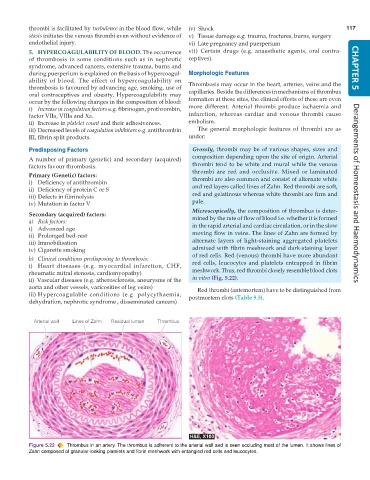
           ii)  Vascular diseases (e.g. atherosclerosis, aneurysms of the  in vitro (Fig. 5.22).
           aorta and other vessels, varicosities of leg veins)    Red thrombi (antemortem) have to be distinguished from
           iii) Hypercoagulable conditions (e.g. polycythaemia,  postmortem clots (Table 5.5).
           dehydration, nephrotic syndrome , disseminated cancers)


           Figure 5.22  Thrombus in an artery. The thrombus is adherent to the arterial wall and is seen occluding most of the lumen. It shows lines of
           Zahn composed of granular-looking platelets and fibrin meshwork with entangled red cells and leucocytes.

